


Prevalence of Gestational Diabetes in preCOVID-19 and COVID-19 Years and Its Impact on Pregnancy: A 5-Year Retrospective Study
- PMID: 35626396
- PMCID: PMC9140441
- DOI: 10.3390/diagnostics12051241
Prevalence of Gestational Diabetes in preCOVID-19 and COVID-19 Years and Its Impact on Pregnancy: A 5-Year Retrospective Study
Abstract
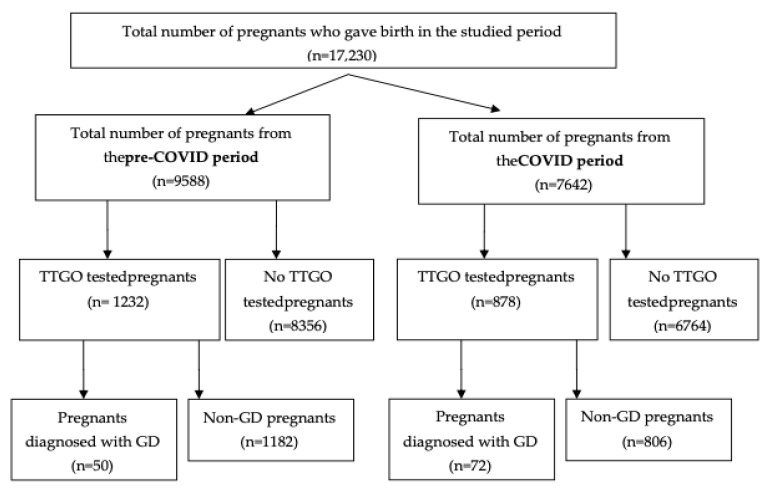
Gestational diabetes mellitus (GDM) affects a total of 3% to 9% of all pregnancies. It has a high impact on both mother and baby, increases the perinatal risks, and predicts the presence of long-term chronic metabolic complications. The aim of our study is to determine the incidence of GDM in tertiary hospitals in the west part of Romania to lay out the risk factors associated with GDM and to observe the evolution of pregnancy among patients with this pathology by emphasizing the state of birth of the fetus, the birth weight, and the way of birth. We also want to compare the prevalence of GDM in preCOVID-19 (Coronavirus disease) versus COVID-19 years. The study took place between January 2017 and December 2021 at the Municipal Emergency Hospital of Timisoara, Romania. The proportion of births with GDM was significantly increased during the COVID-19 period compared to the preCOVID-19 period (chi2 Fisher exact test, p < 0.001). The period 2020−2021 represents a significant risk factor for GDM births (OR = 1.87, with 95% CI = [1.30, 2.67]). COVID years represent a risk period for developing gestational diabetes, which can be explained by reduced physical activity, anxiety, or modified dietary habits, even if the follow-up period was not impacted.
Keywords: COVID-19; gestational diabetes; pregnancy.
Conflict of interest statement
The authors declare no conflict of interest.
Figures
References
-
- Han Y., Tong M., Jin L., Yu J., Meng W., Ren A. Maternal age at pregnancy and risk for gestational diabetes mellitus among Chinese women with singleton pregnancies. Int. J. Diabetes Dev. Ctries. 2020;41:114–120. doi: 10.1007/s13410-020-00859-8. - DOI
-
- American Diabetes Association Standards of medical care in diabetes—2017. J. Clin. Appl. Res. Educ. 2017;35:5.
LinkOut - more resources
Full Text Sources
