Review
. 2022 May 12;11(10):1619.
doi: 10.3390/cells11101619.

The Role of Matrix-Bound Extracellular Vesicles in the Regulation of Endochondral Bone Formation

Affiliations
Review

The Role of Matrix-Bound Extracellular Vesicles in the Regulation of Endochondral Bone Formation

Barbara D Boyan et al. Cells. .

Abstract

Matrix vesicles are key players in the development of the growth plate during endochondral bone formation. They are involved in the turnover of the extracellular matrix and its mineralization, as well as being a vehicle for chondrocyte communication and regulation. These extracellular organelles are released by the cells and are anchored to the matrix via integrin binding to collagen. The exact function and makeup of the vesicles are dependent on the zone of the growth plate in which they are produced. Early studies defined their role as sites of initial calcium phosphate deposition based on the presence of crystals on the inner leaflet of the membrane and subsequent identification of enzymes, ion transporters, and phospholipid complexes involved in mineral formation. More recent studies have shown that they contain small RNAs, including microRNAs, that are distinct from the parent cell, raising the hypothesis that they are a distinct subset of exosomes. Matrix vesicles are produced under complex regulatory pathways, which include the action of steroid hormones. Once in the matrix, their maturation is mediated by the action of secreted hormones. How they convey information to cells, either through autocrine or paracrine actions, is now being elucidated.

Keywords: 1α,25(OH)2D3; 24R,25(OH)2D3; exosomes; matrix vesicles; microRNA.


Conflict of interest statement

The authors declare no conflict of interest.

Figures
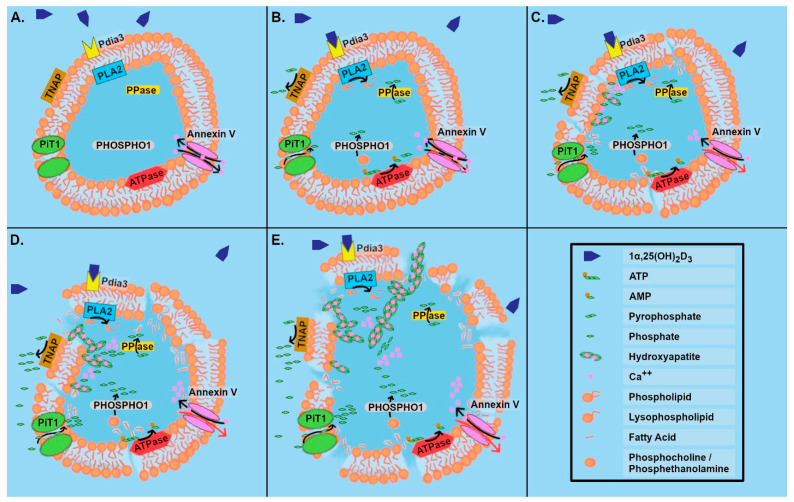
Figure 1
Figure 1
Growth zone matrix vesicle breakdown and hydroxyapatite crystal formation in response to 1α,25(OH)2D3. (A) Annexin V mediated transport of Ca++ maintains homeostasis inside vesicle. (B) 1α,25(OH)2D3 binding with PDIA3 on vesicle membrane activates phospholipase A2 (PLA2). This results in release of arachidonic acid and the production of lysophospholipid. ATPase activity is reduced due to lack of an energy source, so active transport of Ca++ out of the vesicle via annexin V is reduced. The action of ATPase produces AMP and pyrophosphate, which is a calcification inhibitor. PPase breaks pyrophosphate down into phosphates, and on the outer leaflet of the membrane, TNAP generates free phosphate that is available for transport into the vesicle by PiT1. Inside the vesicle, PHOSPHO1 releases phosphate from phosphocholine or phosphoethanolamine. (C) The matrix vesicle membrane becomes leaky. The first hydroxyapatite crystals have formed on the inside of the matrix vesicle following nucleation via Ca-phosphatidylserine-phosphate complexes; active transport of Ca++ via annexin V no longer occurs. (D) There is increased accumulation of calcium and phosphate along the surface of the membrane. (E) Membrane integrity is lost, and hydroxyapatite crystals grow out into the ECM.
Figure 2
Figure 2
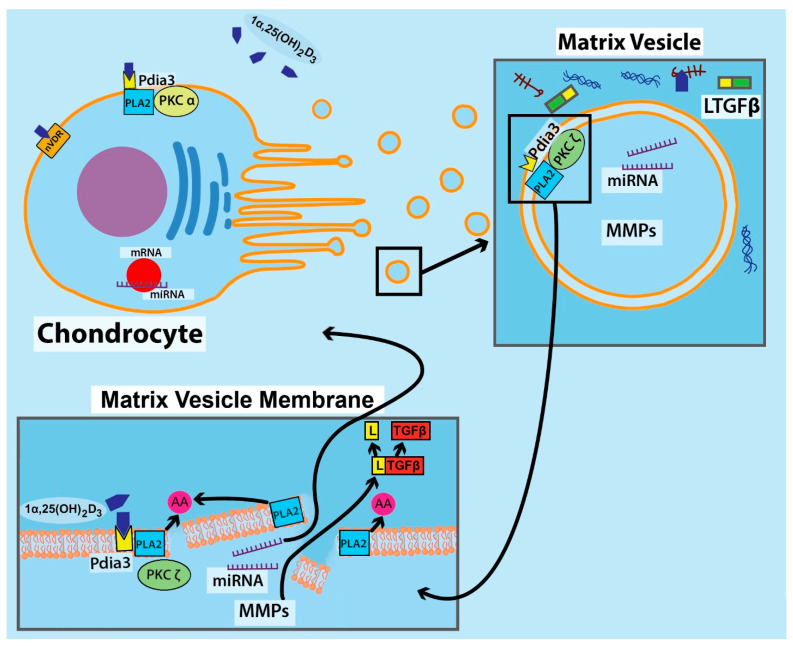
Growth zone chondrocyte with plasma membrane-associated receptors (VDR and PDIA3) for 1α,25(OH)2D3 release matrix vesicles into the ECM that contain microRNA and matrix metalloproteinases (MMPs). Chondrocyte plasma membrane PDIA3 acts via PKCα. Matrix vesicles contain the PDIA3 receptor complexed with PKCζ. 1α,25(OH)2D3 binds to matrix vesicle PDIA3, activating PLA2 to release arachidonic acid and destabilize the vesicle membrane; this releases the contents into the ECM. MMP released from MVs activates latent TGFβ (LTGFβ) in the extracellular matrix removing the latent binding protein. MicroRNAs act back on the chondrocytes, but whether the microRNAs are released into the ECM or are transported to the cells via the matrix vesicles or as membrane liposomes is not known.
Figure 3
Figure 3
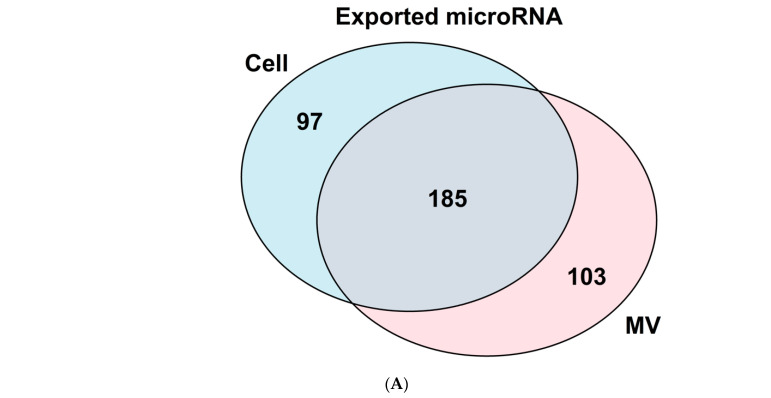
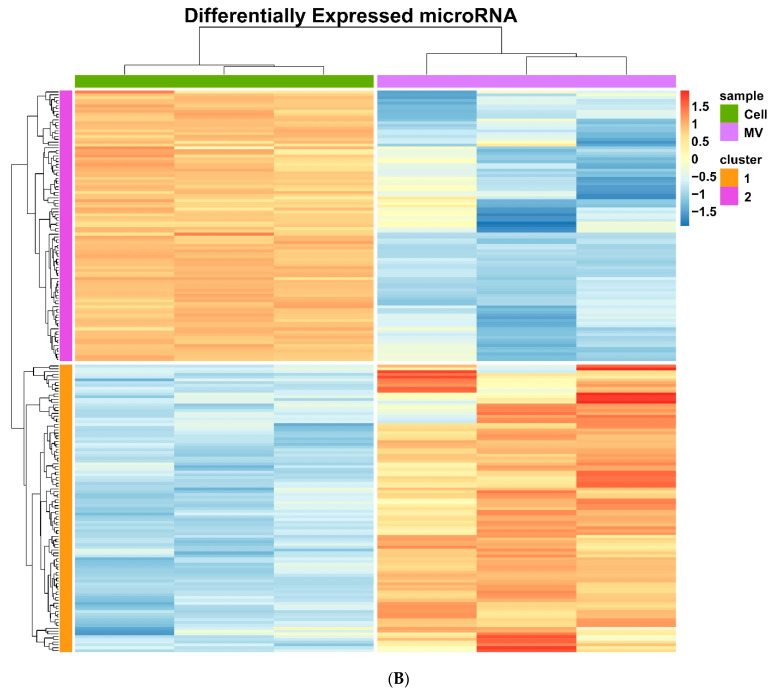
Examination of chondrocyte and matrix vesicle microRNA populations. (A) Venn diagram comparing differentially expressed (p-value < 0.05 and absolute log 2-fold change > 1) microRNA found in growth zone chondrocytes and matrix vesicles with 97 microRNA found only in the chondrocytes, 103 only in vesicles, and 185 shared between cells and vesicles. (B) Heatmap of the differentially expressed (p-value < 0.05 and absolute log 2-fold change > 1) microRNA from growth zone chondrocytes with cells on the left and matrix vesicles on the right (n = 3).
Figure 3
Figure 3
Examination of chondrocyte and matrix vesicle microRNA populations. (A) Venn diagram comparing differentially expressed (p-value < 0.05 and absolute log 2-fold change > 1) microRNA found in growth zone chondrocytes and matrix vesicles with 97 microRNA found only in the chondrocytes, 103 only in vesicles, and 185 shared between cells and vesicles. (B) Heatmap of the differentially expressed (p-value < 0.05 and absolute log 2-fold change > 1) microRNA from growth zone chondrocytes with cells on the left and matrix vesicles on the right (n = 3).

References

    1. Anderson H.C., Garimella R., Tague S.E. The Role of Matrix Vesicles in Growth Plate Development and Biomineralization. Front. Biosci. 2005;10:822–837. doi: 10.2741/1576. - DOI - PubMed
    1. Becker A., Thakur B.K., Weiss J.M., Kim H.S., Peinado H., Lyden D. Extracellular Vesicles in Cancer: Cell-to-Cell Mediators of Metastasis. Cancer Cell. 2016;30:836–848. doi: 10.1016/j.ccell.2016.10.009. - DOI - PMC - PubMed
    1. Anderson H.C. Matrix Vesicles and Calcification. Curr. Rheumatol. Rep. 2003;5:222–226. doi: 10.1007/s11926-003-0071-z. - DOI - PubMed
    1. Bommanavar S., Hosmani J., Togoo R.A., Baeshen H.A., Raj A.T., Patil S., Bhandi S., Birkhed D. Role of Matrix Vesicles and Crystal Ghosts in Bio-Mineralization. J. Bone Miner. Metab. 2020;36:759–764. doi: 10.1007/s00774-020-01125-x. - DOI - PubMed
    1. Cecil R.N.A., Clarke Anderson H. Freeze-Fracture Studies of Matrix Vesicle Calcification in Epiphyseal Growth Plate. Metab. Bone Dis. Relat. Res. 1978;1:89–95. doi: 10.1016/0221-8747(78)90043-7. - DOI

Publication types

LinkOut - more resources