


The Young Carers' Journey: A Systematic Review and Meta Ethnography
- PMID: 35627362
- PMCID: PMC9140828
- DOI: 10.3390/ijerph19105826
The Young Carers' Journey: A Systematic Review and Meta Ethnography
Abstract
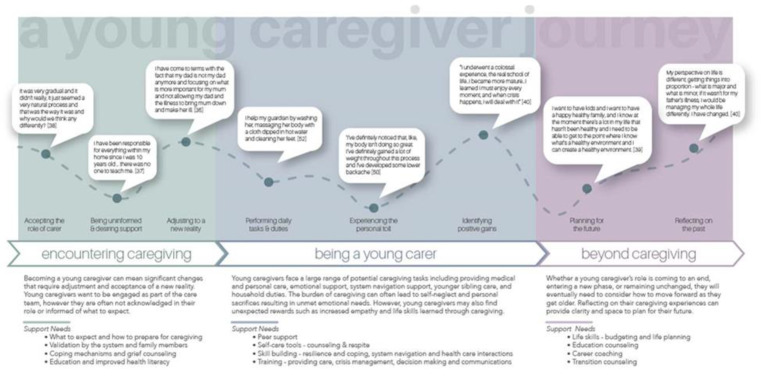
Despite growing international interest, the caregiving body of literature lacks a recent understanding of young carers' experiences and their contact with the health care system. We conducted a systematic review of qualitative studies to (1) synthesize more recent qualitative evidence on young carers' experience, and (2) to identify how these young carers interact with the health care system in their caregiving role. Using a meta-ethnographic synthesis, a total of 28 empirical studies met inclusion. Key findings helped inform an overarching framework of the experience of young carers as illustrated by a journey map. The journey map is a visual depiction of the stages these young carers go through when in a caregiving role framed by three themes: (1) encountering caregiving; (2) being a young caregiver, and (3) moving beyond caregiving. The caregiving experience is perceived by young people as challenging and complex, which could be improved with more informational navigation and emotional support. Understanding these experiences provides insight into gaps in health services and potential solutions that align with the stages outlined in the journey map.
Keywords: caregiving; meta-ethnography; qualitative; young carer; youth.
Conflict of interest statement
The authors declare no conflict of interest.
References
-
- Becker S. Young Carers International: Reflections on 25 Years of Research, Campaigning & Life. In the Swedish Family Care Competence Centre, SFCCC—Nationellt kompetenscentrum anhöriga; Proceedings of the 2nd International Conference ‘Every Child has the Right to Family’; Malmo, Sweden. 29–31 May 2017.
-
- Hendricks B.A., Kavanaugh M.S., Bakitas M.A. How Far Have We Come? An Updated Scoping Review of Young Carers in the U.S. Infant Ment. Health J. 2021;38:491–504. doi: 10.1007/s10560-021-00783-8. - DOI
-
- Kavanaugh M.S., Stamatopoulos V., Cohen D., Zhang L. Unacknowledged Caregivers: A Scoping Review of Research on Caregiving Youth in the United States. Adolesc. Res. Rev. 2015;1:29–49. doi: 10.1007/s40894-015-0015-7. - DOI
-
- Becker S. Global perspectives on children’s unpaid caregiving in the family: Research and policy on ‘young carers’ in the UK, Australia, the USA and Sub-Saharan Africa. Glob. Soc. Policy. 2007;7:23–50. doi: 10.1177/1468018107073892. - DOI
Publication types
MeSH terms
LinkOut - more resources
Full Text Sources
Medical
Miscellaneous
