


A Practical Approach to Assessing Physical Freshness: Utility of a Simple Perceived Physical Freshness Status Scale
- PMID: 35627372
- PMCID: PMC9141079
- DOI: 10.3390/ijerph19105836
A Practical Approach to Assessing Physical Freshness: Utility of a Simple Perceived Physical Freshness Status Scale
Abstract
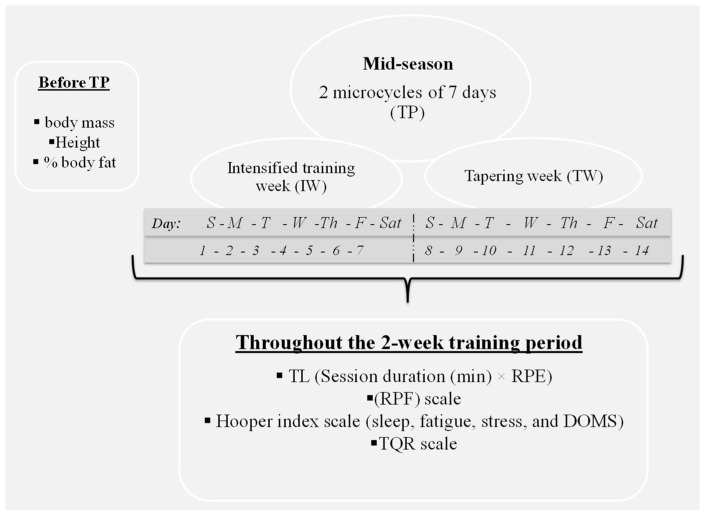
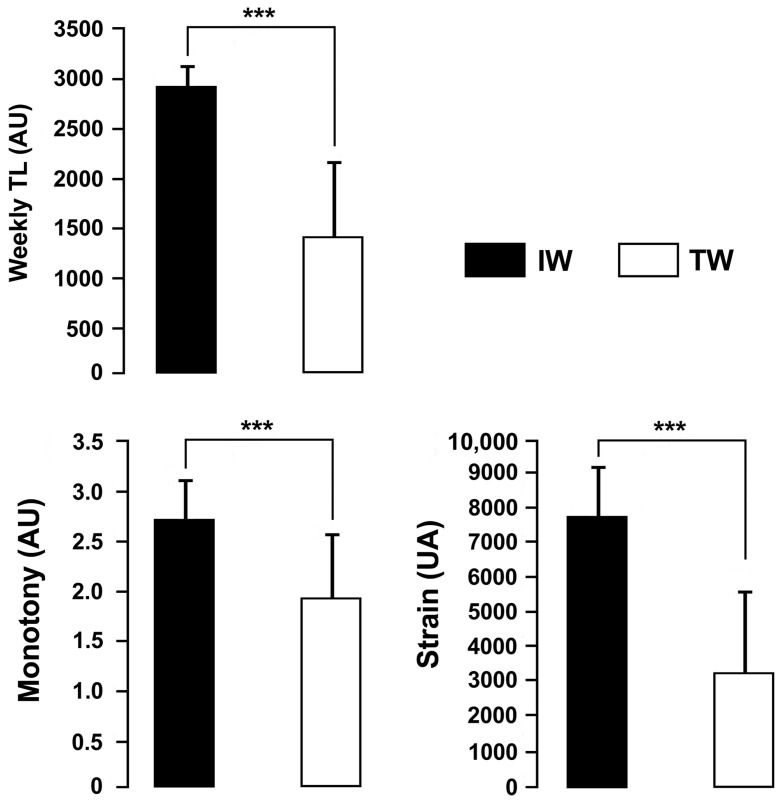
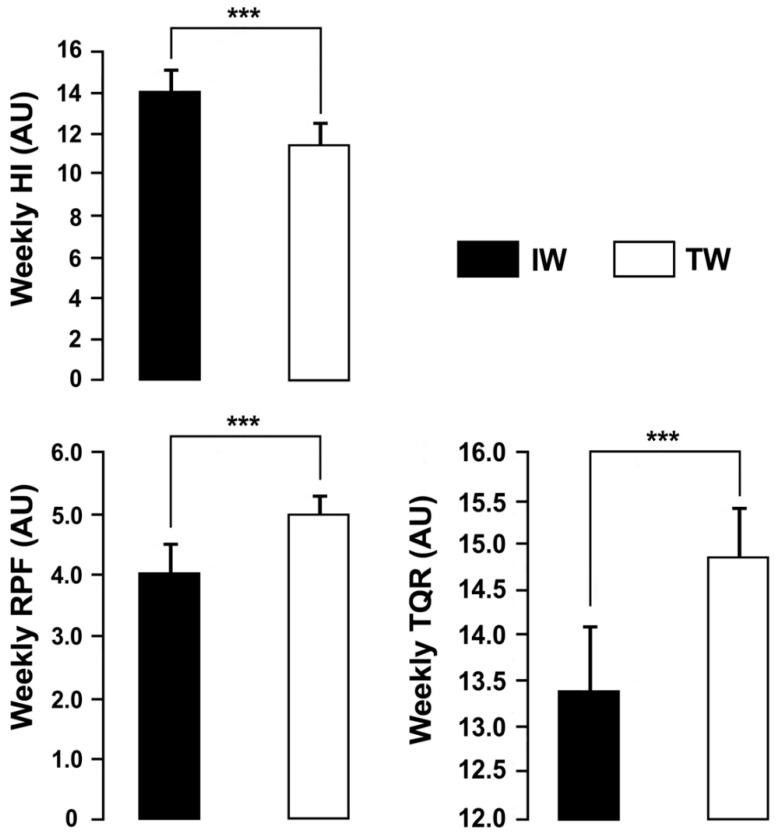
Background: Monitoring physical freshness is essential in assessing athletes’ conditions during training periods, training sessions, or competitions. To date, no single physical freshness scale has been successfully validated against training load variables and widely used scales measuring different facets of physical freshness. Objective: In this study, we develop and test the practical utility of a perceived physical freshness (RPF) scale to monitor the condition of the athletes and to prevent excessive fatigue and insufficient recovery during training sessions or competitions. Methods: Sixteen professional male soccer players (mean ± SD age 26 ± 4 years) were enrolled. Training load (TL), monotony, strain, rate of perceived exertion (RPE), well-being indices (sleep, stress, fatigue, and muscle soreness), total quality recovery (TQR) and RPF were determined each day for two weeks of training, including a week intensified training (IW) and a week taper (TW). The validity of the RPF scale was assessed by measuring the level of agreement of a player’s perceived physical freshness relative to their TL variables, recovery state and well-being indices during each training phase (IW and TW) and during the overall training period (TP). Results: RPF increased during the TW compared to IW (ES = 2.31, p < 0.001, large). For the TP, IW and TW, weekly RPF was related to weekly TL (r = −0.81, r = −0.80, r = −0.69, respectively), well-being (r = −0.91, r = −0.82, r = −0.84, respectively) and TQR (r = 0.76, r = 0.91, r = 0.52, respectively), all p < 0.01. For the TP, IW and TW, daily RPF was related to TL (r = −0.75, r = −0.66, r = −0.70, respectively), well-being (r = −0.84, r = −0.81, r = −0.78, respectively) and TQR (r = 0.82, r = 0.81, r = 0.75, respectively), all p < 0.01. Conclusions: RPF was effective for evaluating the professional soccer players’ physical freshness and may be a strategy for coaches to monitor the physical, psycho-physiological, and psychometric state of the players before training session or matches.
Keywords: readiness; soccer; training load; well-being.
Conflict of interest statement
The authors declare no conflict of interest.
Figures
References
-
- Ouergui I., Franchini E., Selmi O., Levitt D.E., Chtourou H., Bouhlel E., Ardigò L.P. Relationship between perceived training load, well-being indices, recovery state and physical enjoyment during judo-specific training. Int. J. Environ. Public Health. 2020;17:7400. doi: 10.3390/ijerph17207400. - DOI - PMC - PubMed
-
- Selmi O., Ouergui I., Castellano J., Levitt D., Bouassida A. Effect of an intensified training period on well-being indices, recovery, and psychological aspects in professional soccer players. Eur. Appl. Psychol. 2020;70:100603. doi: 10.1016/j.erap.2020.100603. - DOI
MeSH terms
LinkOut - more resources
Full Text Sources
