


Anti-Müllerian Hormone Levels among Female Firefighters
- PMID: 35627519
- PMCID: PMC9141260
- DOI: 10.3390/ijerph19105981
Anti-Müllerian Hormone Levels among Female Firefighters
Abstract
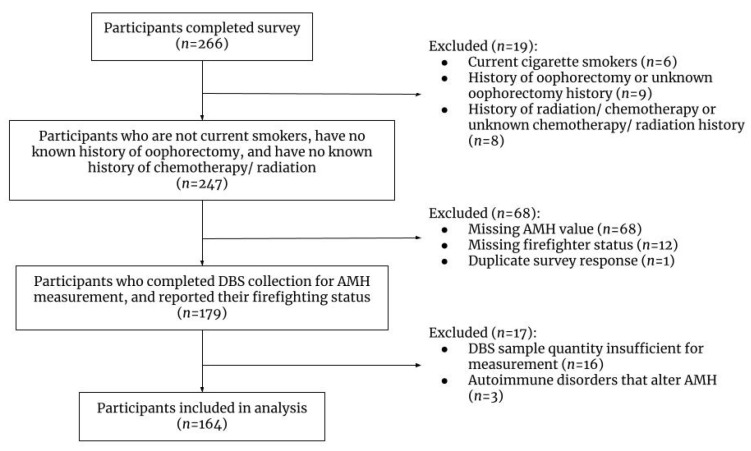
Female firefighters have occupational exposures which may negatively impact their reproductive health. Anti-müllerian hormone (AMH) is a clinical marker of ovarian reserve. We investigated whether AMH levels differed in female firefighters compared to non-firefighters and whether there was a dose-dependent relationship between years of firefighting and AMH levels. Female firefighters from a pre-existing cohort completed a cross-sectional survey regarding their occupational and health history and were asked to recruit a non-firefighter friend or relative. All participants provided a dried blood spot (DBS) for AMH analysis. Linear regression was used to assess the relationship between firefighting status and AMH levels. Among firefighters, the influence of firefighting-related exposures was evaluated. Firefighters (n = 106) and non-firefighters (n = 58) had similar age and BMI. Firefighters had a lower mean AMH compared to non-firefighters (2.93 ng/mL vs. 4.37 ng/mL). In multivariable adjusted models, firefighters had a 33% lower AMH value than non-firefighters (-33.38%∆ (95% CI: -54.97, -1.43)). Years of firefighting was not associated with a decrease in AMH. Firefighters in this study had lower AMH levels than non-firefighters. More research is needed to understand the mechanisms by which firefighting could reduce AMH and affect fertility.
Keywords: anti-müllerian hormone; firefighter health; occupational exposures; reproductive health.
Conflict of interest statement
The authors declare no conflict of interests.
Figures
References
Publication types
MeSH terms
Substances
Grants and funding
LinkOut - more resources
Full Text Sources
