


The Developmental Origins of Health and Disease: Adolescence as a Critical Lifecourse Period to Break the Transgenerational Cycle of NCDs-A Narrative Review
- PMID: 35627561
- PMCID: PMC9141771
- DOI: 10.3390/ijerph19106024
The Developmental Origins of Health and Disease: Adolescence as a Critical Lifecourse Period to Break the Transgenerational Cycle of NCDs-A Narrative Review
Abstract
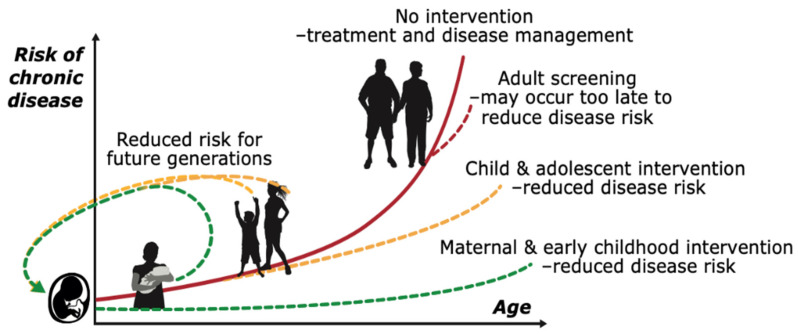
Noncommunicable diseases (NCDs), including type 2 diabetes and cardiovascular disease, represent a significant and growing global health burden. To date, a primary focus has been on treatment approaches to NCDs once manifested rather than strategies aimed at prevention. In this context, there is clear evidence that a range of adverse early life exposures can predispose individuals towards a greater risk of developing NCDs across the lifecourse. These risk factors can be passed to future generations, thus perpetuating a cycle of disease. This concept, preferentially termed "developmental programming", forms the basis of the Developmental Origins of Health and Disease (DOHaD) framework. To date, DOHaD has focused on preconception, pregnancy, lactation and, more recently, paternal health at the time of conception. However, it is becoming increasingly clear that investment in the window of adolescence is perhaps the most critical developmental window. Adolescence is a period where lifestyle behaviours become entrained. Therefore, a focus on adolescent behaviours, health literacy and emotional development may afford the best opportunity to break the cycle of NCDs. As the next generation of parents, adolescents should therefore be considered a priority group in advancing appropriate and informed actions aimed at reducing NCD risk factors across the lifecourse. This advancement requires a more comprehensive community understanding and uptake of DOHaD knowledge and concepts. NCD prevention strategies have typically entailed siloed (and often disease-specific) approaches with limited efficacy in curbing NCD prevalence and breaking the transgenerational transmission of disease traits. Recent findings across various disciplines have highlighted that a lifecourse systems approach is required to establish a comprehensive and sustainable framework for NCD intervention. A whole community approach with a particular focus on adolescents as potential agents of change is necessary to break the disease cycle.
Keywords: DOHaD; adolescence; adolescents; developmental origins of health and disease; developmental programming; lifecourse; noncommunicable diseases.
Conflict of interest statement
The authors declare no conflict of interest. The funders had no role in the writing of the manuscript.
Figures
References
-
- World Health Organization Noncommunicable Diseases Country Profiles 2018. 2018. [(accessed on 12 April 2022)]. pp. 1–223. Available online: https://apps.who.int/iris/handle/10665/274512.
-
- World Health Organization World Health Statistics 2021: Monitoring Health for the SDGs, Sustainable Development Goals. 2021. [(accessed on 9 May 2022)]. pp. 1–132. Available online: https://reliefweb.int/sites/reliefweb.int/files/resources/whs-2021_20may....
-
- Akseer N., Mehta S., Wigle J., Chera R., Brickman Z., Al-Gashm S., Sorichetti B., Vandermorris A., Hipgrave D., Schwalbe N. Non-communicable diseases among adolescents: Current status, determinants, interventions and policies. BMC Public Health. 2020;20:1908. doi: 10.1186/s12889-020-09988-5. - DOI - PMC - PubMed
Publication types
MeSH terms
LinkOut - more resources
Full Text Sources
Medical
Research Materials
