


Mucormycosis and COVID-19-Associated Mucormycosis: Insights of a Deadly but Neglected Mycosis
- PMID: 35628701
- PMCID: PMC9144279
- DOI: 10.3390/jof8050445
Mucormycosis and COVID-19-Associated Mucormycosis: Insights of a Deadly but Neglected Mycosis
Abstract
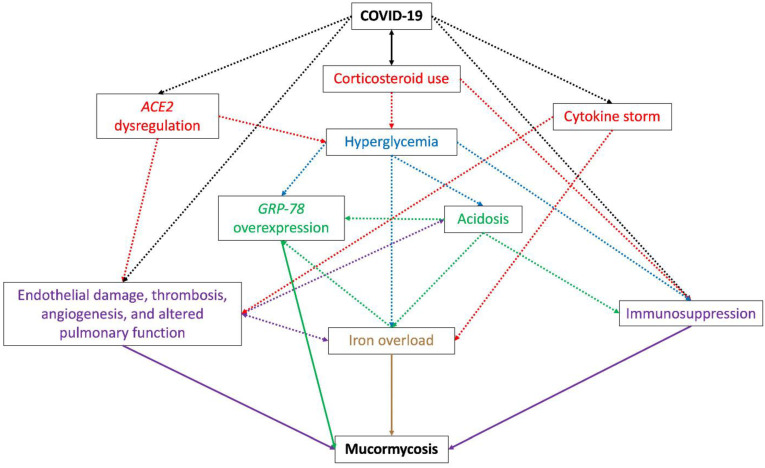
The ongoing COVID-19 pandemic has quickly become a health threat worldwide, with high mortality and morbidity among patients with comorbidities. This viral infection promotes the perfect setting in patients for the development of opportunistic infections, such as those caused by fungi. Mucormycosis, a rare but deadly fungal infection, has recently increased its incidence, especially in endemic areas, since the onset of the pandemic. COVID-19-associated mucormycosis is an important complication of the pandemic because it is a mycosis hard to diagnose and treat, causing concern among COVID-19-infected patients and even in the already recovered population. The risk factors for the development of mucormycosis in these patients are related to the damage caused by the SARS-CoV-2 itself, the patient's overstimulated immune response, and the therapy used to treat COVID-19, causing alterations such as hyperglycemia, acidosis, endothelial and lung damage, and immunosuppression. In this review, the molecular aspects of mucormycosis and the main risk factors for the development of COVID-19-associated mucormycosis are explained to understand this virus-fungi-host interaction and highlight the importance of this neglected mycosis.
Keywords: ACE2; CAM; COVID-19; GRP-78; SARS-CoV-2; corticosteroids; cytokine storm; hyperglycemia; immunosuppression; iron overload; mucormycosis.
Conflict of interest statement
The authors declare no conflict of interest.
Figures
References
-
- Rodriguez-Morales A.J., Bonilla-Aldana D.K., Balbin-Ramon G.J., Rabaan A.A., Sah R., Paniz-Mondolfi A., Pagliano P., Esposito S. History is repeating itself: Probable zoonotic spillover as the cause of the 2019 novel Coronavirus epidemic. Le Infez. Med. 2020;28:3–5. - PubMed
-
- Patel A., Agarwal R., Rudramurthy S.M., Shevkani M., Xess I., Sharma R., Savio J., Sethuraman N., Madan S., Shastri P., et al. Multicenter Epidemiologic Study of Coronavirus Disease–Associated Mucormycosis, India. Emerg. Infect. Dis. 2021;27:2349–2359. doi: 10.3201/eid2709.210934. - DOI - PMC - PubMed
Publication types
Grants and funding
LinkOut - more resources
Full Text Sources
Miscellaneous
