


An Individualized Approach of Multidisciplinary Heart Team for Myocardial Revascularization and Valvular Heart Disease-State of Art
- PMID: 35629130
- PMCID: PMC9144508
- DOI: 10.3390/jpm12050705
An Individualized Approach of Multidisciplinary Heart Team for Myocardial Revascularization and Valvular Heart Disease-State of Art
Abstract
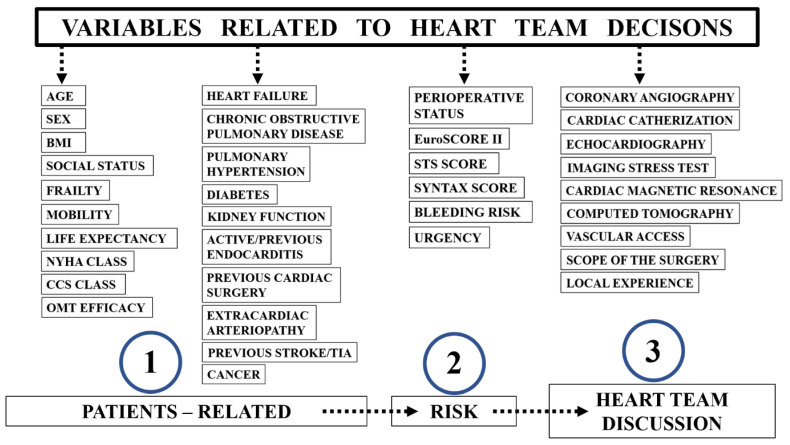
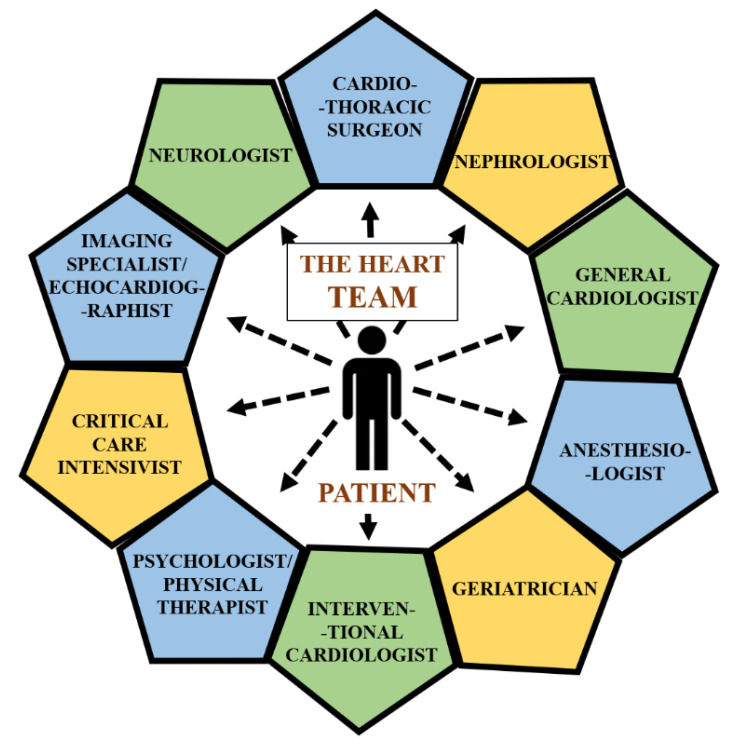
The multidisciplinary Heart Team (HT) remains the standard of care for highly-burdened patients with coronary artery disease (CAD) and valvular heart disease (VHD) and is widely adopted in the medical community and supported by European and American guidelines. An approach of highly-experienced specialists, taking into account numerous clinical factors, risk assessment, long-term prognosis and patients preferences seems to be the most rational option for individuals with. Some studies suggest that HT management may positively impact adherence to current recommendations and encourage the incorporation of patient preferences through the use of shared-decision making. Evidence from randomized-controlled trials are scarce and we still have to satisfy with observational studies. Furthermore, we still do not know how HT should cooperate, what goals are desired and most importantly, how HT decisions affect long-term outcomes and patient's satisfaction. This review aimed to comprehensively discuss the available evidence establishing the role of HT for providing optimal care for patients with CAD and VHD. We believe that the need for research to recognize the HT definition and range of its functioning is an important issue for further exploration. Improved techniques of interventional cardiology, minimally-invasive surgeries and new drugs determine future perspectives of HT conceptualization, but also add new issues to the complexity of HT cooperation. Regardless of which direction HT has evolved, its concept should be continued and refined to improve healthcare standards.
Keywords: aortic stenosis; coronary artery disease; decision-making; heart team; interventions; mitral regurgitation.
Conflict of interest statement
The authors declare no conflict of interest.
Figures
Similar articles
-
Contemporary Presentation and Management of Valvular Heart Disease: The EURObservational Research Programme Valvular Heart Disease II Survey.Circulation. 2019 Oct;140(14):1156-1169. doi: 10.1161/CIRCULATIONAHA.119.041080. Epub 2019 Sep 12. Circulation. 2019. PMID: 31510787
-
Heart team consultations for patients with severe coronary artery disease or valvular heart disease in the era of the COVID-19 pandemic: a single-center experience.Front Cardiovasc Med. 2023 Jul 19;10:1203535. doi: 10.3389/fcvm.2023.1203535. eCollection 2023. Front Cardiovasc Med. 2023. PMID: 37539089 Free PMC article.
-
Description of a Heart Team approach to coronary revascularization and its beneficial long-term effect on clinical events after PCI.Clin Res Cardiol. 2016 May;105(5):388-400. doi: 10.1007/s00392-015-0932-2. Epub 2015 Oct 27. Clin Res Cardiol. 2016. PMID: 26508415
-
Antithrombotic therapy in atrial fibrillation associated with valvular heart disease: a joint consensus document from the European Heart Rhythm Association (EHRA) and European Society of Cardiology Working Group on Thrombosis, endorsed by the ESC Working Group on Valvular Heart Disease, Cardiac Arrhythmia Society of Southern Africa (CASSA), Heart Rhythm Society (HRS), Asia Pacific Heart Rhythm Society (APHRS), South African Heart (SA Heart) Association and Sociedad Latinoamericana de Estimulación Cardíaca y Electrofisiología (SOLEACE).Europace. 2017 Nov 1;19(11):1757-1758. doi: 10.1093/europace/eux240. Europace. 2017. PMID: 29096024 Review.
-
The current state of the multidisciplinary heart team approach: a systematic review.Eur J Cardiothorac Surg. 2024 Dec 26;67(1):ezae461. doi: 10.1093/ejcts/ezae461. Eur J Cardiothorac Surg. 2024. PMID: 39693114 Free PMC article.
References
-
- Collet J.-P., Thiele H., Barbato E., Barthélémy O., Bauersachs J., Bhatt D.L., Dendale P., Dorobantu M., Edvardsen T., Folliguet T., et al. 2020 ESC Guidelines for the management of acute coronary syndromes in patients presenting without persistent ST-segment elevation. Eur. Heart J. 2021;42:1289–1367. doi: 10.1093/eurheartj/ehaa575. - DOI - PubMed
-
- Amsterdam E.A., Wenger N.K., Brindis R.G., Casey D., Ganiats T.G., Holmes D.R., Jaffe A.S., Jneid H., Kelly R.F., Kontos M.C., et al. 2014 AHA/ACC Guideline for the Management of Patients With Non–ST-Elevation Acute Coronary Syndromes: A Report of the American College of Cardiology/American Heart Association Task Force on Practice Guidelines. J. Am. Coll. Cardiol. 2014;64:e139–e228. doi: 10.1016/j.jacc.2014.09.017. - DOI - PubMed
-
- Fihn S.D., Gardin J.M., Abrams J., Berra K., Blankenship J.C., Dallas A.P., Douglas P.S., Foody J.M., Gerber T.C., Hinderliter A.L., et al. 2012 ACCF/AHA/ACP/AATS/PCNA/SCAI/STS guideline for the diagnosis and management of patients with stable ischemic heart disease: Executive summary: A report of the American College of Cardiology Foundation/American Heart Association task force on practice guidelines, and the American College of Physicians, American Association for Thoracic Surgery, Preventive Cardiovascular Nurses Association, Society for Cardiovascular Angiography and Interventions, and Society of Thoracic Surgeons. Circulation. 2012;126:3097–3137. doi: 10.1161/cir.0b013e3182776f83. - DOI - PubMed
-
- O’Gara P.T., Kushner F.G., Ascheim D.D., Casey D.E., Chung M.K., De Lemos J.A., Ettinger S.M., Fang J.C., Fesmire F.M., Franklin B.A., et al. 2013 ACCF/AHA Guideline for the Management of ST-Elevation Myocardial Infarction: A Report of the American College of Cardiology Foundation/American Heart Association Task Force on Practice Guidelines. Circulation. 2013;127:e362–e425. doi: 10.1161/CIR.0b013e3182742c84. - DOI - PubMed
Publication types
LinkOut - more resources
Full Text Sources
Miscellaneous
