


Differences in Willingness to Undergo BRCA1/2 Testing and Risk Reducing Surgery among the General Public, Cancer Patients, and Healthcare Professionals: A Large Population-Based Survey
- PMID: 35629239
- PMCID: PMC9147340
- DOI: 10.3390/jpm12050818
Differences in Willingness to Undergo BRCA1/2 Testing and Risk Reducing Surgery among the General Public, Cancer Patients, and Healthcare Professionals: A Large Population-Based Survey
Abstract
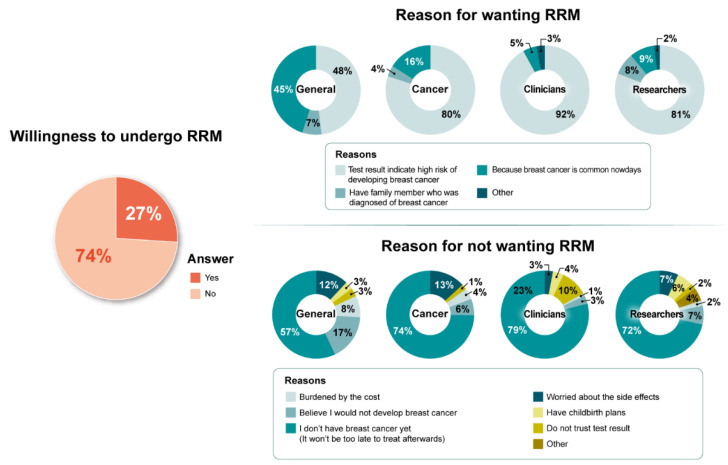
We aimed to understand the decision-making process related to the willingness to undergo BRCA1/2 genetic testing, risk-reducing salpingo-oophorectomy (RRSO), or risk-reducing mastectomy (RRM) among the general public, cancer patients, and healthcare professionals in South Korea. In total, 3444 individuals (1496 from the general public, 1500 cancer patients, 108 clinicians, and 340 researchers) completed a survey addressing genetic testing and related risk management options in a hypothetical scenario. Differences in intent and associated factors for undergoing the above procedures or sharing test results were analyzed. Overall, 67% of participants were willing to undergo BRCA1/2 testing, with proportions of the general public (58%), cancer patients (70%), clinicians (88%), and researchers (90%). The willingness to undergo RRSO was highest among clinicians (58%), followed by among patients (38%), the general public (33%), and researchers (32%) (p < 0.001). Gender, age, education level, and household income were associated with willingness to undergo genetic testing, RRM, and RRSO (p < 0.05). The intent for undergo genetic testing, RRM, and RRSO were affected by many factors. Finally, 69% of the general public intended to share information with family, while this percentage was 92%, 91%, and 94% for patients, clinicians, and researchers, respectively (p < 0.05). These results highlight the requirement for developing targeted educational materials and counseling strategies for facilitating informed decision making.
Keywords: BRCA1; BRCA2; clinical decision making; genetic counseling; genetic testing; information dissemination; mastectomy; prophylactic surgical procedure; salpingo-oophorectomy.
Conflict of interest statement
The authors have declared no conflict of interest.
Figures



References
-
- Domchek S.M., Friebel T.M., Singer C.F., Evans D.G., Lynch H.T., Isaacs C., Garber J.E., Neuhausen S.L., Matloff E., Eeles R., et al. Association of risk-reducing surgery in BRCA1 or BRCA2 mutation carriers with cancer risk and mortality. JAMA. 2010;304:967–975. doi: 10.1001/jama.2010.1237. - DOI - PMC - PubMed
-
- Kang E., Seong M.W., Park S.K., Lee J.W., Lee J., Kim L.S., Lee J.E., Kim S.Y., Jeong J., Han S.A., et al. The prevalence and spectrum of BRCA1 and BRCA2 mutations in Korean population: Recent update of the Korean hereditary breast cancer (KOHBRA) study. Breast Cancer Res. Treat. 2015;151:157–168. doi: 10.1007/s10549-015-3377-4. - DOI - PubMed
Grants and funding
LinkOut - more resources
Full Text Sources
Miscellaneous
