Review
. 2022 May 12;58(5):654.
doi: 10.3390/medicina58050654.

Water Dynamics in Cancer Cells: Lessons from Quasielastic Neutron Scattering

Affiliations
Review

Water Dynamics in Cancer Cells: Lessons from Quasielastic Neutron Scattering

Murillo L Martins et al. Medicina (Kaunas). .

Abstract

The severity of the cancer statistics around the globe and the complexity involving the behavior of cancer cells inevitably calls for contributions from multidisciplinary areas of research. As such, materials science became a powerful asset to support biological research in comprehending the macro and microscopic behavior of cancer cells and untangling factors that may contribute to their progression or remission. The contributions of cellular water dynamics in this process have always been debated and, in recent years, experimental works performed with Quasielastic neutron scattering (QENS) brought new perspectives to these discussions. In this review, we address these works and highlight the value of QENS in comprehending the role played by water molecules in tumor cells and their response to external agents, particularly chemotherapy drugs. In addition, this paper provides an overview of QENS intended for scientists with different backgrounds and comments on the possibilities to be explored with the next-generation spectrometers under construction.

Keywords: cancer cells; quasielastic neutron scattering; water dynamics.


Conflict of interest statement

The authors declare no conflict of interest.

Figures
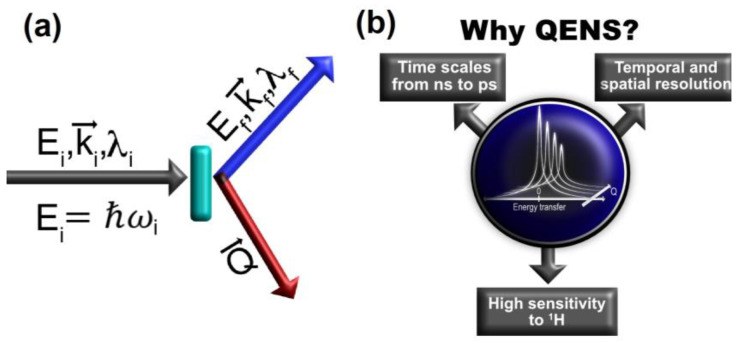
Figure 1
Figure 1
(a) Typical scattering triangle showing incoming neutrons with incident energy Ei, wavelength λi, and wave vector ki interacting with the sample and assuming final energy Ef, wavelength λf, and wave vector kf. The momentum transfer Q is defined as the change in wave vector (Q= kikf); (b) summary of the main features of the QENS technique. These are explained in detail in the text.
Figure 2
Figure 2
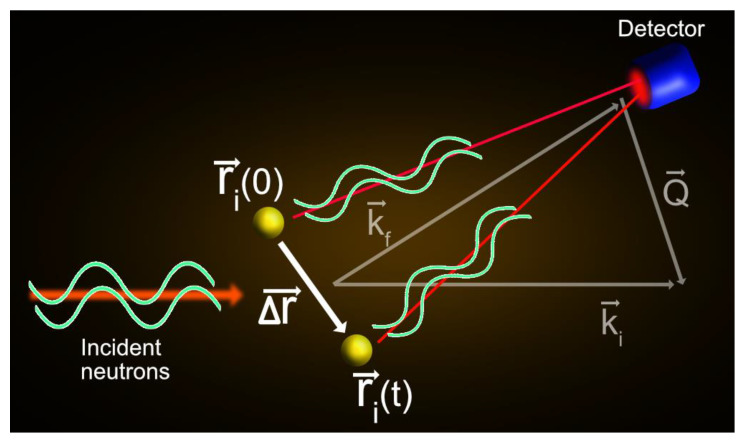
Graphical representation of a single particle scattering. The incoming neutron waves are scattered by a particle i at different times, 0 and t, and positions, ri(0) and ri(t). The scattered waves interfere with each other before detection. The scattering triangle is also represented in the figure.
Figure 3
Figure 3
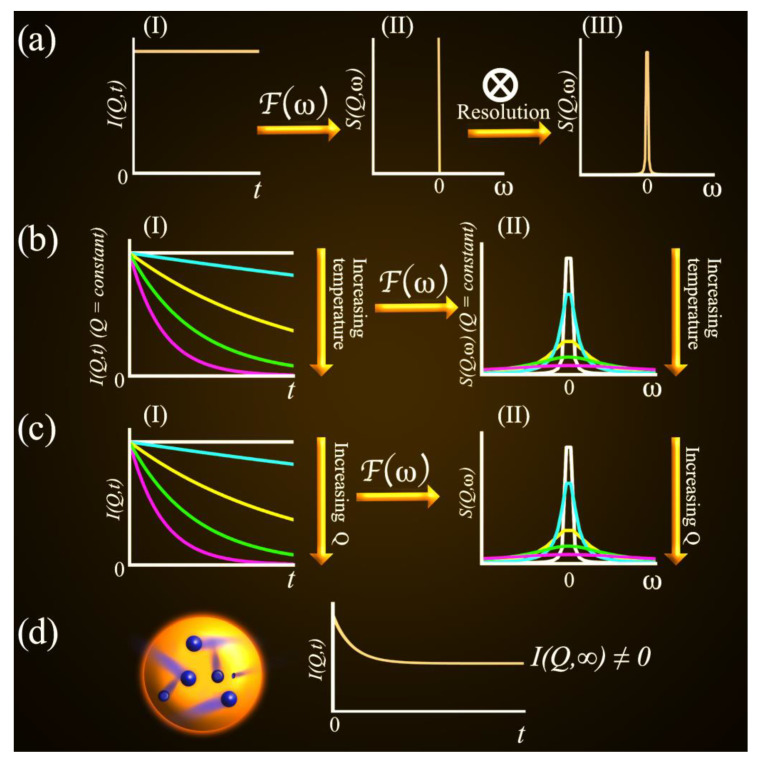
Schematics of the relationship between Iincoh(Q, t) and Sincoh(Q, ω). In (a), curve a-I shows the expected behavior of Iincoh(Q, t) for a static particle where no exchange of energy occurs between the incoming neutrons and the sample. As shown in a-II, after a time-Fourier transformation of Iincoh(Q, t), one obtains a δ-function-shaped Sincoh(Q, ω), which broadens when convoluted with the experimental resolution (see a-III). In (b), the particles under analysis perform motions upon, for example, heating and Iincoh(Q, t) gradually decays (b-II) and Sincoh(Q, ω) becomes broader (b-II). In (c), an unconstrained diffusive motion is depicted, which leads to a gradual decay of Iincoh(Q,t) over Q (c-I) reaching the limit of Iincoh(Q, ) = 0, and Sincoh(Q, ω) broadens as a function of Q (c-II). In (d), the motions of particles within a constrained geometry are depicted and Iincoh(Q, t) plateaus at a finite value at t .
Figure 4
Figure 4
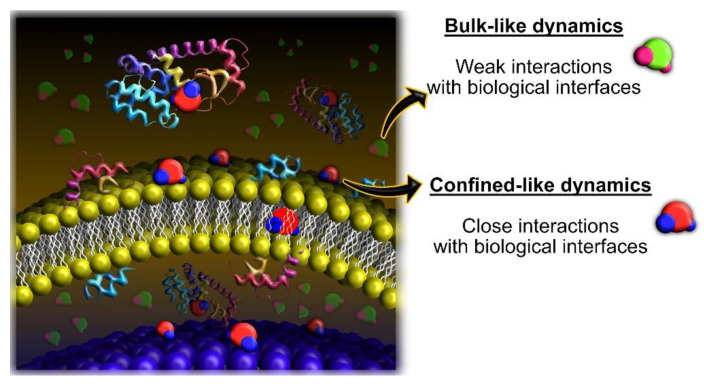
Illustration of the complex chemical environment within living cells and the different water populations. The green/pink molecules depict the bulk-like populations, which are subjected to weak interactions with the biological interfaces and are more abundant in cellular media (they are semi-transparent in the figure for presentation purposes). The red/blue molecules depict the confined-like populations, which are subjected to closer interactions with the biological interfaces and present features of confined dynamics that are not comparable with bulk water.
Figure 5
Figure 5
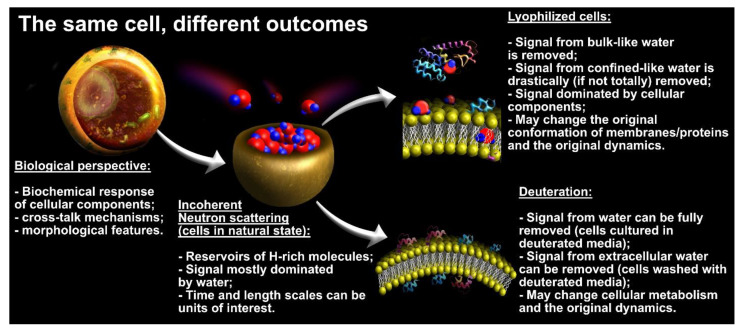
Schematics of the different outcomes obtained in QENS experiments with cancer cells.
Figure 6
Figure 6
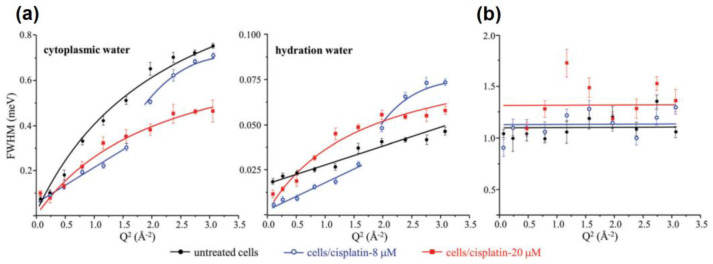
Variation of the full widths at half-maximum (FWHM) with Q2 for untreated and cisplatin-treated (8 and 20 mM) MDA-MB-231 cells in deuterated saline medium (washed), at 298 k: (a) Lorentzian functions representing the translational motions of intracellular water—cytoplasmic and hydration water; (b) Lorentzian function representing the internal localized motions within the cell. Reprinted with permission from ref. [53]. Copyright 2017 The Royal Society of Chemistry.
Figure 7
Figure 7
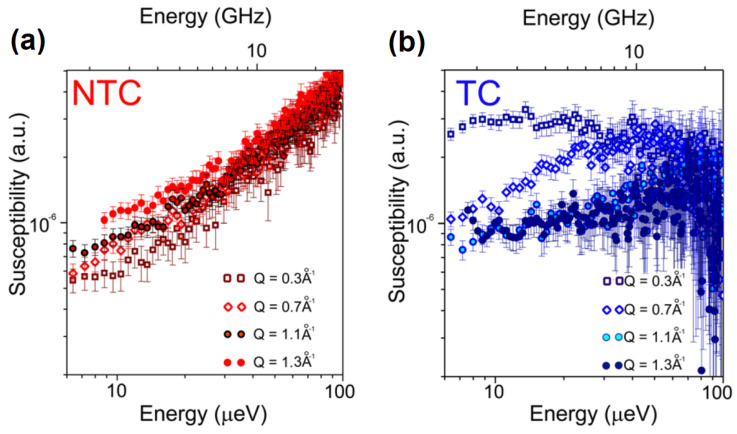
Dynamic susceptibilities obtained from QENS data for not-treated breast cancer cells (MCF-7), NTC (a), and breast cancer cells treated with 15nM of paclitaxel for 24 h, TC (b), reprinted from [16] available via the Creative Commons Attribution 4.0 International License (CCBY4.0, https://creativecommons.org/licenses/by/4.0/, 29 March 2022).

References

    1. Sung H., Ferlay J., Siegel R.L., Laversanne M., Soerjomataram I., Jemal A., Bray F. Global Cancer Statistics 2020: GLOBOCAN Estimates of Incidence and Mortality Worldwide for 36 Cancers in 185 Countries. CA Cancer J. Clin. 2021;71:209–249. doi: 10.3322/caac.21660. - DOI - PubMed
    1. Miller K.D., Fidler-Benaoudia M., Keegan T.H., Hipp H.S., Jemal A., Siegel R.L. Cancer statistics for adolescents and young adults, 2020. CA Cancer J. Clin. 2020;70:443–459. doi: 10.3322/caac.21637. - DOI - PubMed
    1. Ajabnoor G.M.A., Crook T., Coley H.M. Paclitaxel resistance is associated with switch from apoptotic to autophagic cell death in MCF-7 breast cancer cells. Cell Death Dis. 2012;3:e260. doi: 10.1038/cddis.2011.139. - DOI - PMC - PubMed
    1. Eramo A., Ricci-Vitiani L., Zeuner A., Pallini R., Lotti F., Sette G., Pilozzi E., Larocca L.M., Peschle C., De Maria R. Chemotherapy resistance of glioblastoma stem cells. Cell Death Differ. 2006;13:1238–1241. doi: 10.1038/sj.cdd.4401872. - DOI - PubMed
    1. Barker H.E., Paget J.T.E., Khan A.A., Harrington K.J. The tumour microenvironment after radiotherapy: Mechanisms of resistance and recurrence. Nat. Rev. Cancer. 2015;15:409–425. doi: 10.1038/nrc3958. - DOI - PMC - PubMed