


How Does the Gus Schumacher Nutrition Incentive Program Work? A Theory of Change
- PMID: 35631159
- PMCID: PMC9146513
- DOI: 10.3390/nu14102018
How Does the Gus Schumacher Nutrition Incentive Program Work? A Theory of Change
Abstract
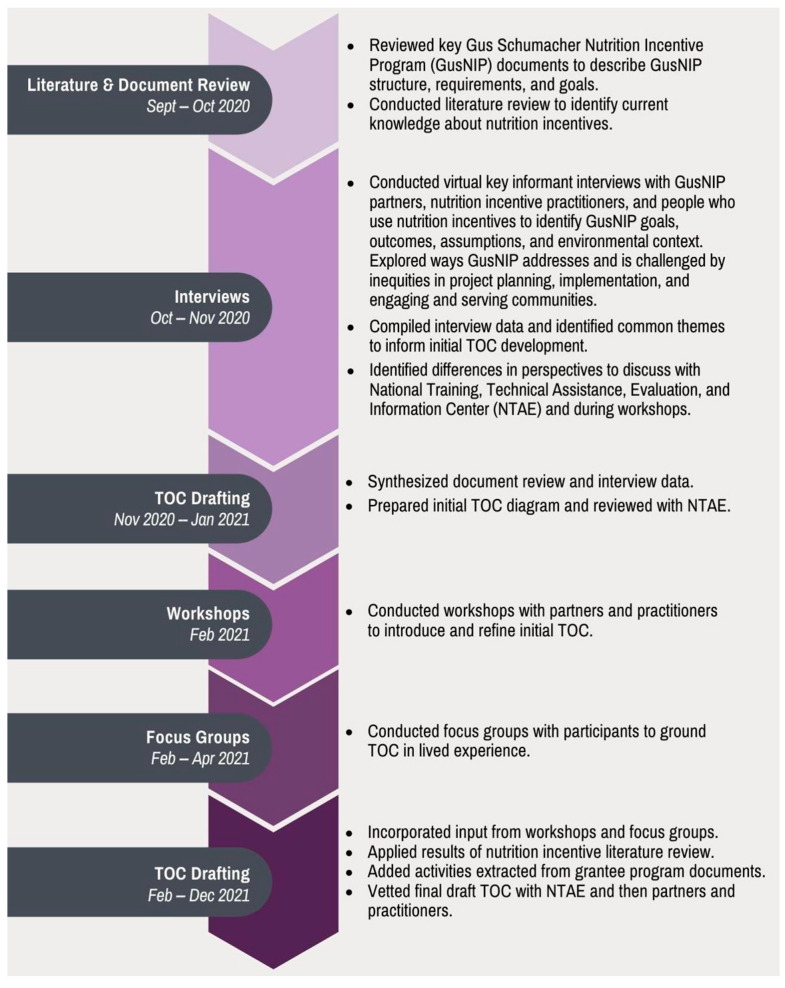
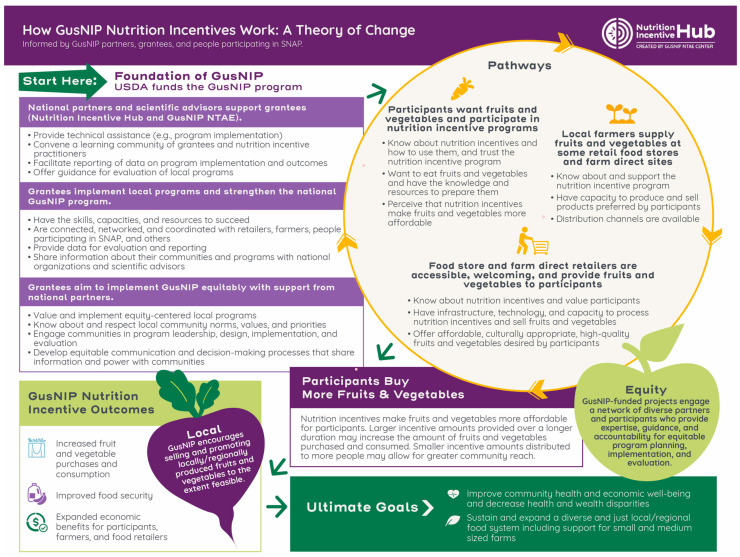
Increased fruit and vegetable (FV) intake is associated with decreased risk of nutrition-related chronic diseases. Sociodemographic disparities in FV intake indicate the need for strategies that promote equitable access to FVs. The United States Department of Agriculture's Gus Schumacher Nutrition Incentive Program (GusNIP) supports state and local programs that offer nutrition incentives (NIs) that subsidize purchase of FVs for people participating in the Supplemental Nutrition Assistance Program (SNAP). While a growing body of research indicates NIs are effective, the pathways through which GusNIP achieves its results have not been adequately described. We used an equity-focused, participatory process to develop a retrospective Theory of Change (TOC) to address this gap. We reviewed key program documents; conducted a targeted NI literature review; and engaged GusNIP partners, practitioners, and participants through interviews, workshops, and focus groups in TOC development. The resulting TOC describes how GusNIP achieves its long-term outcomes of increased participant FV purchases and intake and food security and community economic benefits. GusNIP provides NIs and promotes their use, helps local food retailers develop the capacity to sell FVs and accept NIs in accessible and welcoming venues, and supports local farmers to supply FVs to food retailers. The TOC is a framework for understanding how GusNIP works and a tool for improving and expanding the program.
Keywords: Gus Schumacher Nutrition Incentive Program (GusNIP); Supplemental Nutrition Assistance Program (SNAP); food security; food systems; fruit and vegetables access/intake; health equity; low income; nutrition incentives; theory of change.
Conflict of interest statement
The authors declare no conflict of interest.
Figures
References
-
- Wallace T.C., Bailey R.L., Blumberg J.B., Burton-Freeman B., Chen C.-Y.O., Crowe-White K.M., Drewnowski A., Hooshmand S., Johnson E., Lewis R., et al. Fruits, vegetables, and health: A comprehensive narrative, umbrella review of the science and recommendations for enhanced public policy to improve intake. Crit. Rev. Food Sci. Nutr. 2020;60:2174–2211. doi: 10.1080/10408398.2019.1632258. - DOI - PubMed
-
- Angelino D., Godos J., Ghelfi F., Tieri M., Titta L., Lafranconi A., Marventano S., Alonzo E., Gambera A., Sciacca S., et al. Fruit and vegetable consumption and health outcomes: An umbrella review of observational studies. Int. J. Food Sci. Nutr. 2019;70:652–667. doi: 10.1080/09637486.2019.1571021. - DOI - PubMed
-
- Gearing M., Dixit-Joshi S., May L. Barriers that Constrain the Adequacy of Supplemental Nutrition Assistance Program (SNAP) Allotments: Survey Findings. [(accessed on 8 July 2021)];2021 Available online: https://www.fns.usda.gov/snap/barriers-constrain-adequacy-snap-allotments.
Publication types
MeSH terms
Grants and funding
LinkOut - more resources
Full Text Sources
Miscellaneous
