Review
. 2022 May 14;14(10):2058.
doi: 10.3390/nu14102058.

Diagnostic and Therapeutic Perspectives Associated to Cobalamin-Dependent Metabolism and Transcobalamins' Synthesis in Solid Cancers

Affiliations
Review

Diagnostic and Therapeutic Perspectives Associated to Cobalamin-Dependent Metabolism and Transcobalamins' Synthesis in Solid Cancers

Valentin Lacombe et al. Nutrients. .

Abstract

Cobalamin or vitamin B12 (B12) is a cofactor for methionine synthase and methylmalonyl-CoA mutase, two enzymes implicated in key pathways for cell proliferation: methylation, purine synthesis, succinylation and ATP production. Ensuring these functions in cancer cells therefore requires important cobalamin needs and its uptake through the transcobalamin II receptor (TCII-R). Thus, both the TCII-R and the cobalamin-dependent metabolic pathways constitute promising therapeutic targets to inhibit cancer development. However, the link between cobalamin and solid cancers is not limited to cellular metabolism, as it also involves the circulating transcobalamins I and II (TCI or haptocorrin and TCII) carrier proteins, encoded by TCN1 and TCN2, respectively. In this respect, elevations of B12, TCI and TCII concentrations in plasma are associated with cancer onset and relapse, and with the presence of metastases and worse prognosis. In addition, TCN1 and TCN2 overexpressions are associated with chemoresistance and a proliferative phenotype, respectively. Here we review the involvement of cobalamin and transcobalamins in cancer diagnosis and prognosis, and as potential therapeutic targets. We further detail the relationship between cobalamin-dependent metabolic pathways in cancer cells and the transcobalamins' abundancies in plasma and tumors, to ultimately hypothesize screening and therapeutic strategies linking these aspects.

Keywords: metabolism; methionine; methylation; neoplasms; transcobalamins; vitamin B12.


Conflict of interest statement

The authors declare no conflict of interest.

Figures
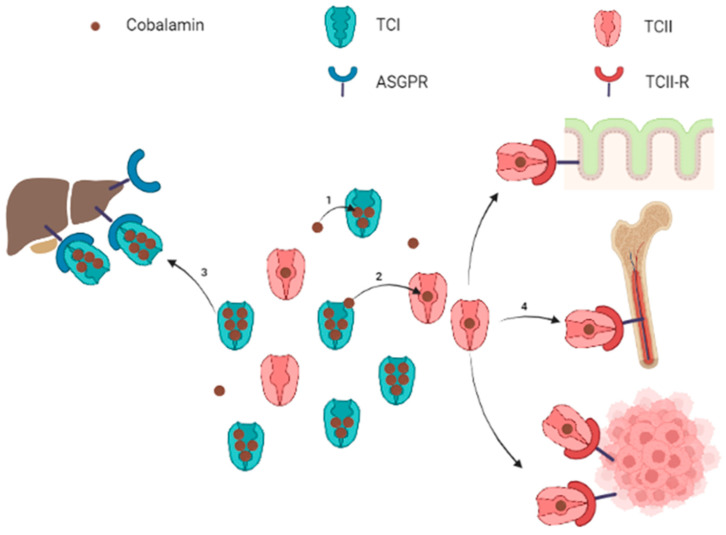
Figure 1
Figure 1
Schematic representation of circulating cobalamin bound to transcobalamins and uptake of transcobalamin-bound cobalamin by target organs. Note: Free cobalamin represents a small part of the total circulating cobalamin. Cobalamin is mostly carried by TCI (1), which constitutes a circulating pool of quickly available cobalamin. Cobalamin carried by TCI can be either transferred to TCII (2) or internalized into liver cells for storage throughout the ASGPR (3). The TCII-bound cobalamin is picked up by cells expressing the TCII-R when cobalamin is required for metabolism (4). The TCII-R is particularly expressed by epithelial cells, bone marrow and in physiological or pathological highly proliferating cells. ASGPR: asialoglycoprotein receptor; TCI: transcobalamin I (haptocorrin); TCII: transcobalamin II; TCII-R: transcobalamin II receptor. Figure created with BioRender.com accessed on 25 April 2022.
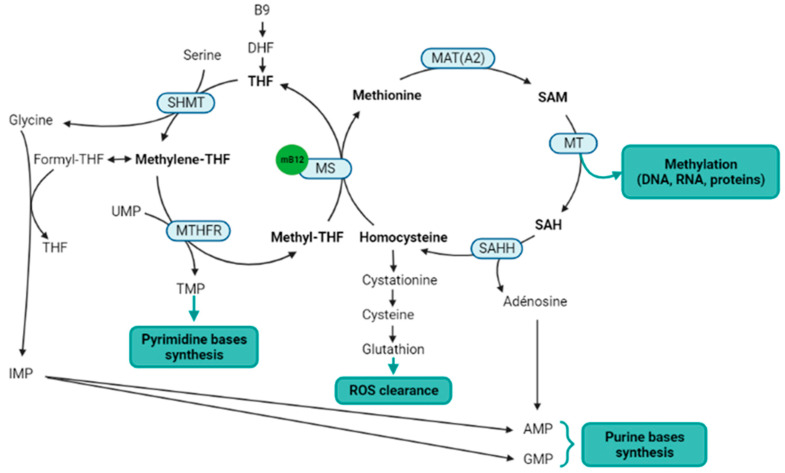
Figure 2
Figure 2
Metabolic pathways directly or indirectly related to the methylcobalamin. Notes: Methylcobalamin is a cofactor for methionine synthase, which is the central enzyme of the one-carbon metabolism (metabolites in bold) that includes the folate cycle (left) and the methionine cycle (right). Two methionine salvage pathways are not represented in this figure: a first salvage pathway allows methionine synthesis from homocysteine and betaine thanks to the cobalamin independent betaine-homocysteine methyltransferase, and a second salvage pathway allows the methionine synthesis from SAM via the polyamine pathway. B9: vitamin B9; AMP: adenosine monophosphate; DHF: dihydrofolate; GMP: guanosine monophosphate; IMP: inosine monophosphate; MAT(A2): methionine adenosyltransferase (notably MATA2); mB12: methylcobalamin; MS: methionine synthase; MT: methyltransferases; MTHFR: methylenetetrahydrofolate reductase; SAH: S-adenosylhomocysteine; SAHH: SAH hydrolase; SAM: S-adenosylmethionine; THF: tetrahydrofolate; TMP: thymidine monophosphate; UMP: uridine monophosphate. Figure created with BioRender.com accessed on 25 April 2022.
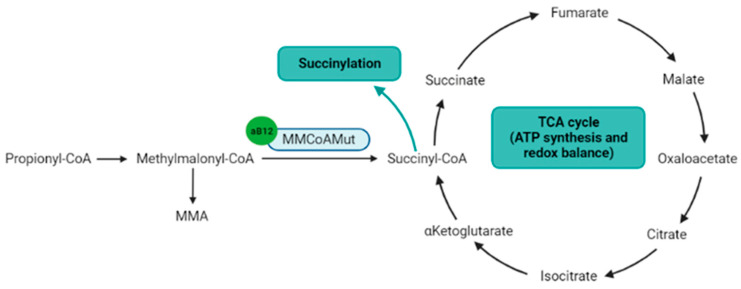
Figure 3
Figure 3
Metabolic pathways directly or indirectly related to the adenosylcobalamin. Notes: Adenosylcobalamin is a cofactor for MMCoAMut enzyme that synthesizes succinyl-CoA, which is a component of the TCA cycle and the substrate for lysine succinylation. aB12: adenosylcobalamin; MMA: methylmalonic acid; MMCoAMut: methylmalonyl-CoA mutase; TCA cycle: tricarboxylic acid cycle (Krebs cycle). Figure created with BioRender.com accessed on 25 April 2022.
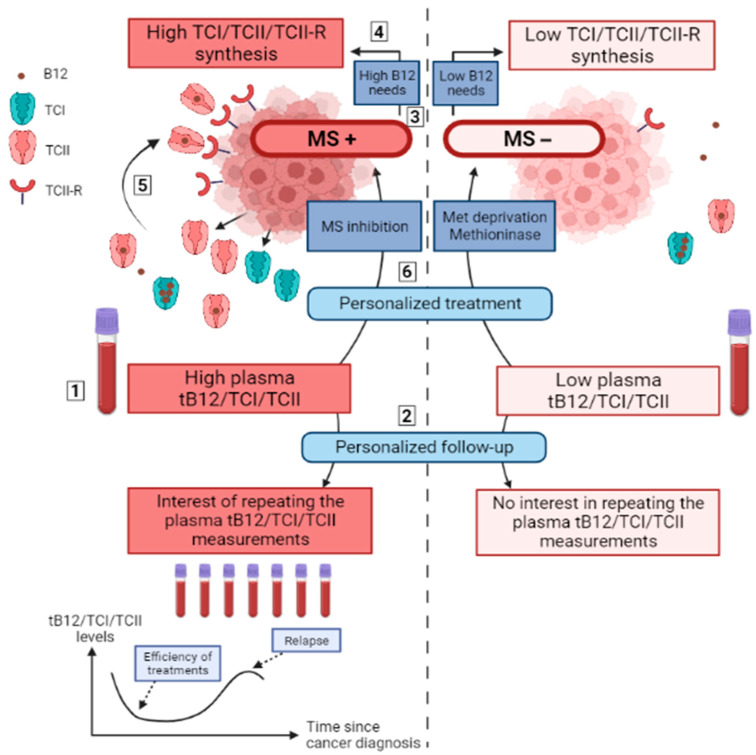
Figure 4
Figure 4
Remaining questions and hypotheses about the relationships between cobalamin-related metabolic pathways and plasma tB12/TCI/TCII measurements in solid cancers. Notes: Elevated plasma tB12, TCI and TCII levels are associated with the diagnosis of solid cancer, but their exact diagnostic performances remain to be assessed, as well as the explorations to perform when searching for cancer in cases of the fortuitous discovery of high tB12 (1). Plasma levels of tB12, TCI and TCII are associated with the course of cancers and could be useful to detect relapses early in the case of a previous elevation at diagnosis, whereas these measurements may be useless in cases of initial normal levels (2). It is demonstrated that cancer cells may be classified according to the activity of the methionine synthase and their dependency on exogenous methionine (3). A hypothesis proposes that the synthesis of TCI, TCII and TCII-R from cancer cells is associated to an elevated activity of MS or MMCoAMut with high B12 needs (4). The synthesis of TCI, TCII and TCII-R from cancer cells favors high B12 uptake (5) and leads to elevated plasma tB12, TCI and TCII levels (1). Plasma measurements of tB12, TCI and TCII could therefore indicate the B12 needs of cancer cells to support the activity of MS and MMCoAMut, which could help determine the most appropriate treatment: the inhibition of MS in the case of high MS activity; methionine deprivation in the case of low MS activity with high exogenous methionine needs (6). B12: vitamin B12 (cobalamin); MMCoAMut: methylmalonyl-CoenzymeA mutase; MS: methionine synthase; MS+: high activity of methionine synthase (independent from exogenous methionine); MS−: low activity of methionine synthase (dependent from exogenous methionine). tB12: total plasma vitamin B12; TCI: transcobalamin I (haptocorrin); TCII: transcobalamin II; TCII-R: transcobalamin II receptor. Figure created with BioRender.com accessed on 25 April 2022.

References

    1. Boroughs L.K., DeBerardinis R.J. Metabolic Pathways Promoting Cancer Cell Survival and Growth. Nat. Cell Biol. 2015;17:351–359. doi: 10.1038/ncb3124. - DOI - PMC - PubMed
    1. Heiden M.G.V., DeBerardinis R.J. Understanding the Intersections between Metabolism and Cancer Biology. Cell. 2017;168:657–669. doi: 10.1016/j.cell.2016.12.039. - DOI - PMC - PubMed
    1. Green R., Allen L.H., Bjørke-Monsen A.-L., Brito A., Guéant J.-L., Miller J.W., Molloy A.M., Nexo E., Stabler S., Toh B.-H., et al. Vitamin B12 Deficiency. Nat. Rev. Dis. Primers. 2017;3:17040. doi: 10.1038/nrdp.2017.40. - DOI - PubMed
    1. Collins D.A., Hogenkamp H.P.C., O’Connor M.K., Naylor S., Benson L.M., Hardyman T.J., Thorson L.M. Biodistribution of Radiolabeled Adenosylcobalamin in Patients Diagnosed With Various Malignancies. Mayo Clin. Proc. 2000;75:568–580. doi: 10.4065/75.6.568. - DOI - PubMed
    1. McLean G.R., Quadros E.V., Rothenberg S.P., Morgan A.C., Schrader J.W., Ziltener H.J. Antibodies to Transcobalamin II Block In Vitro Proliferation of Leukemic Cells. Blood. 1997;89:235–242. doi: 10.1182/blood.V89.1.235. - DOI - PubMed