. 2022 Apr 29;10(5):696.
doi: 10.3390/vaccines10050696.

The Effect of Waning on Antibody Levels and Memory B Cell Recall following SARS-CoV-2 Infection or Vaccination

Affiliations

The Effect of Waning on Antibody Levels and Memory B Cell Recall following SARS-CoV-2 Infection or Vaccination

David Forgacs et al. Vaccines (Basel). .

Abstract

In order to longitudinally track SARS-CoV-2 antibody levels after vaccination or infection, we assessed anti-RBD antibody levels in over 1000 people and found no significant decrease in antibody levels during the first 14 months after infection in unvaccinated participants, however, a significant waning of antibody levels was observed following vaccination. Participants who were pre-immune to SARS-CoV-2 prior to vaccination seroconverted to higher antibody levels, which were maintained at higher levels than in previously infected, unvaccinated participants. Older participants exhibited lower level of antibodies after vaccination, but a higher level after infection than younger people. The rate of antibody waning was not affected by pre-immunity or age. Participants who received a third dose of an mRNA vaccine not only increased their antibody levels ~14-fold, but also had ~3 times more antibodies compared to when they received their primary vaccine series. PBMC-derived memory B cells from 13 participants who lost all circulating antibodies were differentiated into antibody secreting cells (ASCs). There was a significant recall of memory B cell ASCs in the absence of serum antibodies in 5-8 of the 10 vaccinated participants, but not in any of the 3 infected participants, suggesting a strong connection between antibody levels and the effectiveness of memory B cell recall.

Keywords: COVID-19; SARS-CoV-2; antibody decay; antibody secreting cells; infection; memory B cell recall; pre-immunity; vaccination; waning.


Conflict of interest statement

The authors declare no conflict of interest.

Figures
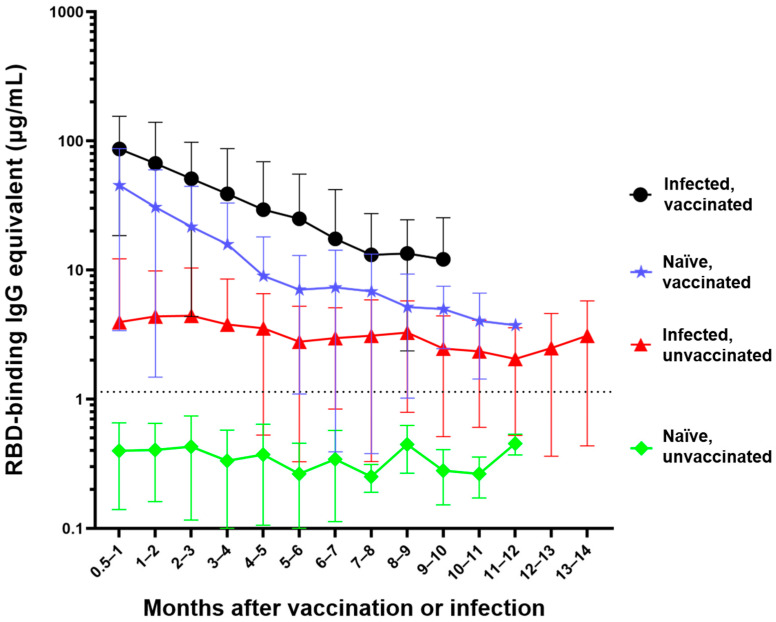
Figure 1
Figure 1
Differential waning of RBD-binding IgG antibody levels based on vaccination and infection status. Naïve unvaccinated (n = 418) and infected unvaccinated (n = 290) show no change in antibody levels over time (p > 0.05); naïve, vaccinated participants (n = 515) and infected, vaccinated participants (n = 298) both show significant waning over the time (**** p < 0.0001). The antibody level of the naïve unvaccinated group was always lower than the other groups (**** p < 0.0001); the infected vaccinated group was always higher than any other group (** p < 0.0042); naïve, vaccinated group is higher than infected, unvaccinated group for the first 4 months after vaccination (** p < 0.0016). The rate of decay was only significantly different between the vaccinated and infected groups (**** p < 0.0001) but not between the two vaccinated (p = 0.7914) and the two unvaccinated groups (p = 0.9569). Number of months start with the time of reception of the primary vaccine series for the vaccinated groups, time of infection for the infected unvaccinated group, and the first available timepoint for the naïve unvaccinated group.
Figure 2
Figure 2
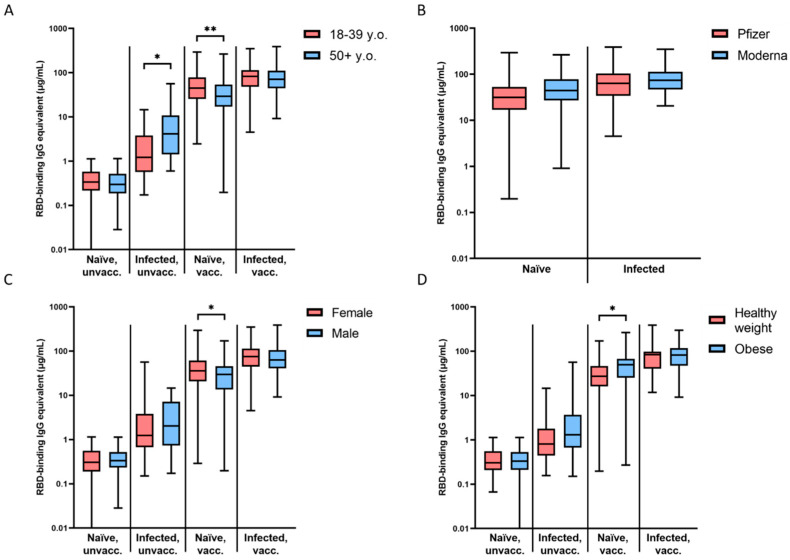
Magnitude of initial seroconversion based on demographic information. (A) Differences between young (18–39 y.o.) and older (50+ y.o.) participants were significant in infected, unvaccinated (* p = 0.0334) and naïve, vaccinated (** p = 0.0038) groups. (B) Differences between Pfizer and Moderna vaccinees were not significant. (C) Differences between females and males were significant in the naïve, vaccinated (* p = 0.0438) group. (D) Differences between participants with a healthy weight (BMI = 18.5–24.9) and those who were obese (BMI ≥ 30) were significant in the naïve, vaccinated group (* p = 0.0119). Initial seroconversion is designated by timepoints 0.5–1 month after COVID-19 infection or the reception of the primary vaccine series (2 × mRNA or 1 × viral vector).
Figure 3
Figure 3
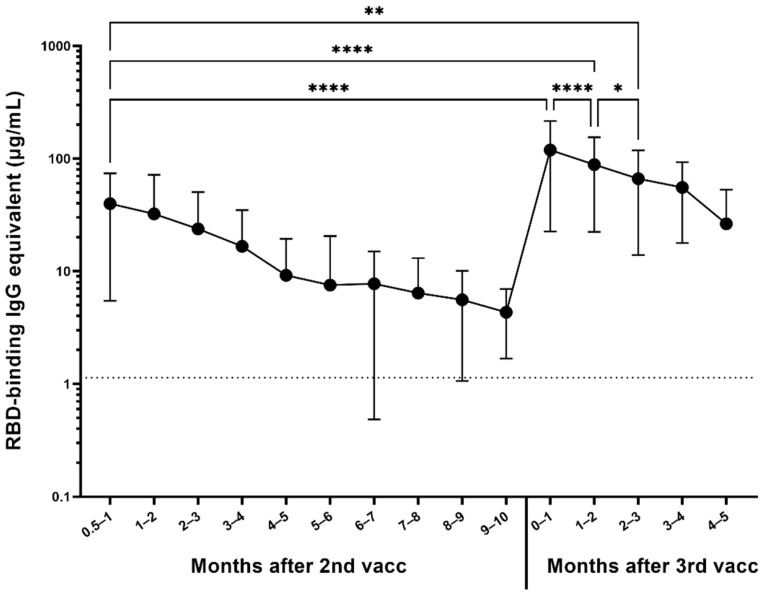
Response to 3rd dose of mRNA vaccines (n = 306). Participants are represented regardless of pre-immunity. Significant increase in anti-RBD IgG antibody level was observed between the last available pre-booster timepoint and the timepoint within the first month after the booster (**** p < 0.0001). The difference between the timepoint 2–4 weeks after the second dose and the timepoint within the first month after the booster was also significant (**** p < 0.0001). Month-to-month antibody decay is significant for the first 3 months after the booster (**** p < 0.0001 for the for the first two months, * p < 0.05 between the second and the third month), at which point the antibody level was still significantly higher than 2–4 weeks after the second dose (** p = 0.0012).
Figure 4
Figure 4
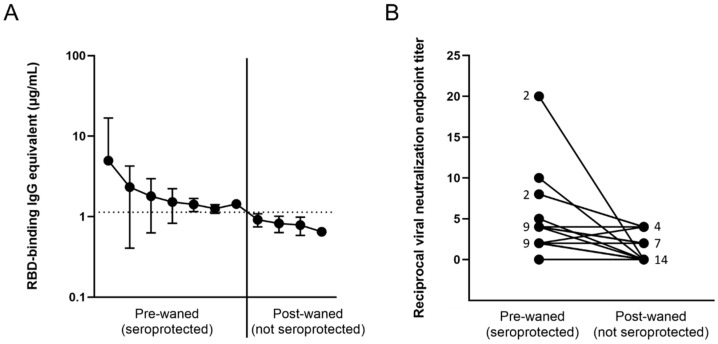
Loss of antibody-protected status based on (A) antibody binding, and (B) viral neutralization in waned participants. (A) All 25 participants demonstrated a loss of anti-RBD binding antibodies; (B) only 13 showed a loss of neutralization potential, signified by an initial non-0 neutralization endpoint titer and an endpoint titer of 0 at the post-waned timepoint. The numbers next to the dots represent the number of overlapping participants with the same neutralizing endpoint titer.
Figure 5
Figure 5
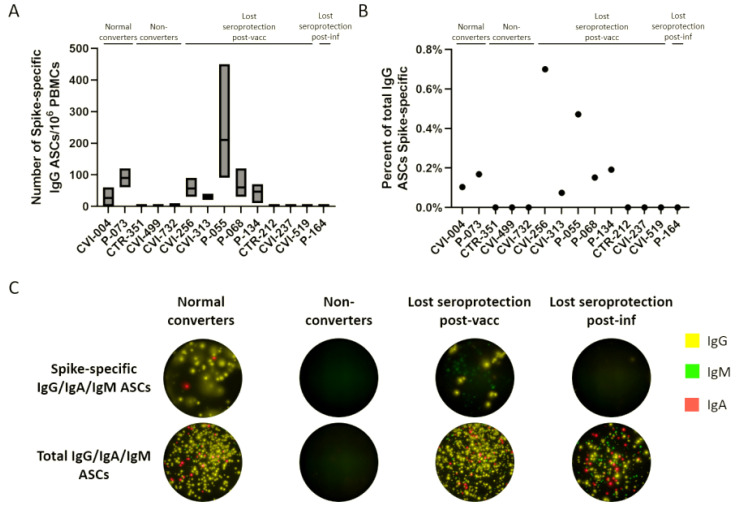
ASC enumeration in nonresponders and participants who lost seroprotection post-vaccination or infection. (A) Number of spike-specific IgG ASCs out of 106 in vitro differentiated PBMCs. (B) Percent of total IgG ASCs that are spike-specific. (C) Representative wells for normal converters, nonconverters, and participants who lost seroprotection post-vaccination or infection, for spike-specific and total ASCs.

Update of

References

    1. Wu F., Zhao S., Yu B., Chen Y.-M., Wang W., Song Z.-G., Hu Y., Tao Z.-W., Tian J.-H., Pei Y.-Y., et al. A new coronavirus associated with human respiratory disease in China. Nature. 2020;579:265–269. doi: 10.1038/s41586-020-2008-3. - DOI - PMC - PubMed
    1. Tao K., Tzou P.L., Nouhin J., Gupta R.K., de Oliveira T., Kosakovsky Pond S.L., Fera D., Shafer R.W. The biological and clinical significance of emerging SARS-CoV-2 variants. Nat. Rev. Genet. 2021;22:757–773. doi: 10.1038/s41576-021-00408-x. - DOI - PMC - PubMed
    1. Lan J., Ge J., Yu J., Shan S., Zhou H., Fan S., Zhang Q., Shi X., Wang Q., Zhang L., et al. Structure of the SARS-CoV-2 spike receptor-binding domain bound to the ACE2 receptor. Nature. 2020;581:215–220. doi: 10.1038/s41586-020-2180-5. - DOI - PubMed
    1. Salvatori G., Luberto L., Maffei M., Aurisicchio L., Roscilli G., Palombo F., Marra E. SARS-CoV-2 spike protein: An optimal immunological target for vaccines. J. Transl. Med. 2020;18:222. doi: 10.1186/s12967-020-02392-y. - DOI - PMC - PubMed
    1. Baden L.R., El Sahly H.M., Essink B., Kotloff K., Frey S., Novak R., Diemert D., Spector S.A., Rouphael N., Creech C.B., et al. Efficacy and safety of the mRNA-1273 SARS-CoV-2 vaccine. N. Engl. J. Med. 2021;384:403–416. doi: 10.1056/NEJMoa2035389. - DOI - PMC - PubMed

LinkOut - more resources