. 2022 Apr 27;14(5):907.
doi: 10.3390/v14050907.

Epipharyngeal Abrasive Therapy (EAT) Has Potential as a Novel Method for Long COVID Treatment

Affiliations

Epipharyngeal Abrasive Therapy (EAT) Has Potential as a Novel Method for Long COVID Treatment

Kazuaki Imai et al. Viruses. .

Abstract

COVID-19 often causes sequelae after initial recovery, referred to collectively as long COVID. Long COVID is considered to be caused by the persistence of chronic inflammation after acute COVID-19 infection. We found that all long COVID patients had residual inflammation in the epipharynx, an important site of coronavirus replication, and some long COVID symptoms are similar to those associated with chronic epipharyngitis. Epipharyngeal abrasive therapy (EAT) is a treatment for chronic epipharyngitis in Japan that involves applying zinc chloride as an anti-inflammatory agent to the epipharyngeal mucosa. In this study, we evaluated the efficacy of EAT for the treatment of long COVID. The subjects in this study were 58 patients with long COVID who were treated with EAT in the outpatient department once a week for one month (mean age = 38.4 ± 12.9 years). The intensities of fatigue, headache, and attention disorder, which are reported as frequent symptoms of long COVID, were assessed before and after EAT using the visual analog scale (VAS). EAT reduced inflammation in the epipharynx and significantly improved the intensity of fatigue, headache, and attention disorder, which may be related to myalgic encephalomyelitis/chronic fatigue syndrome (ME/CFS). These results suggest that EAT has potential as a novel method for long COVID treatment.

Keywords: chronic epipharyngitis; epipharyngeal abrasive therapy (EAT); long COVID; myalgic encephalomyelitis/chronic fatigue syndrome (ME/CFS).


Conflict of interest statement

The authors declare no conflict of interest.

Figures
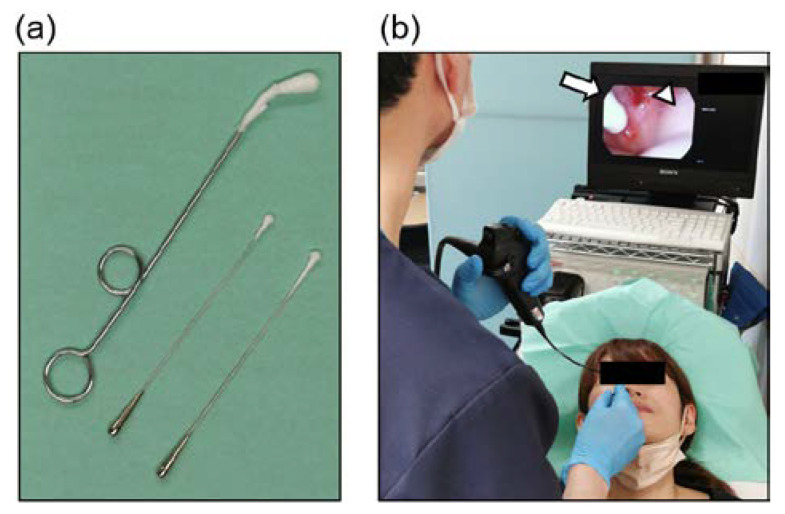
Figure 1
Figure 1
Epipharyngeal abrasive therapy (EAT). (a) Cotton swabs for EAT. (b) The method of endoscopic EAT. The entire epipharyngeal wall is scrubbed using a sterile straight nasal cotton swab soaked in 0.5% ZnCl2 solution. The white arrow indicates a sterile straight nasal cotton swab. The white triangle indicates impure bleeding.
Figure 2
Figure 2
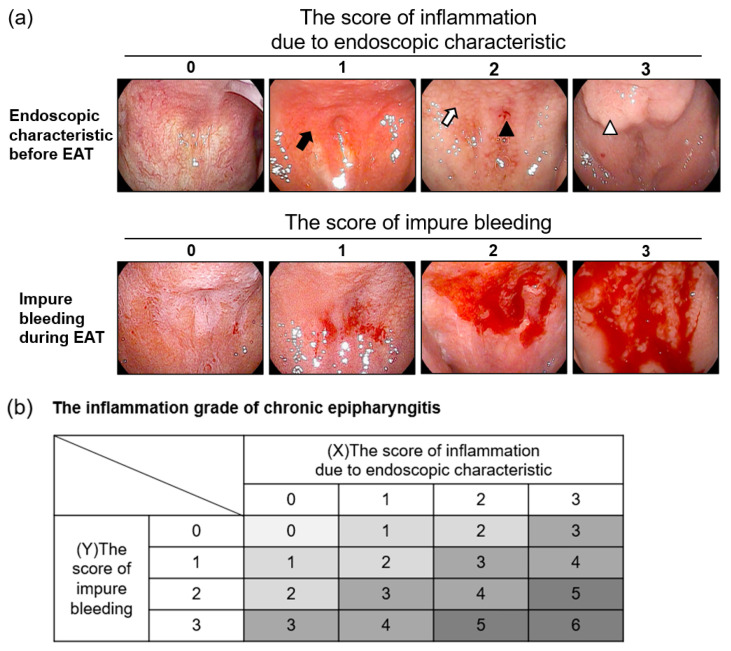
The inflammation grade of chronic epipharyngitis. (a) The endoscopic findings of chronic epipharyngitis. The upper panels show the endoscopic characteristics before epipharyngeal abrasive therapy (EAT). The score of inflammation was assessed using endoscopic characteristics. The black arrow indicates redness of the mucosa. The white arrow indicates cobblestone-like granular changes. The black triangle indicates submucosal bleeding. The white triangle indicates severe mucosal swelling. The lower panels show impure bleeding during EAT, which correlates with the intensity of inflammation. The score of impure bleeding was evaluated by the degree of bleeding. (b) The inflammation grade of chronic epipharyngitis was calculated using (X) the score of inflammation due to endoscopic characteristics and (Y) the score of impure bleeding. The inflammation grade of chronic epipharyngitis was scored on a scale of 0–6 (0: absent, 1–2: mild inflammation, 3–4: moderate inflammation, 5–6: severe inflammation).
Figure 3
Figure 3
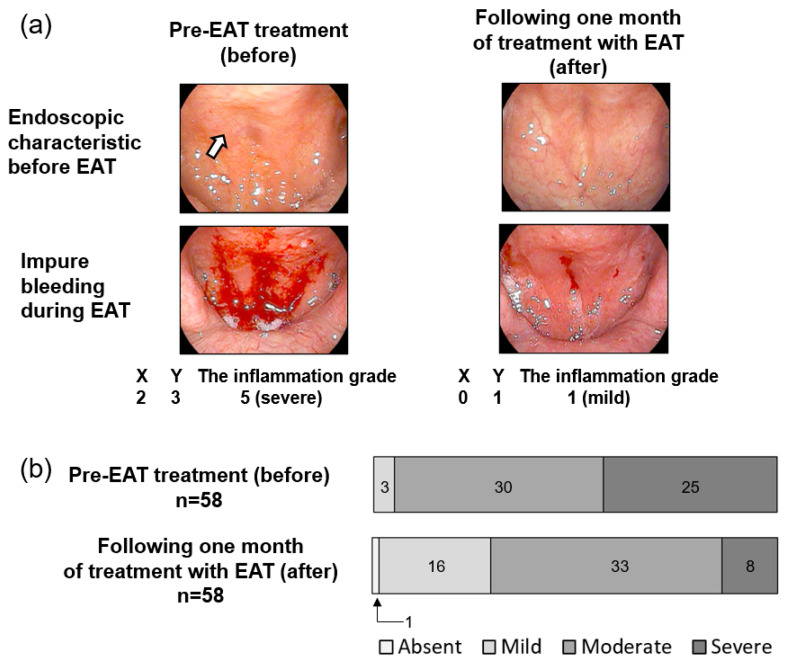
Effect of epipharyngeal abrasive therapy (EAT) for the treatment of chronic epipharyngitis. (a) Trans-nasal endoscopic photographs of the epipharynx in a patient. Left panel shows the epipharynx pre-EAT treatment (before). Right panel shows the epipharynx following one month of treatment with EAT (after). The white arrow indicates cobblestone-like granular changes. The inflammation grade = (X) the score of inflammation due to endoscopic characteristic + (Y) the score of impure bleeding. (b) Changes in inflammation grade due to EAT. All patients were treated with EAT once a week. The upper panel shows the inflammation grade at the first visit. The lower panel shows the inflammation grade following one month of treatment with EAT. The inflammation grade of chronic epipharyngitis was scored on a scale of 0–6 (0: absent, 1–2: mild inflammation, 3–4: moderate inflammation, 5–6: severe inflammation).
Figure 4
Figure 4
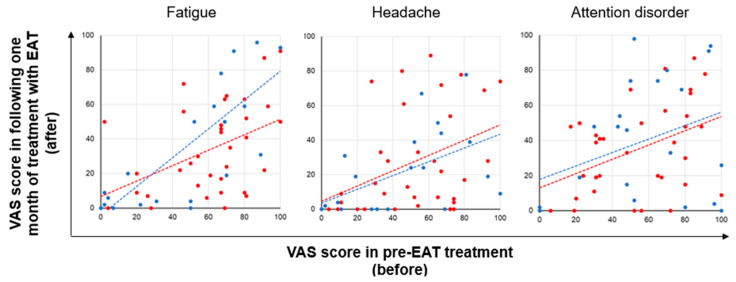
Visual analog scale (VAS) scores pre-epipharyngeal abrasive therapy (EAT) treatment (before) and following one month of treatment with EAT (after). Red circles indicate 35 patients with an inflammatory grade improvement of 1 or more. Blue circles indicate 23 patients without an inflammatory grade improvement. Dashed lines are added to guide the eye.
Figure 5
Figure 5
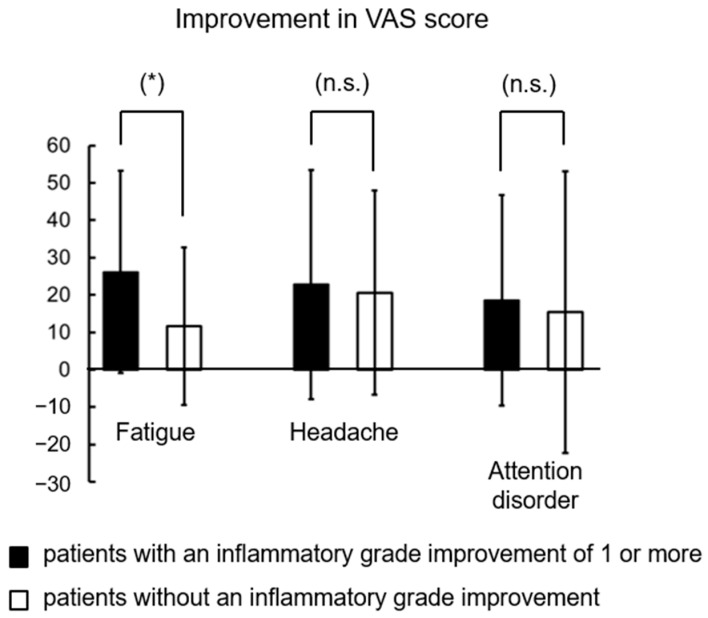
Improvements in VAS scores in 35 patients with an inflammatory grade improvement of 1 or more and 23 patients without an inflammatory grade improvement. Parametric unpaired t-test. * Significantly different at p < 0.05. n.s.: not significantly different.

References

    1. Gorna R., MacDermott N., Rayner C., O’Hara M., Evans S., Agyen L., Nutland W., Rogers N., Hastie C. Long COVID guidelines need to reflect lived experience. Lancet. 2021;397:455–457. doi: 10.1016/S0140-6736(20)32705-7. - DOI - PMC - PubMed
    1. Nalbandian A., Sehgal K., Gupta A., Madhavan M.V., McGroder C., Stevens J.S., Cook J.R., Nordvig A.S., Shalev D., Sehrawat T.S., et al. Post-acute COVID-19 syndrome. Nat. Med. 2021;27:601–615. doi: 10.1038/s41591-021-01283-z. - DOI - PMC - PubMed
    1. Lopez-Leon S., Wegman-Ostrosky T., Perelman C., Sepulveda R., Rebolledo P.A., Cuapio A., Villapol S. More than 50 long-term effects of COVID-19: A systematic review and meta-analysis. Sci. Rep. 2021;11:16144. doi: 10.1038/s41598-021-95565-8. - DOI - PMC - PubMed
    1. Bansal R., Gubbi S., Koch C.A. COVID-19 and chronic fatigue syndrome: An endocrine perspective. J. Clin. Transl. Endocrinol. 2022;27:100284. doi: 10.1016/j.jcte.2021.100284. - DOI - PMC - PubMed
    1. Hennigs J.K., Oqueka T., Harbaum L., Klose H. Organ-specific sequelae of COVID-19 in adults. Bundesgesundheitsblatt Gesundheitsforschung Gesundheitsschutz. 2022;65:462–470. doi: 10.1007/s00103-022-03513-2. - DOI - PMC - PubMed

Publication types