


Hepatitis B Virus Infection among Japanese Immigrants and Descendants: The Need to Strengthen Preventive and Control Measures
- PMID: 35632826
- PMCID: PMC9145874
- DOI: 10.3390/v14051085
Hepatitis B Virus Infection among Japanese Immigrants and Descendants: The Need to Strengthen Preventive and Control Measures
Abstract
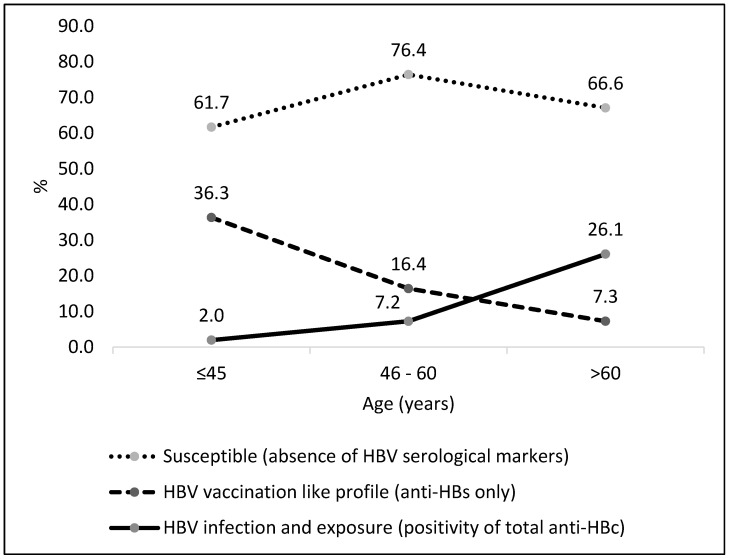
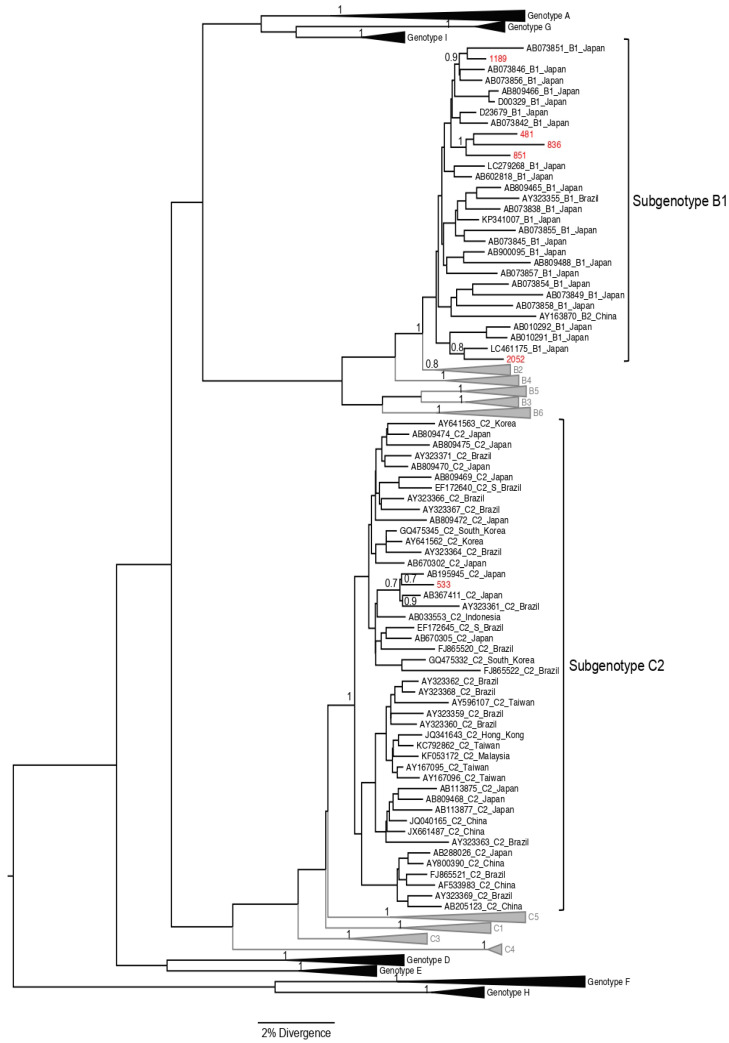
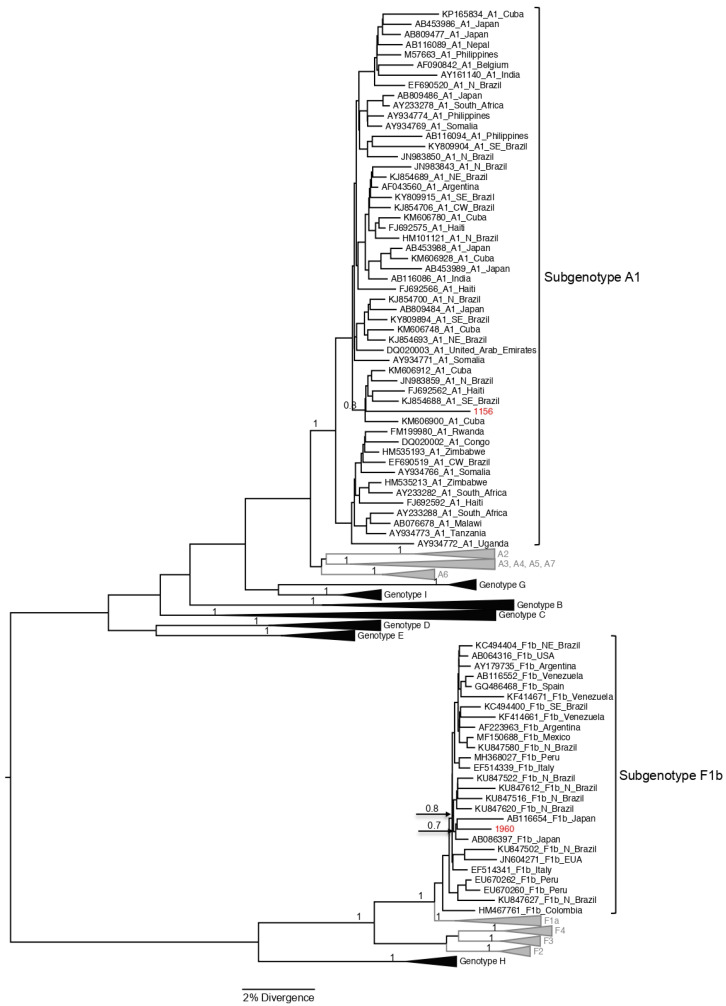
This cross-sectional study aimed to investigate the prevalence and risk factors of Hepatitis B virus infection among Japanese immigrants and their descendants from São Paulo (SP), and to verify the occurrence of occult hepatitis B and coinfection with HCV, Delta, and HTLV. All samples (n = 2.127) were tested for HBV serological markers by electrochemiluminescence. HBsAg and/or total anti-HBc positive samples were tested for HBV DNA by real-time PCR, and genotyped by sequencing using the Sanger methodology. The prevalence rate of HBV exposure was 13.4% (CI 95%: 11.9-14.9%), and 22 (1.1%) were HBsAg positive. A high rate of susceptibility to HBV infection was found (67.4%; CI 95%: 65.4-69.4%). In contrast, only 19.2% (CI 95%: 17.6-20.9%) presented a serological profile analogous to that elicited by Hepatitis B vaccination. HBV isolates (n = 8) were classified as genotypes HBV/B1 (62.5%), HBV/C2 (12.5%), HBV/F1b (12.5%), and HBV/A1 (12.5%). Hepatitis B vaccination strategies and educational measures to control this infection should be considered.
Keywords: Hepatitis B; epidemiology; genotype; seroprevalence.
Conflict of interest statement
The authors declare no conflict of interest.
Figures
References
-
- World Health Organization (WHO) Hepatitis B. Key Facts. [(accessed on 22 August 2021)]. Available online: https://www.who.int/en/news-room/fact-sheets/detail/hepatitis-b.
-
- Sato T., Do S.H., Asao T., Akita T., Katayama K., Tatara K., Miyakawa Y., Tanaka J. Estimating numbers of persons with persistent hepatitis B virus infection transmitted vertically and horizontally in the birth cohort during 1950–1985 in Japan. Hepatol. Res. 2014;44:E181–E188. doi: 10.1111/hepr.12288. - DOI - PubMed
Publication types
MeSH terms
Substances
LinkOut - more resources
Full Text Sources
Medical
Miscellaneous
