Review
. 2022 May 19;14(5):1094.
doi: 10.3390/v14051094.

Human Retrovirus Genomic RNA Packaging

Affiliations
Review

Human Retrovirus Genomic RNA Packaging

Heather M Hanson et al. Viruses. .

Abstract

Two non-covalently linked copies of the retrovirus genome are specifically recruited to the site of virus particle assembly and packaged into released particles. Retroviral RNA packaging requires RNA export of the unspliced genomic RNA from the nucleus, translocation of the genome to virus assembly sites, and specific interaction with Gag, the main viral structural protein. While some aspects of the RNA packaging process are understood, many others remain poorly understood. In this review, we provide an update on recent advancements in understanding the mechanism of RNA packaging for retroviruses that cause disease in humans, i.e., HIV-1, HIV-2, and HTLV-1, as well as advances in the understanding of the details of genomic RNA nuclear export, genome translocation to virus assembly sites, and genomic RNA dimerization.

Keywords: RNA dimerization; RNA encapsidation; RNA translocation; deltaretrovirus; human retrovirus; lentivirus; nuclear export.


Conflict of interest statement

The authors declare no conflict of interest.

Figures
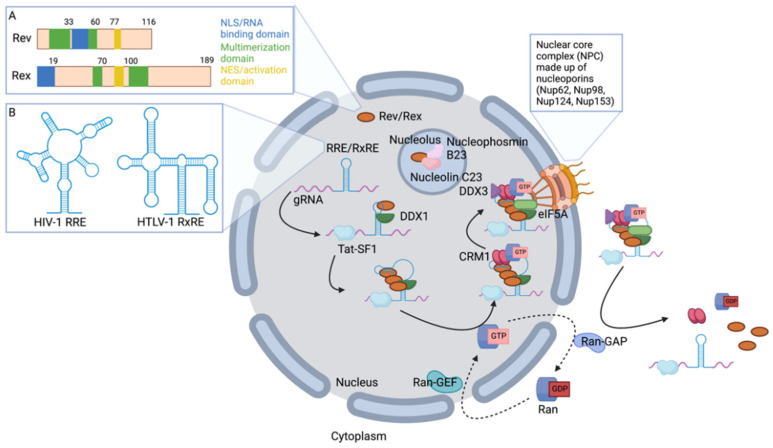
Figure 1
Figure 1
Nuclear export of human retroviral gRNA. (A). The mapped domains in the HIV-1 Rev and HTLV-1 Rex proteins. Nuclear localization signal (NLS) Nuclear export signal (NES) (B). The secondary structure of the HIV-1 RRE and HTLV-1 RxRE. Rev responsive element (RRE) Rex responsive element (RxRE) See text for further details. Note that the RRE and RxRE structures are not drawn to scale. DEAD box helicase 1 (DDX1), DEAD box helicase 3 (DDX3), HIV Tat-specific factor 1 (Tat-SF1), Chromosomal Maintenance 1, also known as Exportin 1 (CRM1), Ras-related Nuclear protein (Ran), Ran Guanine nucleotide exchange factor (Ran-GEF), Ran GTPase activating protein (Ran-GAP), Eukaryotic translation initiation factor 5A (eIF5A). Created with BioRender.com software (accessed on 4 May 2022).
Figure 2
Figure 2
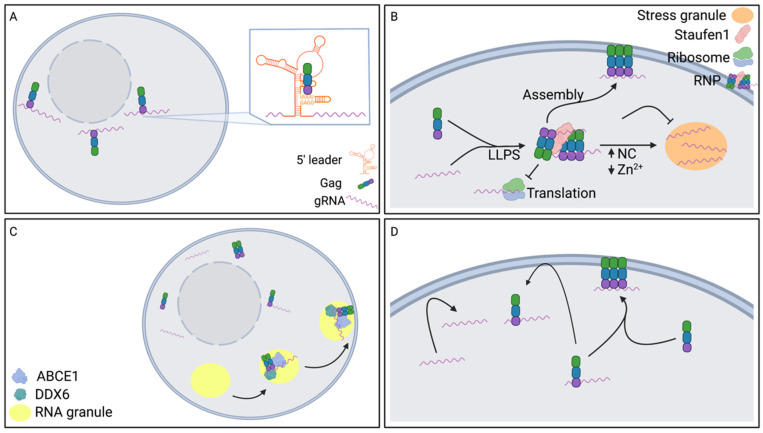
HIV-1 gRNA interaction with Gag and translocation to assembly sites. (A). Genome recognition occurs in the perinuclear region of the cell. (B). Phase separation of gRNA regulates translocation to virus particle assembly sites. Liquid-liquid phase separation (LLPS), Ribonucleoprotein complex (RNP), Gag nucleocapsid domain (NC). (C). Localization of gRNA to assembly intermediates promotes virus particle assembly. DEAD box Helicase 6 (DDX6), ATP Binding Cassette Subfamily E Member 1 (ABCE1) (D). Retention of gRNA at the plasma membrane is dependent upon interaction with Gag. Created with BioRender.com (accessed 4 May 2022).
Figure 3
Figure 3
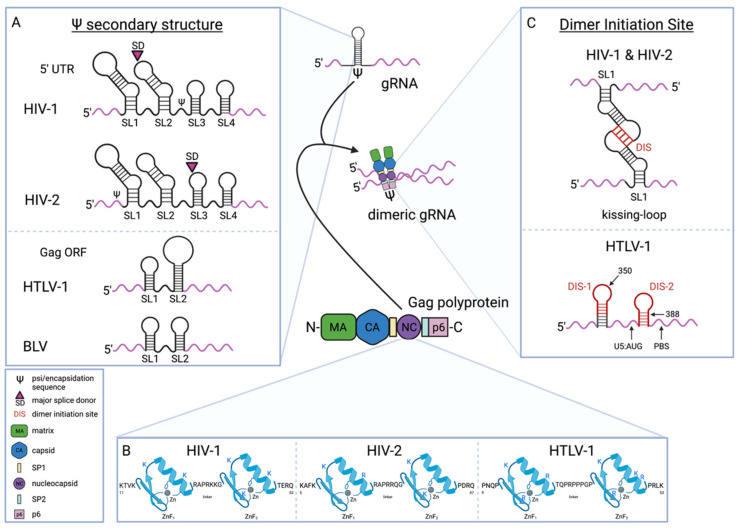
Schematic representation of the human retroviral gRNA packaging process. Gag stabilization of retroviral genome dimers which occurs between two Gag-gRNA duplexes. (A) HIV-1 and HIV-2 RNA secondary structure models of the 5-untranslated region (5′ UTR) containing the psi (Ψ) sequence with indication of the major splice donor site (SD) either upstream to the Ψ sequences necessary for packaging, as in HIV-1 or downstream to the Ψ packaging sequences as in the case of HIV-2; HTLV-1 and BLV RNA secondary structure models of the gRNA packaging sequence are located in the Gag open reading frame (ORF). The RNA structural elements are marked as indicated: SL1, stem-loop 1; SL2, stem-loop 2; SL3, stem-loop 3; SL4, stem-loop 4; gRNA, viral genomic RNA. Stem-loops are not drawn to scale. (B) Model of the structural motifs in the retroviral Gag polyprotein nucleocapsid (NC) domain mediating the specific Gag-gRNA interaction. Shown are the two zinc-finger (ZnF1 and ZnF2) motifs in HIV-1, HIV-2, and HTLV-1 NC (amino acid residues 11–53, 5–47, and 9–53 respectively). During HIV-1 gRNA packaging, both ZnFs are necessary as the predominant interacting partners with the gRNA, yet the N-terminal ZnF has a greater impact on gRNA packaging. Highlighted in blue are the specific, positively charged, basic amino acid residues within the two ZnF motifs that have been identified to be involved in binding the gRNA. (C) Representative kissing-loop structure induced by NC of HIV-1 and HIV-2 at the gRNA dimer initiation site (DIS), a palindromic sequence located in SL1 of the Ψ sequence secondary structure in the 5′ UTR; representative structure of the two DIS sites identified for HTLV-1 containing palindrome-like sequences located within loop structures in the 5’ leader sequence upstream of the primer binding site (PBS). Created with BioRender.com software (accessed 4 May 2022).

References

    1. Burdick R.C., Li C., Munshi M., Rawson J.M.O., Nagashima K., Hu W.S., Pathak V.K. HIV-1 uncoats in the nucleus near sites of integration. Proc. Natl. Acad. Sci. USA. 2020;117:5486–5493. doi: 10.1073/pnas.1920631117. - DOI - PMC - PubMed
    1. Li C., Burdick R.C., Nagashima K., Hu W.S., Pathak V.K. HIV-1 cores retain their integrity until minutes before uncoating in the nucleus. Proc. Natl. Acad. Sci. USA. 2021;118:e2019467118. doi: 10.1073/pnas.2019467118. - DOI - PMC - PubMed
    1. Pfeifer K., Weiler B.E., Ugarkovic D., Bachman M., Schroder H.C., Muller W.E.G. Evidence for specific nucleocytoplasmic transport pathways used by leucine-rich nuclear export signals. Eur. J. Biochem. 1991;199:53–64. doi: 10.1111/j.1432-1033.1991.tb16091.x. - DOI - PubMed
    1. Bogerd H., Greene W.C. Dominant Negative Mutants of Human T-Cell Leukemia Virus Type I Rex and Human Immunodeficiency Virus Type 1 Rev Fail To Multimerize In Vivo. J. Virol. 1993;67:2496–2502. doi: 10.1128/jvi.67.5.2496-2502.1993. - DOI - PMC - PubMed
    1. Madore S.J., Tiley L.S., Malim M.H., Cullen B.R. Sequence Requirements for Rev Multimerization in Vivo. Virology. 1994;202:186–194. doi: 10.1006/viro.1994.1334. - DOI - PubMed

Publication types

LinkOut - more resources