Review
. 2022 May 28;189(6):236.
doi: 10.1007/s00604-022-05317-2.

Advanced wearable biosensors for the detection of body fluids and exhaled breath by graphene

Affiliations
Review

Advanced wearable biosensors for the detection of body fluids and exhaled breath by graphene

Santoshi U Singh et al. Mikrochim Acta. .

Abstract

Given the huge economic burden caused by chronic and acute diseases on human beings, it is an urgent requirement of a cost-effective diagnosis and monitoring process to treat and cure the disease in their preliminary stage to avoid severe complications. Wearable biosensors have been developed by using numerous materials for non-invasive, wireless, and consistent human health monitoring. Graphene, a 2D nanomaterial, has received considerable attention for the development of wearable biosensors due to its outstanding physical, chemical, and structural properties. Moreover, the extremely flexible, foldable, and biocompatible nature of graphene provide a wide scope for developing wearable biosensor devices. Therefore, graphene and its derivatives could be trending materials to fabricate wearable biosensor devices for remote human health management in the near future. Various biofluids and exhaled breath contain many relevant biomarkers which can be exploited by wearable biosensors non-invasively to identify diseases. In this article, we have discussed various methodologies and strategies for synthesizing and pattering graphene. Furthermore, general sensing mechanism of biosensors, and graphene-based biosensing devices for tear, sweat, interstitial fluid (ISF), saliva, and exhaled breath have also been explored and discussed thoroughly. Finally, current challenges and future prospective of graphene-based wearable biosensors have been evaluated with conclusion. Graphene is a promising 2D material for the development of wearable sensors. Various biofluids (sweat, tears, saliva and ISF) and exhaled breath contains many relevant biomarkers which facilitate in identify diseases. Biosensor is made up of biological recognition element such as enzyme, antibody, nucleic acid, hormone, organelle, or complete cell and physical (transducer, amplifier), provide fast response without causing organ harm.

Keywords: Biomarkers; Body fluids; Exhaled breath; Graphene; Non-invasive detection; Wearable biosensors.


Conflict of interest statement

The authors declare no competing interests.

Figures
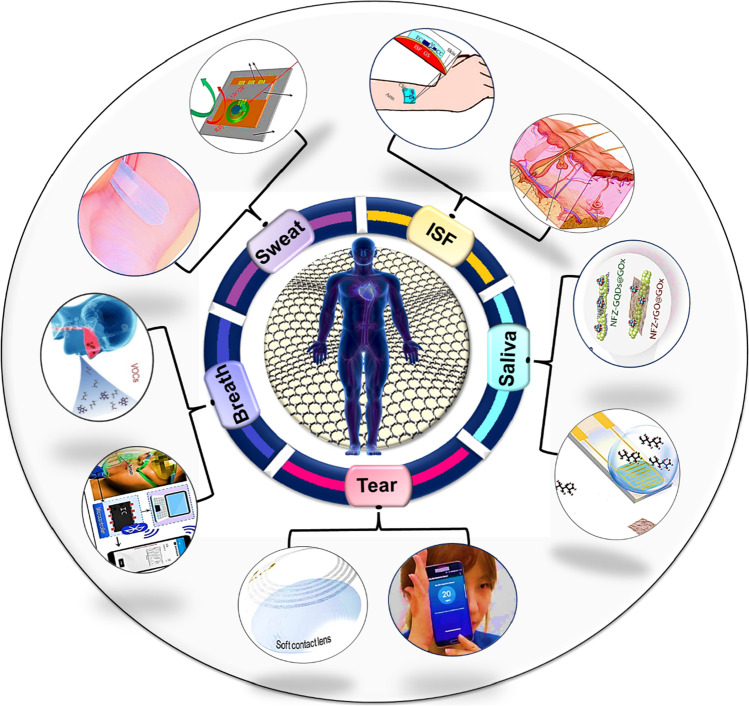
Fig. 1
Fig. 1
Schematic overview of graphene-based wearable biosensors for the detection of differnt biomarkers
Fig. 2
Fig. 2
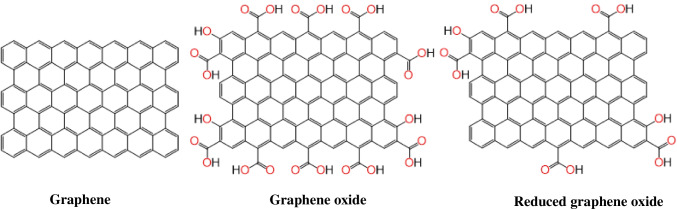
Molecular structure of graphene, graphene oxide, and reduced graphene oxide
Fig. 3
Fig. 3
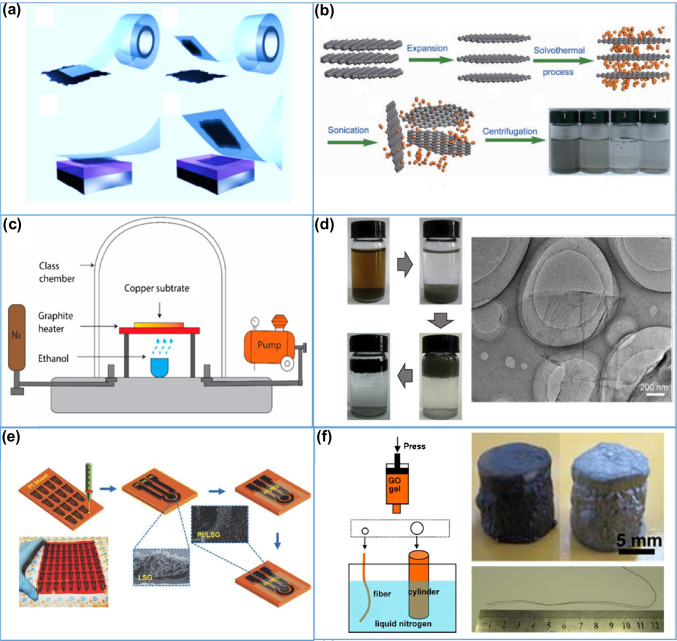
a Schematic representation of the graphene synthesis by micromechanical exfoliation method. Reprinted with permission from [57]. Copyright 2012 Institute of Physics Publishing. b Schematic process of liquid phase exfoliation (LPE) production of graphene. Reprinted with permission from [60]. Copyright 2009 Springer Nature. c Schematic of a common chemical vapor deposition setup for synthesis of graphene. Reprinted with permission from [61]. Copyright 2020 Multidisciplinary Digital Publishing Institute. d Photograph of the GO before and after reduction with L-ascorbic acid and HRTEM images of reduced GO. Reprinted with permission from [62]. Copyright 2010 Elsevier. e Schematic illustration of fabrication of a laser scribed graphene (LSG) electrodes on a polyimide (PI) sheet. Reprinted with permission from [55]. Copyright 2016Wiley-VCH. f Schematic diagram for synthesis of the 3D graphene aerogel fibers. Reprinted with permission from [63]. Copyright 2012 American Chemical Society
Fig. 4
Fig. 4
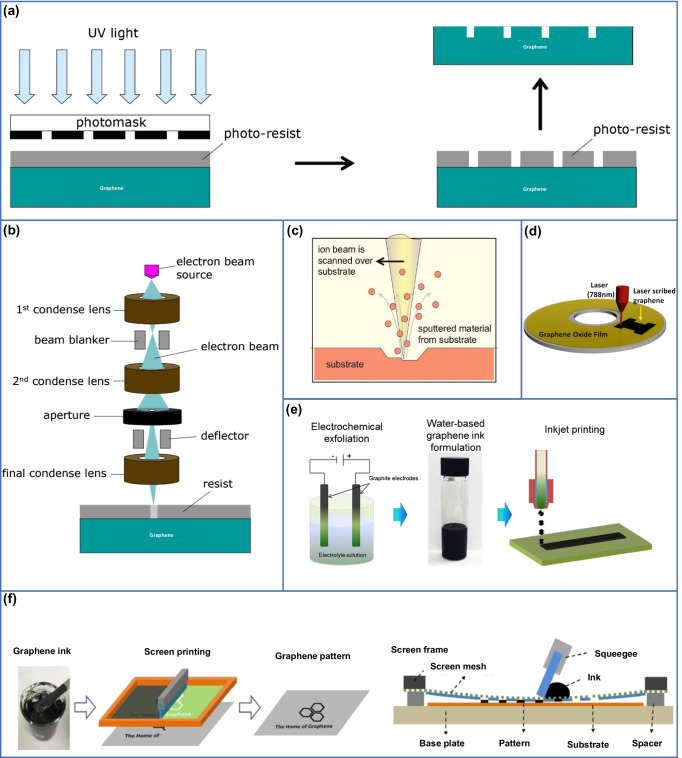
a Schematic diagram of photolithography process. Reprinted with permission from [122]. Copyright Faculty of Engineering, Chulalongkorn University. b Schematic diagram of e-beam lithography. Reprinted with permission from [122]. Copyright Faculty of Engineering, Chulalongkorn University. c Schematic diagram of focused ion beam lithography used for milling and deposition. Reprinted with permission from [127]. Copyright 2021 Institute of Physics Publishing. d Schematic diagram of DVD laser scribing for graphene patterning. Reprinted with permission from [128]. Copyright 2013 Springer Nature. e Schematic showing water-based inkjet printing of graphene patterning. Reprinted with permission from [129]. Copyright 2021 Elsevier. f Schematic diagram of screen printing of graphene. Reprinted with permission from [130]. Copyright 2019 American Chemical Society
Fig. 5
Fig. 5
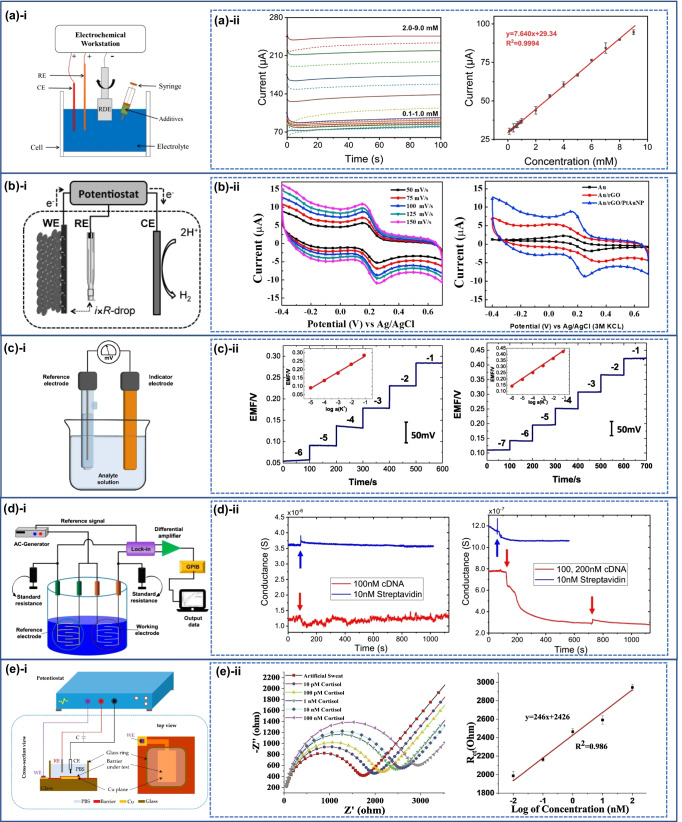
a Measurement setup of chronoamperometry and its corresponding sensing performance. a (i) Reprinted with permission from [144]. Copyright 2020 Springer Nature. a (ii) Reprinted with permission from [149]. Copyright 2021 American chemical society. b Measurement setup of cyclic voltammetry and its corresponding sensing performance. (i) Reprinted with permission from [150]. Copyright 2012 Wiley–VCH. (ii) Reprinted with permission from [151]. Copyright 2018 Elsevier. c Measurement setup of potentiometry and its corresponding sensing performance. (i) Reprinted with permission from [152]. Copyright 2019 Elsevier. (ii) Reprinted with permission from [153]. Copyright 2019 Elsevier. d Measurement setup of conductometry and its corresponding sensing performance. (i) Reprinted with permission from [154]. Copyright 2021 Multidisciplinary Digital Publishing Institute. (ii) Reprinted with permission from [155]. Copyright 2019 Springer Nature. e Measurement setup of EIS and its corresponding sensing performance. (i) Reprinted with permission from [156]. Copyright 2019 Multidisciplinary Digital Publishing Institute. (ii) Reprinted with permission from [157]. Copyright 2021 Elsevier
Fig. 6
Fig. 6
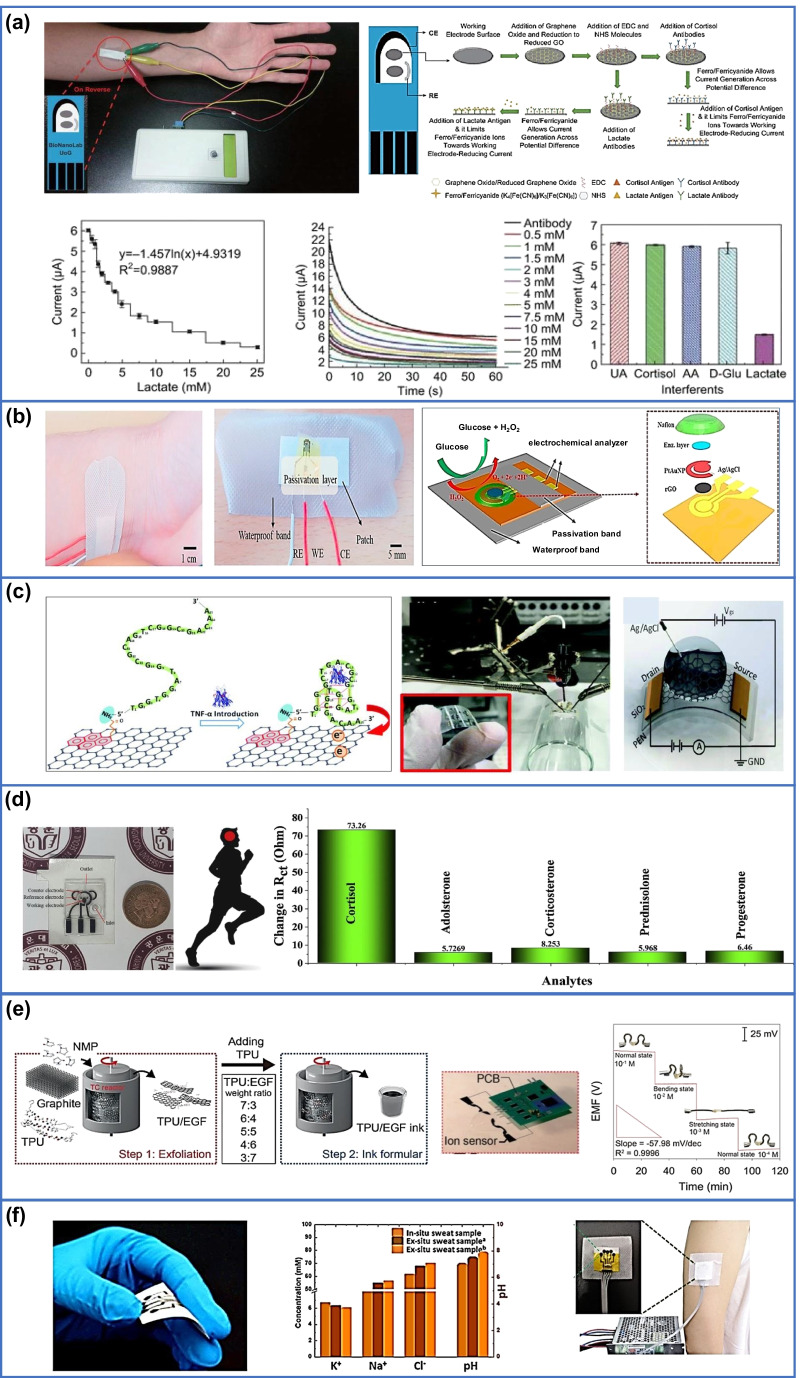
a Detection of lactate using graphene embedded screen-printed electrode. Reprinted with permission from. [145]. Copyright 2018 Springer Nature. b Au/rGO/AuPtNP/GOx/Nafion-based miniaturized hybrid working electrode-based wearable biosensor to monitor glucose in real human sweat. Reprinted with permission from [151]. Copyright 2018 Elsevier. c Detection of cytokine using graphene-Nafion biosensor. Reprinted with permission from [194]. Copyright 2021 Wiley–VCH. d Wearable immuno-sensor based on laser-burned graphene with incorporation of Ti3C2Tx MXene for non-invasive sweat cortisol detection. Reprinted with permission from [157]. Copyright 2021 Elsevier. e Flexible wearable electronic devices to measure Na+ ion detection. Reprinted with permission from [195]. Copyright 2021 Wiley–VCH. f A multi-ion sensing system based on multichannel electrochemical all-solid-state wearable potentiometric sensor for real-time sweat ion monitoring. Reprinted with permission from [153]. Copyright 2019 Elsevier
Fig. 7
Fig. 7
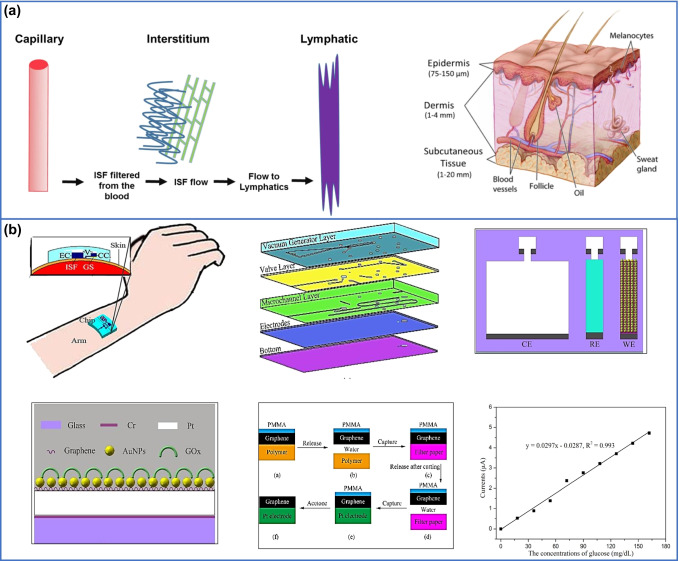
a Interstitial fluid moment and skin anatomy showing the outermost epidermal layer the epidermis, dermis, and subcutaneous. Reprinted with the permission from [223]. Copyright 2020 Elsevier. b Transdermal extraction system of ISF fluid for continuous glucose monitoring. Reprinted with the permission from [227]. Copyright 2015 American institute of publishing
Fig. 8
Fig. 8
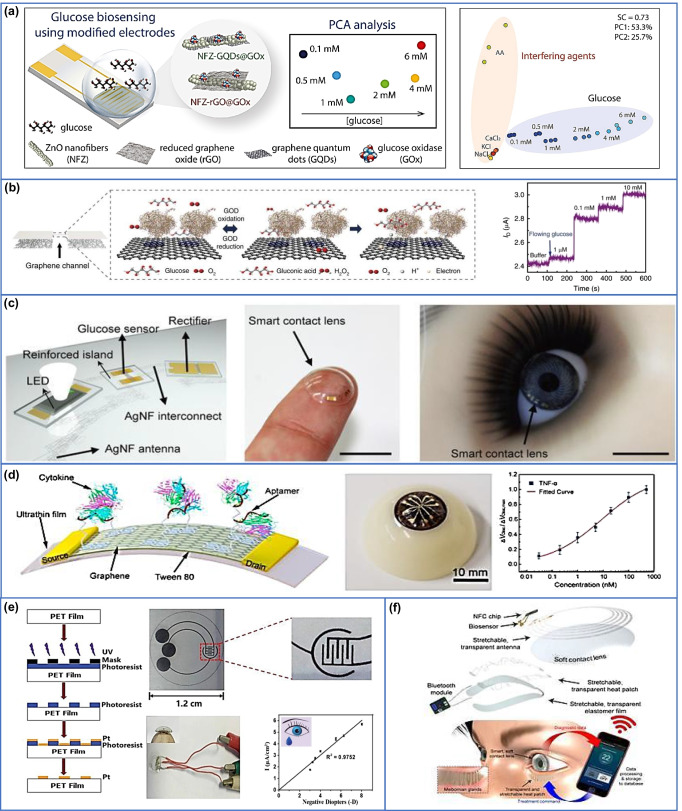
a Schematic of a bioelectronic tongue developed using zinc oxide and graphene derivatives (rGO and GQDs) for monitoring of glucose present in saliva. Reprinted with permission from [241]. Copyright 2021 Elsevier. b Diagram of a graphene-based wearable contact lens sensor showing glucose sensing with graphene-AgNW. Reprinted with permission from [242]. Copyright 2017 Springer Nature. c The schematic picture of the graphene-based soft, smart contact lens for glucose detection. Reprinted with the permission from [243]. Copyright 2018 American Association for the Advancement of Science. d Schematic of the flexible graphene field-effect transistor (GFET) biosensor fabricated on an ultrathin film, and the device attached onto the artificial eyeball for detection of cytokine. Reprinted with the permission from [244]. Copyright 2020 Multidisciplinary Digital Publishing Institute. e Fabrication process and photographs of corneal microelectrode of corneal biosensors for the in vivo tears testing. Reprinted with the permission from [245]. Copyright 2020 Wiley–VCH. f Schematic illustration of integrated and therapeutic devices for chronic OSI. Reprinted with the permission from [246]. Copyright 2021 American Association for the Advancement of Science
Fig. 9
Fig. 9
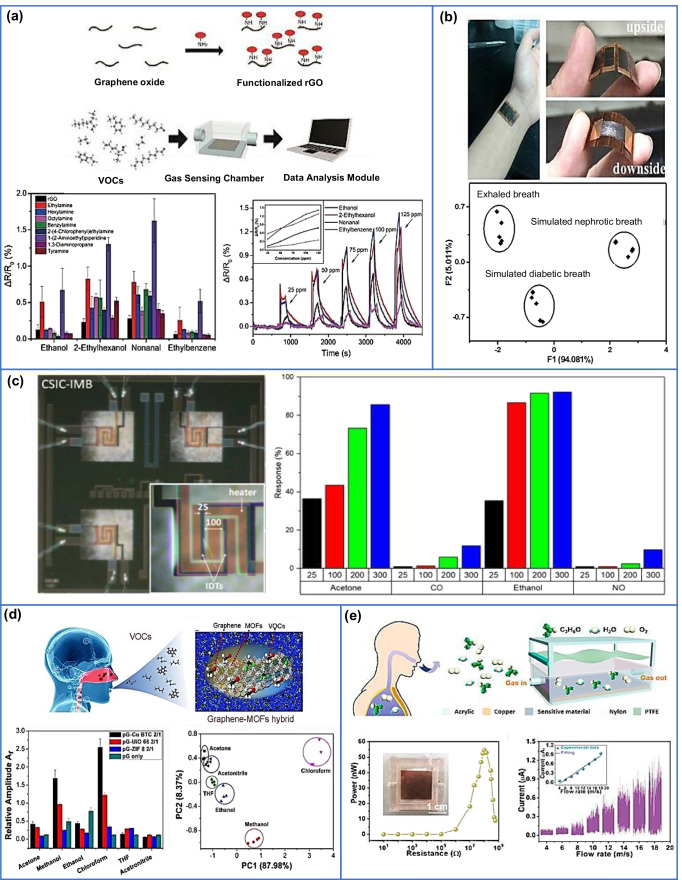
a Schematic representation of the functionalized graphene composite sensor with the observed responses to various VOCs. Reprinted with permission from [282]. Copyright 2019 Elsevier. b Multifunctional sensing device with the pattern of detection. Reprinted with permission from [280]. Copyright 2018 American Chemical Society. c The silicon substrates with micro hot plates and the sensor response to various VOCs. Reprinted with permission from [283]. Copyright 2020 Multidisciplinary Digital Publishing Institute. d Schematic representation of the VOC sensor along with the observed response to various VOCs. Reprinted with permission from [284]. Copyright 2020 Elsevier. e Schematic representation of triboelectric powered pre-diabetics detection. Reprinted with permission from [286]. Copyright 2020 Elsevier
Fig. 10
Fig. 10
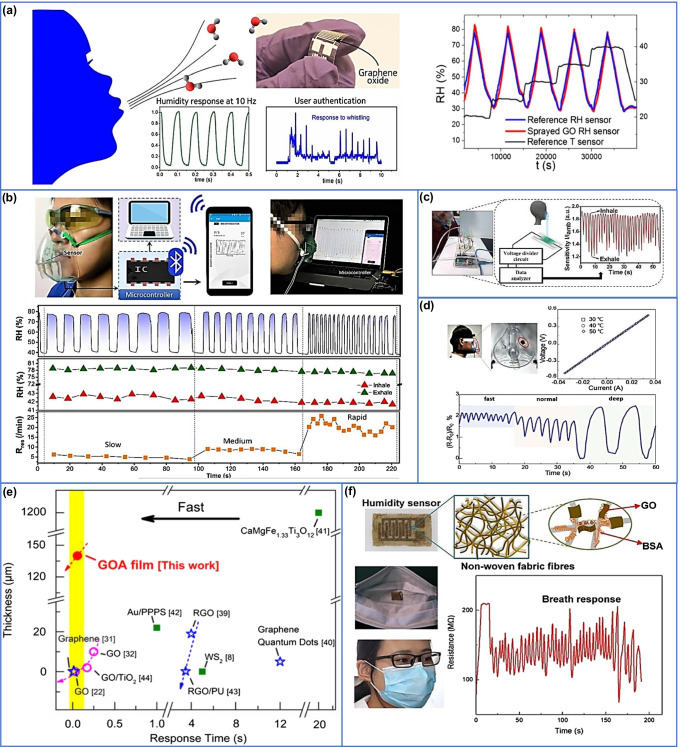
a Graphene oxide-based humidity sensors from exhaled breath. Reprinted with permission from [290]. Copyright 2013 American Chemical Society. b Bio-inspired atomic precise tunable graphene for humidity detection from breath. Reprinted with permission [291]. Copyright 2018 American Chemical Society. c Schematic representation of PVDF/rGO nanofibers and polyaniline-based wearable sensor for humidity detection. Reprinted with permission from [292]. Copyright 2019 American Chemical Society. d Porous graphene coated with PEDOT: PSS, GO, and Ag colloids for respiration monitoring. Reprinted with permission from [275]. Copyright 2018 Elsevier. e GO and aniline-based humidity sensor. Reprinted with permission from [293]. Copyright 2020 Wiley–VCH. f Non-woven fabric and graphene oxide-based respiration monitoring with the application demonstrated in a mask. Reprinted with permission from [294]. Copyright 2020 American Chemical Society

References

    1. Bandodkar AJ, Jeerapan I, Wang J. Wearable chemical sensors: present challenges an future prospects. ACS Sensors. 2016;1:482. doi: 10.1021/acssensors.6b00250. - DOI
    1. Heikenfeld J, Jajack A, Rogers J, Gutruf P, Tian L, Pan T, Li R, Khine M, Kim J, Wang J, Kim J. Wearable sensors: modalities, challenges, and prospects. Lab Chip. 2018;18:217–248. doi: 10.1039/c7lc00914c. - DOI - PMC - PubMed
    1. Morales NE, Baptista PL, Zamora GA, Merkoçi A. Graphene-based biosensors: going simple. Adv Mater. 2017;29:1604905. doi: 10.1002/adma.201604905. - DOI - PubMed
    1. Salim A, Lim S. Recent advances in noninvasive flexible and wearable wireless biosensors. Biosens Bioelectron. 2019;141:111422. doi: 10.1016/j.bios.2019.111422. - DOI - PubMed
    1. Lin Y, Bariya M, Javey A. Wearable biosensors for body computing. Adv Funct Mater. 2021;31:2008087. doi: 10.1002/adfm.202008087. - DOI

Publication types

LinkOut - more resources