


The Neural Signature of Psychological Interventions in Persons With Cancer: A Scoping Review
- PMID: 35635127
- PMCID: PMC9158410
- DOI: 10.1177/15347354221096808
The Neural Signature of Psychological Interventions in Persons With Cancer: A Scoping Review
Abstract
Objective: People diagnosed with cancer have to deal with the debilitating psychological implications of this disease. Although the clinical efficacy of psychological interventions is well documented, relatively little has been written on the neural correlates of these treatments in the context of oncology. The present work is the first to provide an overall perspective of the existing literature on this topic. It also considers the potential directions for future research.
Methods: This scoping review was carried out across 5 databases (EMBASE, PsycINFO, OVID MEDLINE, CINAHL, COCHRANE CENTRAL), from conception dates until 3 December 2021.
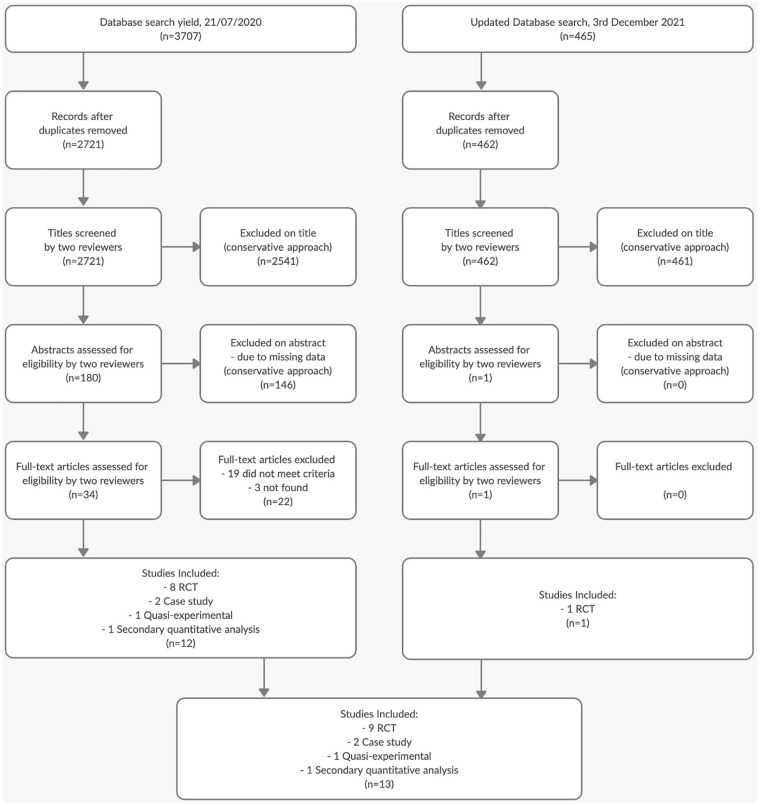
Results: From an initial set of 4172 records, 13 papers were selected for this review. They consisted of 9 randomized controlled studies (RCTs), 1 quasi-experiment, 2 single case studies, and 1 secondary quantitative analysis. The studies were also heterogeneous in terms of the patient and control populations, psychological interventions, and neuroimaging methodologies used. The findings from these few studies suggest that psychological interventions in oncology patients may modulate both cortical and subcortical brain activity, consistent with the brain areas involved in distress reactions in general and to cancer specifically. The implications of this scoping review in terms of future research are also discussed.
Conclusions: The literature on the neural correlates of psychological interventions in cancer patients is very limited, and thus requires further exploration. The provision of psychological interventions offers cancer patients a more integrated approach to care, which may in turn help preserve both the physical and the psychological wellbeing of individuals with cancer.
Keywords: cancer; neural correlates; neural signature; neuroimaging; oncology; psycho-oncology; psychological interventions; scoping review.
Conflict of interest statement
Figures

References
-
- World Health Organization (WHO). Latest global cancer data. Press release no. 263. 2018. https://www.iarc.who.int/wp-content/uploads/2018/09/pr263_E.pdf. Accessed April 29, 2022.
