


Challenges of integrating economics into epidemiological analysis of and policy responses to emerging infectious diseases
- PMID: 35636312
- PMCID: PMC9124042
- DOI: 10.1016/j.epidem.2022.100585
Challenges of integrating economics into epidemiological analysis of and policy responses to emerging infectious diseases
Abstract
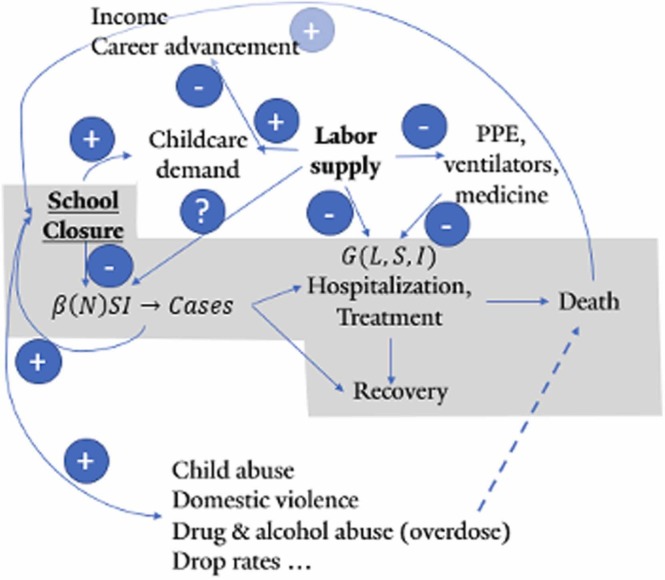
COVID-19 has shown that the consequences of a pandemic are wider-reaching than cases and deaths. Morbidity and mortality are important direct costs, but infectious diseases generate other direct and indirect benefits and costs as the economy responds to these shocks: some people lose, others gain and people modify their behaviours in ways that redistribute these benefits and costs. These additional effects feedback on health outcomes to create a complicated interdependent system of health and non-health outcomes. As a result, interventions primarily intended to reduce the burden of disease can have wider societal and economic effects and more complicated and unintended, but possibly not anticipable, system-level influences on the epidemiological dynamics themselves. Capturing these effects requires a systems approach that encompasses more direct health outcomes. Towards this end, in this article we discuss the importance of integrating epidemiology and economic models, setting out the key challenges which such a merging of epidemiology and economics presents. We conclude that understanding people's behaviour in the context of interventions is key to developing a more complete and integrated economic-epidemiological approach; and a wider perspective on the benefits and costs of interventions (and who these fall upon) will help society better understand how to respond to future pandemics.
Keywords: Behaviour; Cost-benefit; Economic; Modelling; Pandemics.
Copyright © 2022 The Authors. Published by Elsevier B.V. All rights reserved.
Conflict of interest statement
None.
Figures
References
-
- Aadland, D., Finnoff, D., Huang, Kevin, 2013. Syphilis cycles. B.E. J. Econ. Anal. Policy, vol. 14(issue 1), pp. 297–348, ISSN (Online) 1935-1682, ISSN (Print) 2194-6108. 〈 10.1515/bejeap-2012-0060〉. - DOI
-
- Aadland D.A., Finnoff D., Huang K.X.D. Economic dynamics of epidemiological bifurcations. Stud. Nonlinear Dyn. Econ. 2020
-
- Acemoglu D., Chernozhukov V., Werning I., Whinston M.D. National Bureau of Economic Research; 2020. A Multi-risk SIR Model with Optimally Targeted Lockdown.
-
- Akbarpour, M., Cook, C., Marzuoli, A., Mongey, S., Nagaraj, A., Saccarolak, M., Tebaldi, P., Vasserman, S., 2020. Socioeconomic Network Heterogeneity and Pandemic Policy Response. BFI, working paper 2020-75.
-
- Alon, T.M., Doepke, M, Olmstead-Rumsey, J., Tertilt, M., 2020. The impact of COVID-19 on gender equality. 0898-2937, COVID Economics.
Publication types
MeSH terms
LinkOut - more resources
Full Text Sources
Medical
