. 2022 Jun:55:101114.
doi: 10.1016/j.dcn.2022.101114. Epub 2022 May 13.

A practical introduction to EEG Time-Frequency Principal Components Analysis (TF-PCA)

Affiliations

A practical introduction to EEG Time-Frequency Principal Components Analysis (TF-PCA)

George A Buzzell et al. Dev Cogn Neurosci. 2022 Jun.

Abstract

This EEG methods tutorial provides both a conceptual and practical introduction to a promising data reduction approach for time-frequency representations of EEG data: Time-Frequency Principal Components Analysis (TF-PCA). Briefly, the unique value of TF-PCA is that it provides a data-reduction approach that does not rely on strong a priori constraints regarding the specific timing or frequency boundaries for an effect of interest. Given that the time-frequency characteristics of various neurocognitive process are known to change across development, the TF-PCA approach is thus particularly well suited for the analysis of developmental TF data. This tutorial provides the background knowledge, theory, and practical information needed to allow individuals with basic EEG experience to begin applying the TF-PCA approach to their own data. Crucially, this tutorial article is accompanied by a companion GitHub repository that contains example code, data, and a step-by-step guide of how to perform TF-PCA: https://github.com/NDCLab/tfpca-tutorial. Although this tutorial is framed in terms of the utility of TF-PCA for developmental data, the theory, protocols and code covered in this tutorial article and companion GitHub repository can be applied more broadly across populations of interest.

Keywords: Analysis methods; Development; EEG; PCA; Principal components analysis; Time-frequency.


Conflict of interest statement

The authors declare that they have no known competing financial interests or personal relationships that could have appeared to influence the work reported in this paper.

Figures
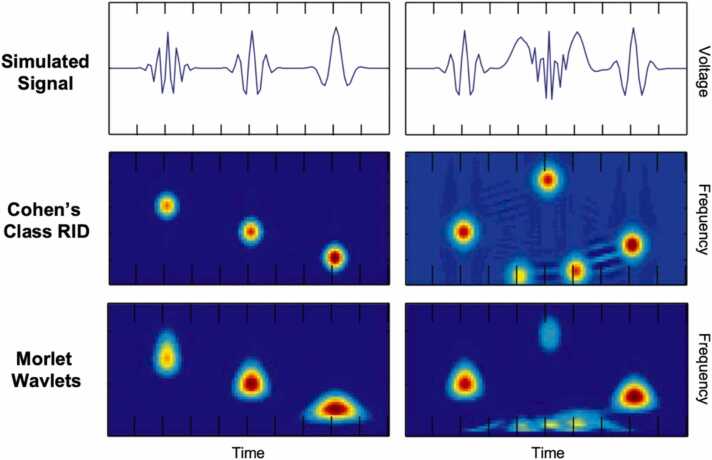
Fig. 1
Fig. 1
Comparison of time-frequency representations produced using Morlet wavelets vs. Cohen’s Class Reduced Interference Distributions (RID).
Fig. 2
Fig. 2
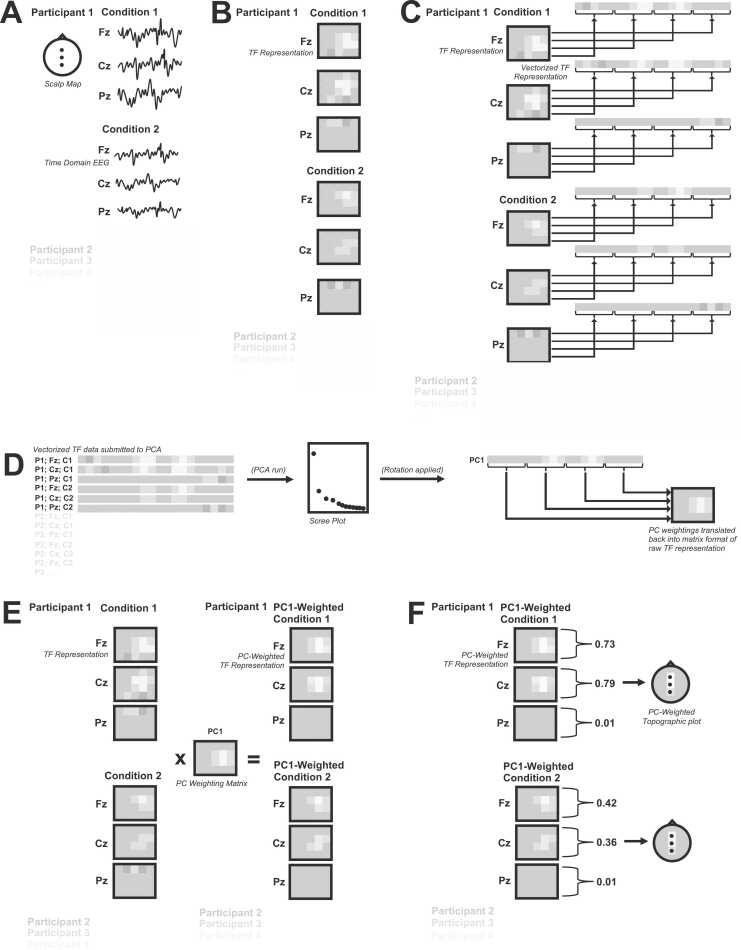
Conceptual overview of steps involved in TF-PCA. A) For all conditions/channels of interest, for all participants, preprocessed/epoched data is required. B) TF representations are computed for each channel, for each condition of interest, for each participant. C) Each TF representation is transformed from its native matrix organization into a vector by concatenating each row in each TF representation (corresponding to change over time for a single frequency bin) end-to-end. D). The Vectorized TF representations are “stacked” across conditions, channels, and participants to create a matrix of data submitted to PCA. A factor solution is chosen, and analytic rotation applied, yielding a single vector of weights for each PC. This vector of PC weights is transformed back into the native matrix format of the original TF representation, yielding a PC weighting matrix. E) The same PC weighting matrix is multiplied by the original TF representations for each channel, for each condition of interest, for each participant, resulting in a set of PC-weighted TF representations. F) For each PC-weighted TF representation of interest, the mean of all TF points within a given TF representation is taken. These mean values can then be plotted topographically and statistically compared across conditions.
Fig. 3
Fig. 3
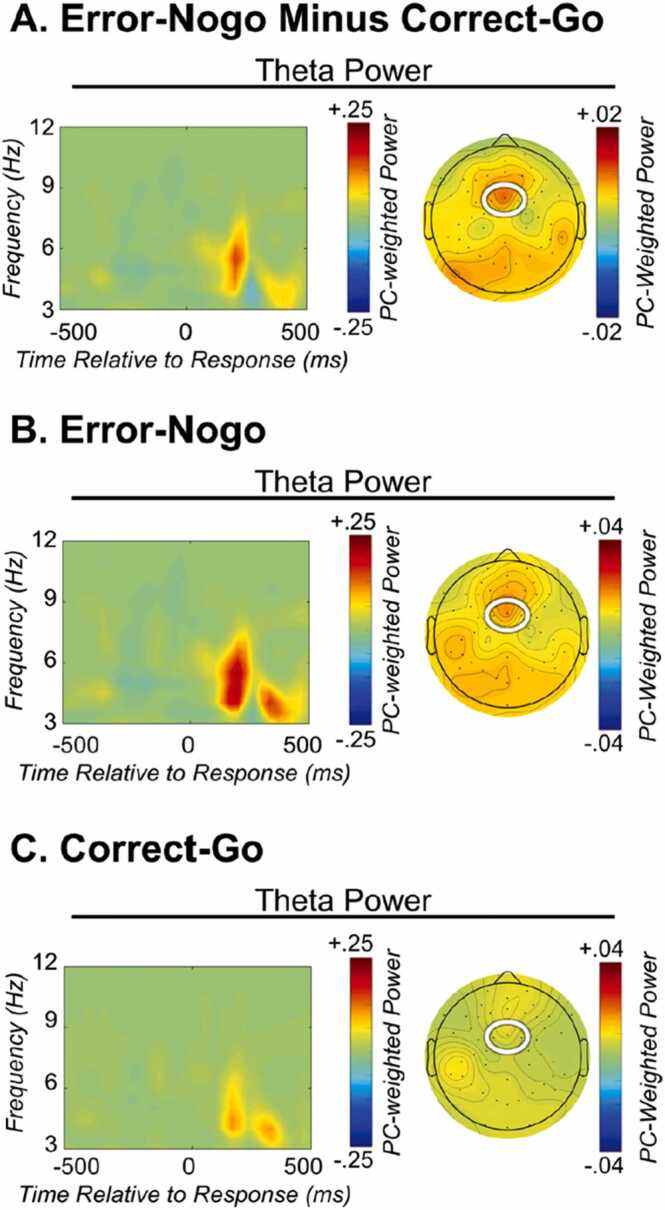
Error vs. correct theta isolated using TF-PCA. PC-weighted TF representations of response-locked average power for (A) the error-correct difference, (B) Error-nogo trials, and (C) Error-go trials. Note that the timing of the error-related theta component identified is > 100 ms later than similar effects observed in healthy adults; without employing a TF-PCA approach, this effect of interest might have been missed.
Fig. 4
Fig. 4
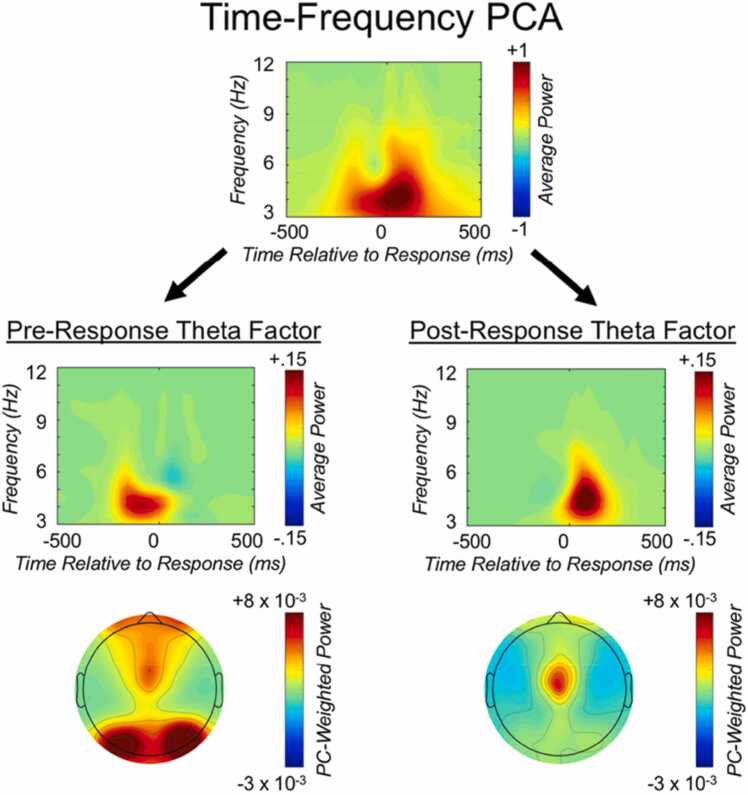
Example of time-frequency principal components analysis (TF-PCA) applied to EEG data. Isolation of separate pre- and post-response theta factors by applying time-frequency principal component analysis (PCA) to average power data. The top panel reflects the unweighted average power time-frequency distribution over medial-frontal cortex (MFC), collapsed across all conditions of interest. The second row depicts the same average power distribution weighted by the pre- and post-response theta factors, respectively; the third row displays the corresponding topographic plots.

References

    1. Bernat E.M., Williams W.J., Gehring W.J. Decomposing ERP time–frequency energy using PCA. Clin. Neurophysiol. 2005;116(6):1314–1334. doi: 10.1016/j.clinph.2005.01.019. - DOI - PubMed
    1. Bernat E.M., Malone S.M., Williams W.J., Patrick C.J., Iacono W.G. Decomposing delta, theta, and alpha time–frequency ERP activity from a visual oddball task using PCA. Int. J. Psychophysiol.: Off. J. Int. Org. Psychophysiol. 2007;64(1):62–74. doi: 10.1016/j.ijpsycho.2006.07.015. - DOI - PMC - PubMed
    1. Bernat E.M., Malone S.M., Williams W.J., Patrick C.J., Iacono W.G. Decomposing delta, theta, and alpha time–frequency ERP activity from a visual oddball task using PCA. Int. J. Psychophysiol. 2007;64(1):62–74. doi: 10.1016/j.ijpsycho.2006.07.015. - DOI - PMC - PubMed
    1. Bernat E.M., Nelson L.D., Steele V.R., Gehring W.J., Patrick C.J. Externalizing psychopathology and gain/loss feedback in a simulated gambling task: dissociable components of brain response revealed by time-frequency analysis. J. Abnorm. Psychol. 2011;120(2):352–364. doi: 10.1037/a0022124. - DOI - PMC - PubMed
    1. Bowers M.E., Buzzell G.A., Bernat E.M., Fox N.A., Barker T.V. Time-frequency approaches to investigating changes in feedback processing during childhood and adolescence. Psychophysiology. 2018;55(10) doi: 10.1111/psyp.13208. - DOI - PMC - PubMed

LinkOut - more resources