


Longitudinal variation in SARS-CoV-2 antibody levels and emergence of viral variants: a serological analysis
- PMID: 35636436
- PMCID: PMC9141682
- DOI: 10.1016/S2666-5247(22)00090-8
Longitudinal variation in SARS-CoV-2 antibody levels and emergence of viral variants: a serological analysis
Abstract
Background: Serological assays are being used to monitor antibody responses in individuals who had SARS-CoV-2 infection and those who received a COVID-19 vaccine. We aimed to determine whether such assays can predict neutralising antibody titres as antibody levels wane and viral variants emerge.
Methods: We measured antibody levels in serum samples from a cohort of 112 participants with SARS-CoV-2 infection using ten high-throughput serological tests and functional neutralisation assays. Serum samples were taken at baseline and at up to four subsequent visits. We assessed the effects of time and spike protein sequence variation on the performance and predictive value of the various assays. We did correlation analyses for individual timepoints using non-parametric Spearman correlation, and differences between timepoints were determined by use of a two-tailed Wilcoxon matched-pairs signed rank test.
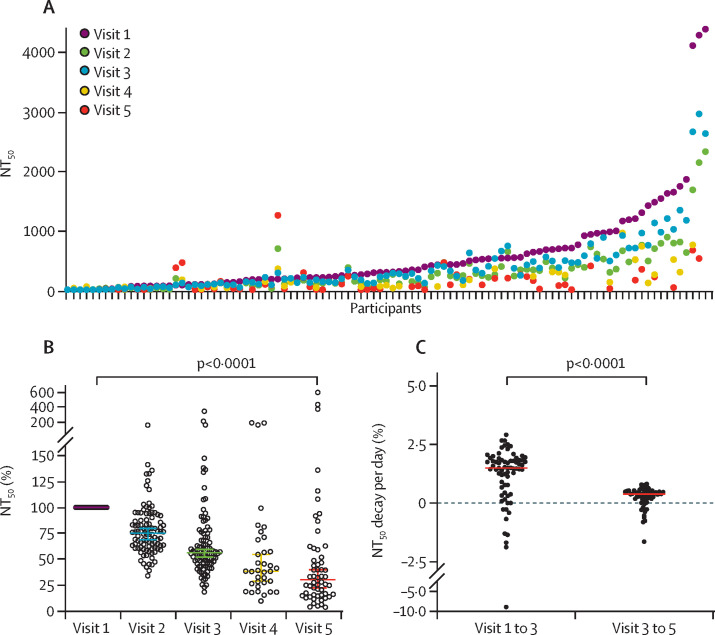
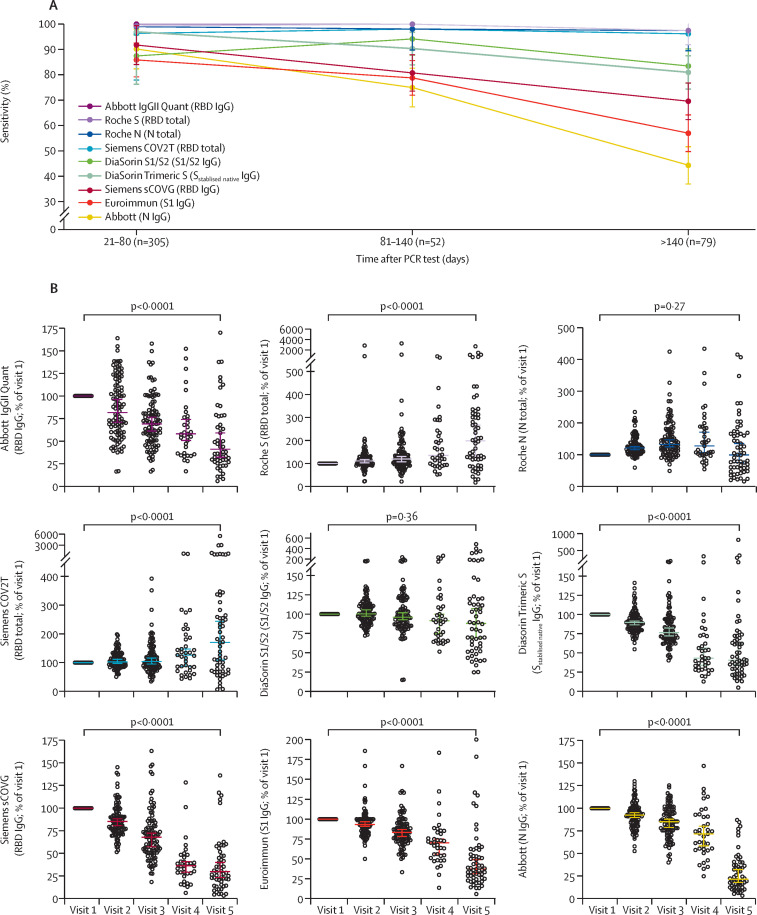
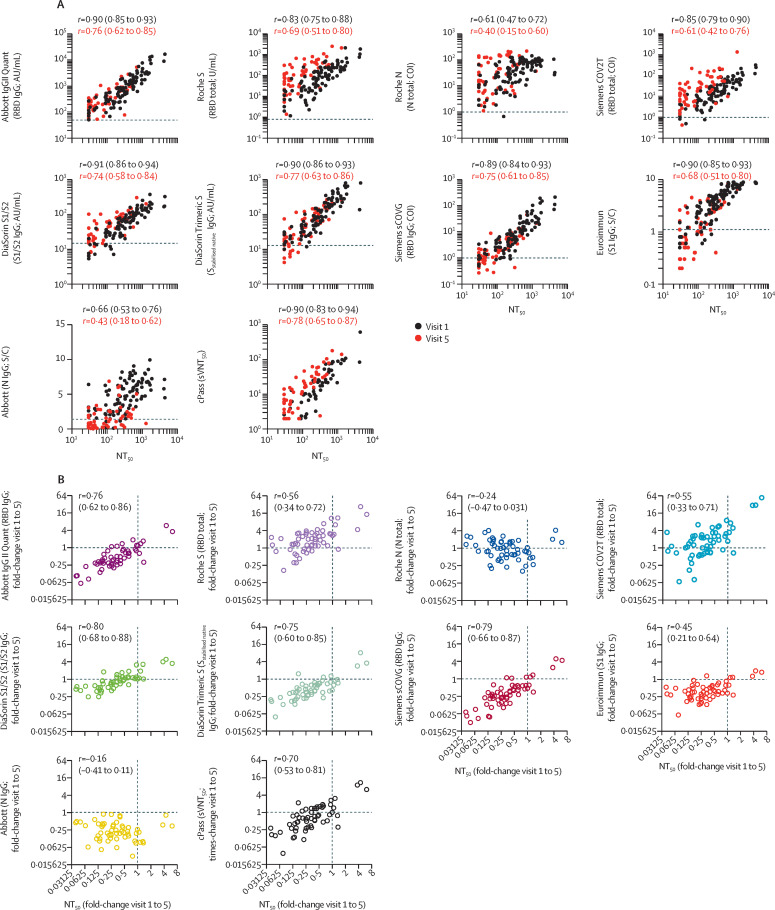
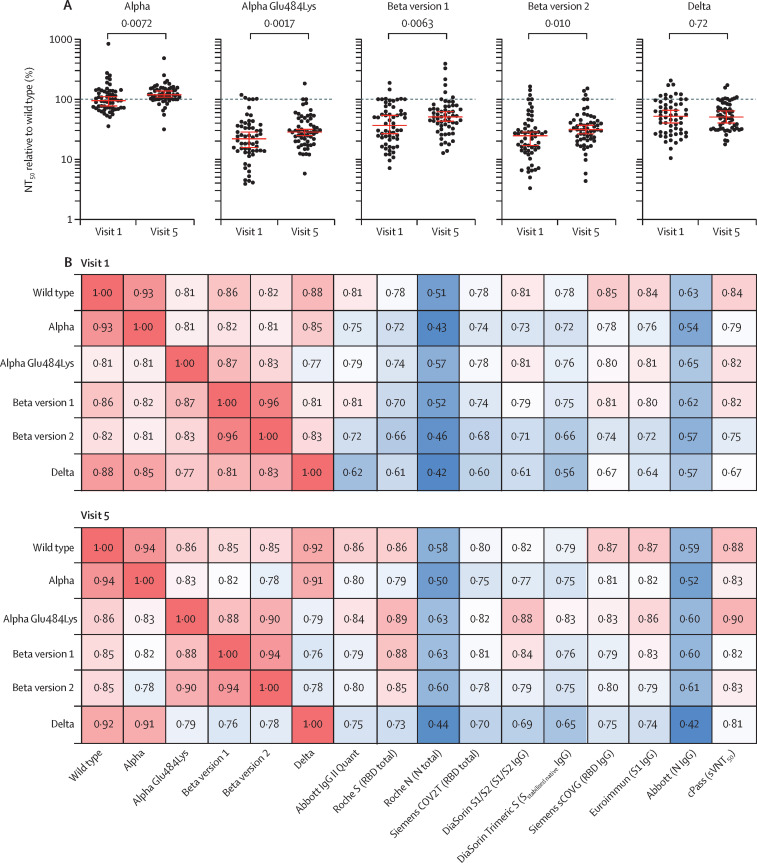
Findings: Neutralising antibody titres decreased over the first few months post-infection but stabilised thereafter, at about 30% of the level observed shortly after infection. Serological assays commonly used to measure antibodies against SARS-CoV-2 displayed a range of sensitivities that declined to varying extents over time. Quantitative measurements generated by serological assays based on the spike protein were better at predicting neutralising antibody titres than those based on nucleocapsid, but performance was variable, and manufacturer positivity thresholds were not able to predict the presence or absence of detectable neutralising activity. Although we observed some deterioration in correlation between serological measurements and functional neutralisation activity, some assays maintained an ability to predict neutralising titres, even against variants of concern.
Interpretation: The ability of high-throughput serological assays to predict neutralising antibody titres is likely to be crucial for evaluation of immunity at the population scale. These data can facilitate the selection of the most suitable assays as surrogates of functional neutralising activity and suggest that such measurements might be useful in clinical practice.
Funding: US National Institutes of Health and National Health Service Research Scotland BioResource.
Copyright © 2022 The Author(s). Published by Elsevier Ltd. This is an Open Access article under the CC BY-NC-ND 4.0 license. Published by Elsevier Ltd.. All rights reserved.
Conflict of interest statement
Declaration of interests SJ and EF received honoraria from Siemens for an online webinar in October, 2020, which was paid to their institutions. EF received sCOVG reagent from Siemens to support this study. All other authors declare no competing interests.
Figures
Update of
-
Longitudinal variation in SARS-CoV-2 antibody levels and emergence of viral variants: implications for the ability of serological assays to predict immunity.medRxiv [Preprint]. 2021 Jul 7:2021.07.02.21259939. doi: 10.1101/2021.07.02.21259939. medRxiv. 2021. Update in: Lancet Microbe. 2022 Jul;3(7):e493-e502. doi: 10.1016/S2666-5247(22)00090-8. PMID: 34268524 Free PMC article. Updated. Preprint.
References
Publication types
MeSH terms
Substances
Grants and funding
LinkOut - more resources
Full Text Sources
Medical
Miscellaneous
