. 2022 May 31;14(1):27.
doi: 10.1038/s41368-022-00177-1.

Four-Octyl itaconate ameliorates periodontal destruction via Nrf2-dependent antioxidant system

Affiliations

Four-Octyl itaconate ameliorates periodontal destruction via Nrf2-dependent antioxidant system

Liangjing Xin et al. Int J Oral Sci. .

Abstract

Periodontitis is a widespread oral disease characterized by continuous inflammation of the periodontal tissue and an irreversible alveolar bone loss, which eventually leads to tooth loss. Four-octyl itaconate (4-OI) is a cell-permeable itaconate derivative and has been recognized as a promising therapeutic target for the treatment of inflammatory diseases. Here, we explored, for the first time, the protective effect of 4-OI on inhibiting periodontal destruction, ameliorating local inflammation, and the underlying mechanism in periodontitis. Here we showed that 4-OI treatment ameliorates inflammation induced by lipopolysaccharide in the periodontal microenvironment. 4-OI can also significantly alleviate inflammation and alveolar bone loss via Nrf2 activation as observed on samples from experimental periodontitis in the C57BL/6 mice. This was further confirmed as silencing Nrf2 blocked the antioxidant effect of 4-OI by downregulating the expression of downstream antioxidant enzymes. Additionally, molecular docking simulation indicated the possible mechanism under Nrf2 activation. Also, in Nrf2-/- mice, 4-OI treatment did not protect against alveolar bone dysfunction due to induced periodontitis, which underlined the importance of the Nrf2 in 4-OI mediated periodontitis treatment. Our results indicated that 4-OI attenuates inflammation and oxidative stress via disassociation of KEAP1-Nrf2 and activation of Nrf2 signaling cascade. Taken together, local administration of 4-OI offers clinical potential to inhibit periodontal destruction, ameliorate local inflammation for more predictable periodontitis.


Conflict of interest statement

The authors declare no competing interests.

Figures
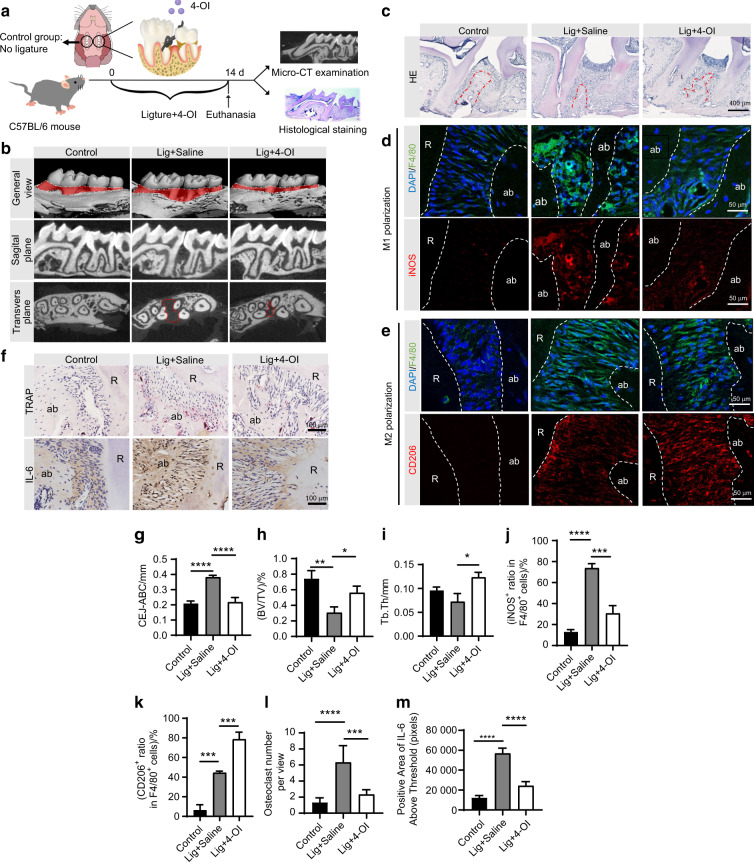
Fig. 1
Fig. 1
Local administration of 4-OI ameliorates periodontal inflammation and alveolar bone loss in vivo. a Timeline for the operation process in C57BL/6 male mice. b Micro-CT image of the alveolar bone. The red part displayed the exposure of root. c Representative images of H&E staining of the periodontitis areas. (Scale bar = 400 μm). d, e IF staining of M1 polarization-related markers (iNOS/F4/80) and M2 polarization-related markers (CD206/F4/80) and in macrophages across the periodontal region at 14 days post-operation. (Scale bar = 50 μm). f Representative images of TRAP staining and the IHC staining of IL-6 in the periodontal tissue. (Scale bar = 100 μm). g CEJ-ABC distance. h BV/TV. i Tb.Th. j, k Semi-quantitative analyses of iNOS+ ratio in F4/80+ cells and CD206+ ratio in F4/80+ cells. l Quantitative analysis of osteoclast number per view at alveolar bone. m Positive area of IL-6 above threshold. Values are presented as mean ± SD. *P < 0.05, **P < 0.01, ***P < 0.001, ****P < 0.000 1. Lig ligature, ab alveolar bone, R root
Fig. 2
Fig. 2
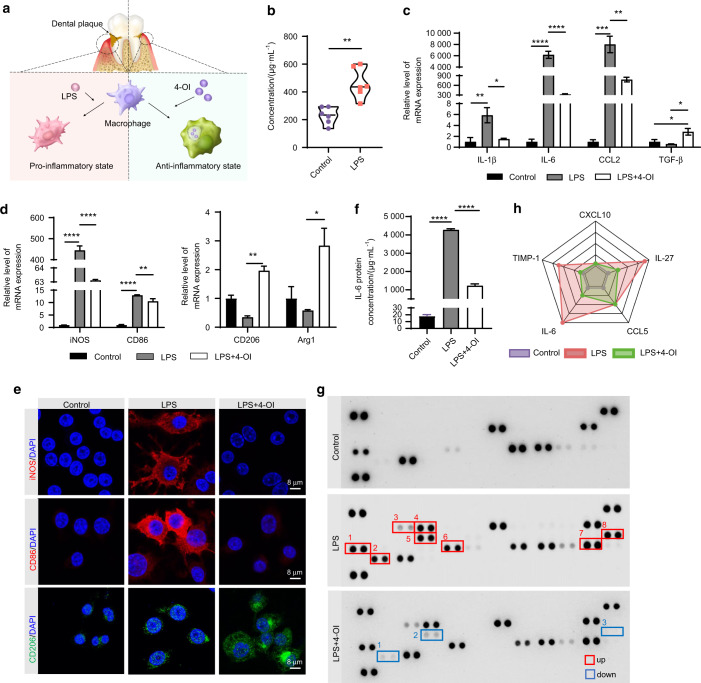
4-OI induces a shift in polarization phenotype of macrophages in vitro. a Schematic illustration for the method utilized for the local administration of 4-OI in a periodontitis model. b The concentration of itaconate in RAW 264.7 analyzed using UPLC-MS assay. c, d Expression of M1 and M2-related genes in RAW 264.7 using qRT-PCR (The M1-related IL-1β, IL-6, CCL2, iNOS, CD86, and the M2-related TGF-β, Arg-1 and CD206). e Micrographs showing staining of iNOS, CD86 and CD206 obtained using confocal laser scanning microscopy. (Nucleus: blue, iNOS and CD86: red, CD206: green. Scale bar = 8 μm). f IL-6 protein concentration of RAW 264.7 tested by ELISA assay. g The cytokine array images of RAW 264.7. Each two adjacent dots represent one kind of cytokine, among which the representative upregulated (up) cytokines of the LPS group compared to the control group and downregulated (down) cytokines of the LPS + 4-OI group compared to the LPS group were marked in different color boxes (red and blue). h The expression profiles of differentially expressed factors in panel g shown as a Radar Chart. All data are presented as the mean ± SD. *P < 0.05, **P < 0.01, ***P < 0.001, ****P < 0.000 1
Fig. 3
Fig. 3
4-OI scavenges excess ROS and mitigates oxidative damage in vitro. Fluorescent images (a) and semi-quantitative analysis (b) of the intracellular ROS in RAW 264.7 measured by DCFH-DA staining. (Scale bar = 400 µm). c Flow cytometry images of intracellular ROS in RAW264.7 stained by DCFH-DA. d Representative fluorescent images and 3D surface plot images of 8-OHdG and nuclei in RAW 264.7. (Nucleus: blue, 8-OHdG: red. Scale bar = 400 µm). e The MDA content of RAW 264.7. f Schematic diagram of applying 4-OI to reduce LPS-induced oxidative damage in vitro. Data are expressed as the mean ± SD. *P < 0.05, **P < 0.01, ***P < 0.001, ****P < 0.000 1
Fig. 4
Fig. 4
4-OI attenuates oxidative damage via disassociation of KEAP1-Nrf2 complex in vitro. a View and zoomed in view of the binding modes of itaconate with BTB domain in binding site of KEAP1 (PDB code: 5DAF). The itaconate molecule structure is displayed in Ball and sticks style and capped sticks are the amino acids of BTB domain in KEAP1. Green dashed lines are hydrogen bonds. b 2D interaction diagram depicting the interaction pattern of itaconate with BTB domain. c View and zoomed in view of the binding modes of itaconate with residue Cys583 in Kelch domain in binding site of KEAP1 (PDB code: 2FLU). d 2D interaction diagram depicting the interaction pattern of itaconate with residue Cys583 in Kelch domain. e Co-IP assay in RAW264.7. f Expression of listed proteins in cytosol fraction lysates tested by western blotting. g Schematic illustration of the therapeutic role of 4-OI in the inflammatory periodontal tissue
Fig. 5
Fig. 5
The role of Nrf2 exerted in the protection of 4-OI against periodontal inflammation. a The Nrf2 protein expression in nuclei fraction lysates quantified by western blotting. b qRT-PCR analysis of NQO1, HO-1, Prdx and GCLM in RAW264.7. c The expression of Nrf2 downstream ARE-dependent proteins in RAW264.7 measured by western blotting. d Transfection effects of siRNA or negative control siRNA (NC) analyzed by western blotting. Nrf2 expression in nuclei fraction lysates (e) and downstream proteins in cytosol fraction lysates (f) after siRNA transfection as detected by western blotting. g Representative images of histological analysis in periodontal tissue. (Scale bar = 100 or 25 µm). h Schematic diagram of the nuclear translocation of Nrf2. Data are expressed as the mean ± SD. *P < 0.05, **P < 0.01, ***P < 0.001, ****P < 0.000 1. sMaf small musculoaponeurotic fibrosarcoma
Fig. 6
Fig. 6
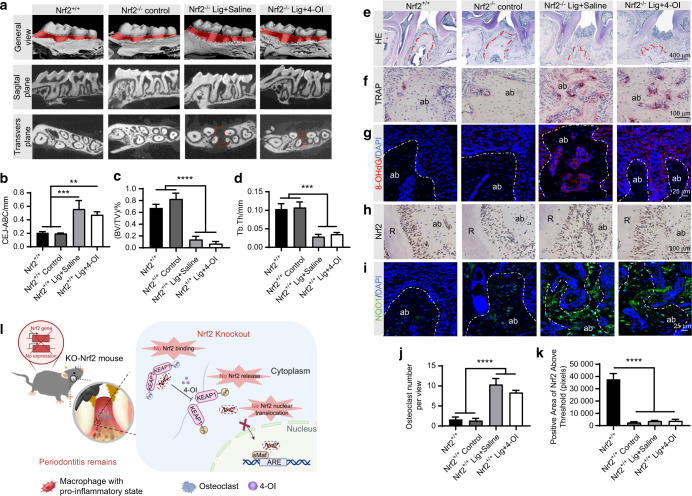
Inhibition of Nrf2 impairs the 4-OI mediated antioxidant protective effect and the therapeutic effect on inflammatory periodontal microenvironment. a Micro-CT image of the alveolar bone. The red part displayed the exposure of root. CEJ-ABC distance (b), BV/TV (c), and Tb. Th (d). e–i Representative images of histological analysis in periodontal tissue. (Scale bar = 400, 100, or 25 µm). j, k The semi-quantitative analysis of TRAP staining and IHC staining of Nrf2. l Illustration of local injection of 4-OI in experimental periodontitis Nrf2−/− mice for 14 days. Data are presented as the mean ± SD. *P < 0.05, **P < 0.01, ***P < 0.001, ****P < 0.000 1. Lig ligature, ab alveolar bone, R root, sMaf small musculoaponeurotic fibrosarcoma

References

    1. Kinane DF, Stathopoulou PG, Papapanou PN. Periodontal diseases. Nat. Rev. Dis. Prim. 2017;3:17038. doi: 10.1038/nrdp.2017.38. - DOI - PubMed
    1. Pihlstrom BL, Michalowicz BS, Johnson NW. Periodontal diseases. Lancet (Lond., Engl.) 2005;366:1809–1820. doi: 10.1016/S0140-6736(05)67728-8. - DOI - PubMed
    1. Yamada H, Nakajima T, Domon H, Honda T, Yamazaki K. Endoplasmic reticulum stress response and bone loss in experimental periodontitis in mice. J. Periodontal Res. 2015;50:500–508. doi: 10.1111/jre.12232. - DOI - PubMed
    1. Allen EM, Matthews JB, DJ OH, Griffiths HR, Chapple IL. Oxidative and inflammatory status in Type 2 diabetes patients with periodontitis. J. Clin. Periodontol. 2011;38:894–901. doi: 10.1111/j.1600-051X.2011.01764.x. - DOI - PubMed
    1. Hajishengallis G, Chavakis T. Local and systemic mechanisms linking periodontal disease and inflammatory comorbidities. Nat. Rev. Immunol. 2021;21:426–440. doi: 10.1038/s41577-020-00488-6. - DOI - PMC - PubMed

Publication types