Review
. 2022 Dec;21(12):899-914.
doi: 10.1038/s41573-022-00472-w. Epub 2022 May 30.

Phenotypic drug discovery: recent successes, lessons learned and new directions

Affiliations
Review

Phenotypic drug discovery: recent successes, lessons learned and new directions

Fabien Vincent et al. Nat Rev Drug Discov. 2022 Dec.

Erratum in

Abstract

Many drugs, or their antecedents, were discovered through observation of their effects on normal or disease physiology. For the past generation, this phenotypic drug discovery approach has been largely supplanted by the powerful but reductionist approach of modulating specific molecular targets of interest. Nevertheless, modern phenotypic drug discovery, which combines the original concept with modern tools and strategies, has re-emerged over the past decade to systematically pursue drug discovery based on therapeutic effects in realistic disease models. Here, we discuss recent successes with this approach, as well as consider ongoing challenges and approaches to address them. We also explore how innovation in this area may fuel the next generation of successful projects.


Figures

Figure 1:
Figure 1:
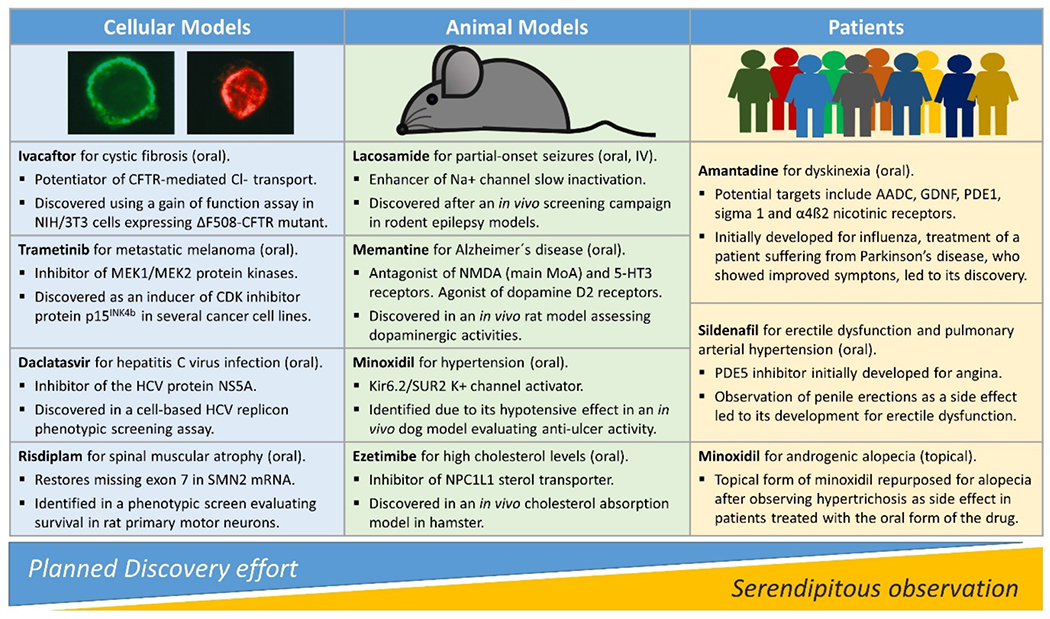
Modern PDD strikes a balance between planned discovery and serendipity. Approved drugs are listed based on the original phenotypic assay which first connected the compound series or the drug itself to the disease. Notably, while all discoveries from cellular screens represented the outcome of planned efforts, it was unexpected clinical side effects in patients which led to compound repurposing. References: ivacaftor,, , daclatasvir, risdiplam, trametinib, lacosamide, memantine, minoxidil,, ezetimibe, amantadine, sildenafil.
Figure 2.
Figure 2.
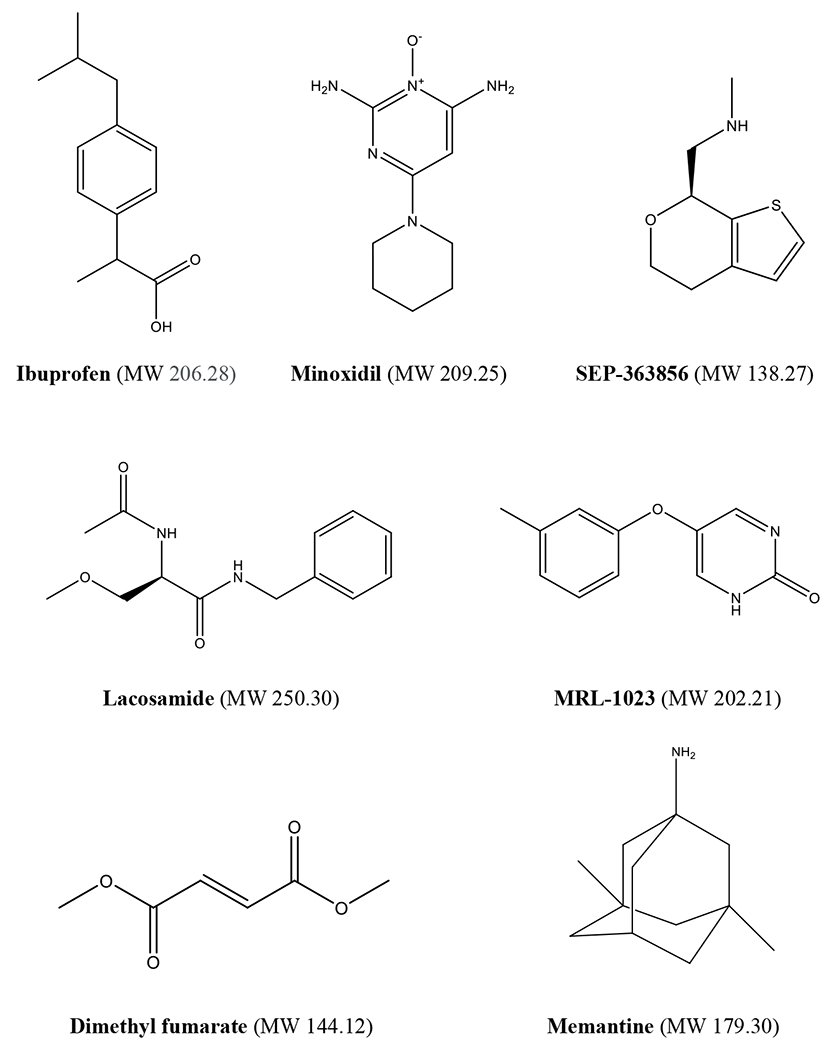
Low molecular weight clinical candidates and drugs derived from phenotypic approaches
Figure 3.
Figure 3.
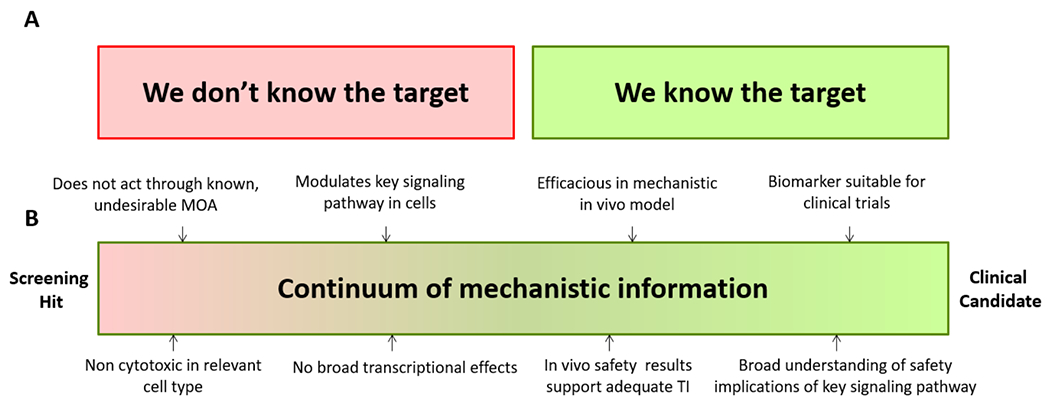
Target identification is sometimes perceived as necessary and having a simple binary outcome: the target is identified or it is not (Panel A, legacy thinking). We suggest instead that a continuum of information can be accessed which may address the true end goal of target identification, helping obtain sufficient confidence in safety and translation to support progression into the clinic (Panel B, emerging thinking). TI: Therapeutic index.
Figure 4.
Figure 4.
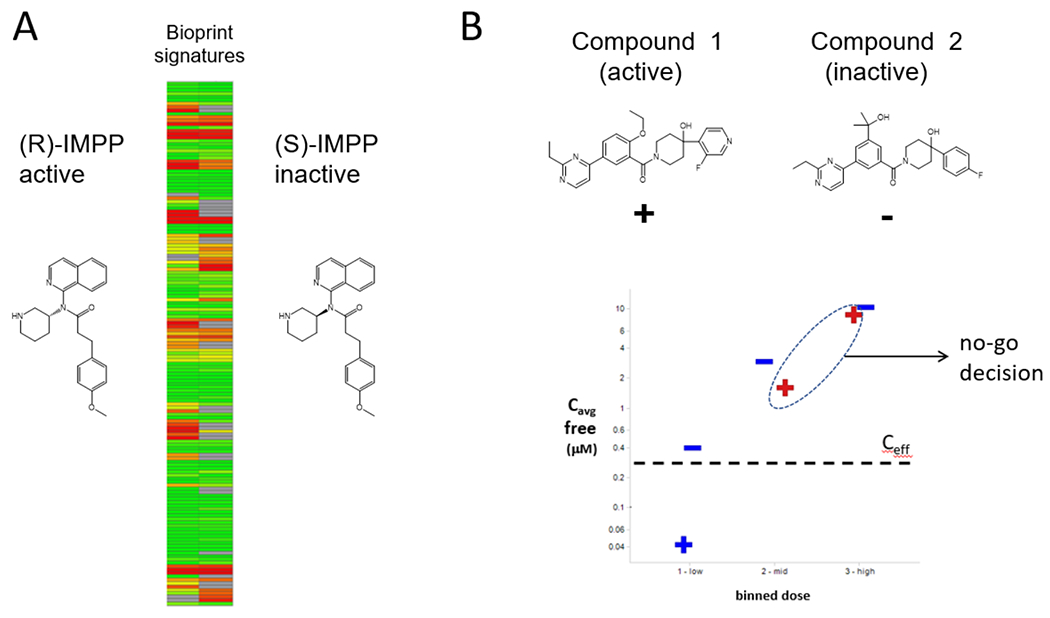
Utility of active / inactive compound pairs to address safety questions for compound series with unknown target(s) or MoA(s). A) Profiles in the BioPrint pharmacology panel of PCSK9 secretion inhibitor (R)-IMPP and its inactive analogue (S)-IMPP. Figure adapted with permission from ref B) In vivo toxicology results following multi day dosing of of cystic fibrosis lead Compound 1 (+) and its inactive analogue Compound 2 (−). Blue coloring indicates the compound was tolerated while red lettering indicates it was not. Cave: average in vivo concentration, Ceff: predicted in vivo effective concentration for Compound 1.
Figure 5.
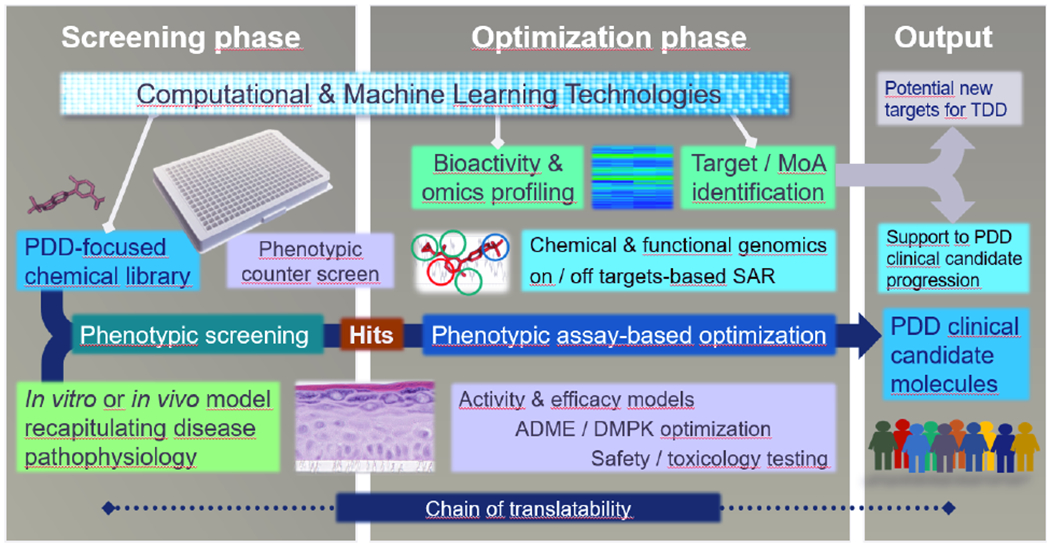
Figure 5.. Schematic overview of an industrialized phenotypic drug discovery process.
A chemical library designed for phenotypic screening (e.g. with smaller MW compounds) and a disease-relevant in vitro or in vivo model system capable of providing sufficient throughput, are combined in a phenotypic screening campaign to identify hits whose optimization, characterization and progression to clinical phases can take advantage of the current plethora of omics, profiling and computational approaches (including machine learning). Target or MoA information is used to support the progress of clinical PDD candidates. One additional possibility, if targets are identified, is their potential use as starting points for new TDD programs. Chain of translatability is shown to represent the molecular association between the mechanisms driving the phenotypic assay, the preclinical disease models, and human disease. Counter screen refers to an assay aimed at verifying the selectivity of the hit molecules versus other unintended phenotypic endpoints. SAR: structure-activity relationship, MoA: mechanism of action.

References

    1. Swinney DC & Anthony J How were new medicines discovered? Nat Rev Drug Discov 10, 507–519, doi:10.1038/nrd3480 (2011). - DOI - PubMed
    1. Lee JA & Berg EL Neoclassic drug discovery: the case for lead generation using phenotypic and functional approaches. J Biomol Screen 18, 1143–1155, doi:10.1177/1087057113506118 (2013). - DOI - PubMed
    1. Moffat JG, Vincent F, Lee JA, Eder J & Prunotto M Opportunities and challenges in phenotypic drug discovery: an industry perspective. Nat Rev Drug Discov 16, 531–543, doi:10.1038/nrd.2017.111 (2017). - DOI - PubMed
    1. Eder J, Sedrani R & Wiesmann C The discovery of first-in-class drugs: origins and evolution. Nat Rev Drug Discov 13, 577–587, doi:10.1038/nrd4336 (2014). - DOI - PubMed
    1. Edwards A What Are the Odds of Finding a COVID-19 Drug from a Lab Repurposing Screen? J. Chem. Inf. Model, doi:10.1021/acs.jcim.0c00861 (2020). - DOI - PubMed