


High-Dose Osimertinib for CNS Progression in EGFR+ NSCLC: A Multi-Institutional Experience
- PMID: 35637759
- PMCID: PMC9142556
- DOI: 10.1016/j.jtocrr.2022.100328
High-Dose Osimertinib for CNS Progression in EGFR+ NSCLC: A Multi-Institutional Experience
Abstract
Introduction: This multicenter review evaluated the efficacy and safety of osimertinib dose escalation for central nervous system (CNS) progression developing on osimertinib 80 mg in EGFR-mutant NSCLC.
Methods: Retrospective review identified 105 patients from eight institutions with advanced EGFR-mutant NSCLC treated with osimertinib 160 mg daily between October 2013 and January 2020. Radiographic responses were clinically assessed, and Kaplan-Meier analyses were used. We defined CNS disease control as the interval from osimertinib 160 mg initiation to CNS progression or discontinuation of osimertinib 160 mg.
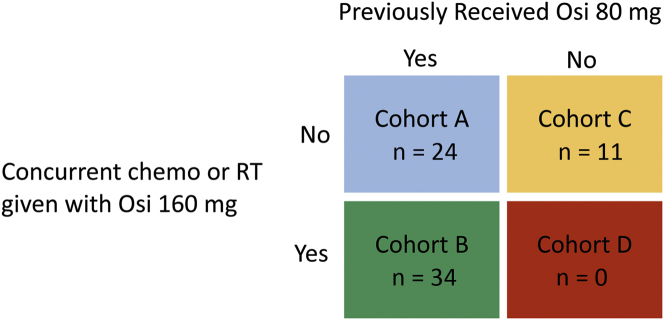
Results: Among 105 patients treated with osimertinib 160 mg, 69 were escalated for CNS progression, including 24 treated with dose escalation alone (cohort A), 34 who received dose-escalated osimertinib plus concurrent chemotherapy and/or radiation (cohort B), and 11 who received osimertinib 160 mg without any prior 80 mg exposure. The median duration of CNS control was 3.8 months (95% confidence interval [CI], 1.7-5.8) in cohort A, 5.1 months (95% CI, 3.1-6.5) in cohort B, and 4.2 months (95% CI 1.6-not reached) in cohort C. Across all cohorts, the median duration of CNS control was 6.0 months (95% CI, 5.1-9.0) in isolated leptomeningeal progression (n = 27) and 3.3 months (95% CI, 1.0-3.1) among those with parenchymal-only metastases (n = 23). Patients on osimertinib 160 mg experienced no severe or unexpected side effects.
Conclusion: Among patients with EGFR-mutant NSCLC experiencing CNS progression on osimertinib 80 mg daily, dose escalation to 160 mg provided modest benefit with CNS control lasting approximately 3 to 6 months and seemed more effective in patients with isolated leptomeningeal CNS progression.
Keywords: 160 mg; CNS progression; EGFR; Leptomeningeal progression; Osimertinib.
© 2022 The Authors.
Figures
References
-
- Ramalingam S.S., Vansteenkiste J., Planchard D., et al. Overall survival with osimertinib in untreated, EGFR-mutated advanced NSCLC. N Engl J Med. 2019;382:41–50. - PubMed
-
- YJWYZ B.P., Yates J.W., Yang Z., et al. Pre-clinical comparison of osimertinib with other EGFR-TKIs in EGFR-mutant NSCLC brain metastases models, and early evidence of clinical brain metastases activity. Clin Cancer Res. 2016;22:5130–5140. - PubMed
-
- Soria J.C., Ohe Y., Vansteenkiste J., et al. Osimertinib in untreated EGFR-mutated advanced non-small-cell lung cancer. N Engl J Med. 2018;378:113–125. - PubMed
-
- Reungwetwattana T., Nakagawa K., Cho B.C., et al. CNS response to osimertinib versus Standard epidermal growth factor receptor tyrosine kinase inhibitors in patients with untreated EGFR-mutated advanced non–small-cell lung cancer. J Clin Oncol. 2018;36:3290–3297. - PubMed
Grants and funding
LinkOut - more resources
Full Text Sources
Other Literature Sources
Research Materials
Miscellaneous
