


Factors associated with failure of high-flow nasal cannula oxygen therapy in patients with severe COVID-19: a retrospective case series
- PMID: 35638595
- PMCID: PMC9160912
- DOI: 10.1177/03000605221103525
Factors associated with failure of high-flow nasal cannula oxygen therapy in patients with severe COVID-19: a retrospective case series
Abstract
Objective: To identify factors associated with high-flow nasal cannula (HFNC) therapy failure in patients with severe COVID-19.
Methods: We retrospectively examined clinical and laboratory data upon admission, treatments, and outcomes of patients with severe COVID-19. Sequential Organ Failure Assessment (SOFA) scores were also calculated.
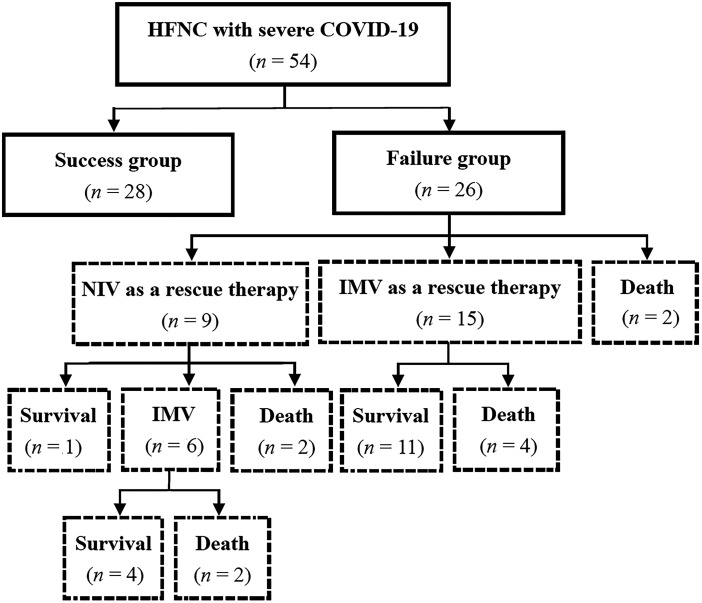
Results: Of 54 patients with severe COVID-19, HFNC therapy was successful in 28 (51.9%) and unsuccessful in 26 (48.1%). HFNC therapy failure was more common in patients aged ≥60 years and in men. Compared with patients with successful HFNC therapy, patients with HFNC therapy failure had higher percentages of fatigue, anorexia, and cardiovascular disease; a longer time from symptom onset to diagnosis; higher SOFA scores; a higher body temperature, respiratory rate, and heart rate; more complications, including acute respiratory distress syndrome, septic shock, myocardial damage, and acute kidney injury; a higher C-reactive protein concentration, neutrophil count, and prothrombin time; and a lower arterial partial pressure of oxygen/fraction of inspired oxygen (PaO2/FiO2). However, male sex, a low PaO2/FiO2, and a high SOFA score were the only independent factors significantly associated with HFNC therapy failure.
Conclusions: Male sex, a low PaO2/FiO2, and a high SOFA score were independently associated with HFNC therapy failure in patients with severe COVID-19.
Keywords: COVID-19; SOFA score; acute respiratory failure; case series; high-flow nasal cannula therapy; risk factor.
Conflict of interest statement
Figures
References
-
- Notice of the National Health Commission of the People’s Republic of China on revising the English name of novel coronavirus pneumonia (2020). http://www.nhc.gov.cn/yzygj/s7653p/202002/33393aa53d984ccdb1053a52b6bef8... (Accessed 29 Feb 2020).
-
- World Health Organization. Clinical management of severe acute respiratory infection (SARI) when COVID-19 disease is suspected: interim guidance, 13 March 2020. https://apps.who.int/iris/handle/10665/331446
MeSH terms
Substances
LinkOut - more resources
Full Text Sources
Medical
Research Materials
