


doi: 10.1007/s00134-022-06748-4.
Epub 2022 May 31.
Understanding base excess (BE): merits and pitfalls
Affiliations
- PMID: 35639122
- PMCID: PMC9304040
- DOI: 10.1007/s00134-022-06748-4
Item in Clipboard
Understanding base excess (BE): merits and pitfalls
Intensive Care Med.
2022 Aug.
No abstract available
Conflict of interest statement
The authors certify that they have no affiliations with or involvement in any organization or entity with any financial or non-financial interest in the subject matter discussed in this manuscript.
Figures
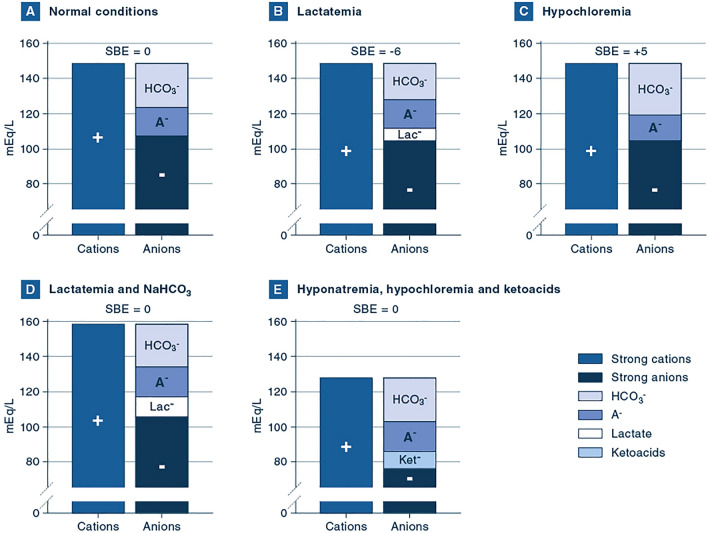
Gamblegrams of different acid–base conditions. A Normal conditions. This Gamblegram, i.e. the graph summarizing the electrical charges and the concept of electrical neutrality, represents a normal situation, with standard concentrations of electrolytes and normal acid–base parameters (HCO3− 24 mmol/L, PCO2 40 mmHg and pH of 7.40), leading to a SBE of 0 mmol/L. B Lactatemia. In this situation, lactate concentration is increased by 6 mmol/L and pH is 7.31. Other electrolytes and PCO2 have normal values. HCO3− concentration is decreased to 20 mmol/L and BE is − 6 mmol/L. This is an example of isolated metabolic acidosis. C Hypochloremia. In this situation, chloride concentration is decreased by 5 mmol/L and pH is 7.47. Other electrolytes and PCO2 have normal values. HCO3− concentration is increased to 29 mmol/L and BE is + 5 mmol/L. This is an example of isolated metabolic alkalosis, which can frequently be observed in case of persistent vomiting or after administration of loop diuretics. D Lactatemia and sodium bicarbonate (NaHCO3). In this situation, lactate concentration is increased by 10 mmol/L and sodium concentration is increased by 10 mmol/L due to the administration of NaHCO3. Other electrolytes and PCO2 have normal values. As the increase in cations is equal to the increase in anions, no other change in electrolytes is required to fulfill the electroneutrality principle, i.e. HCO3− concentration is unaffected (24 mmol/L) and pH is 7.40. Therefore, two acid–base disorders co-exist and cancel each other out. Consequently, the calculated SBE is 0 mmol/L. Of note, the columns are higher than normal, underlining the fact that sodium-bicarbonate administration causes an increase in osmolarity. E Hyponatremia, hypochloremia and ketoacids. In this situation, sodium and chloride concentrations are reduced by 20 and 30 mmol/L, respectively. At the same time, 10 mmol/L of ketoacids are present. Also in this case, variations in strong cations and anions cancel out each other and, assuming a normal PCO2 of 40 mmHg, normal values of pH and HCO3− are expected, leading to a normal SBE of 0 mmol/L. This acid–base derangement can be observed in infants with hypertrophic pyloric stenosis, where electrolyte losses due to persistent vomiting can coexist with hypovolemia and starvation ketoacidosis. HCO3−, bicarbonate; A−, dissociated non-carbonic weak acids; Lac−, lactate; Ket−, ketoacids
References
-
- Van Slyke DD, Cullen GE. Studies of acidosis. I. The bicarbonate concentration of the blood plasma; its significance and its determination as a measure of acidosis. J Biol Chem. 1917;30:289. doi: 10.1016/S0021-9258(18)86738-2. - DOI
Publication types
LinkOut - more resources
Full Text Sources
