


Effects of Intermittent Hypoxia-Hyperoxia on Performance- and Health-Related Outcomes in Humans: A Systematic Review
- PMID: 35639211
- PMCID: PMC9156652
- DOI: 10.1186/s40798-022-00450-x
Effects of Intermittent Hypoxia-Hyperoxia on Performance- and Health-Related Outcomes in Humans: A Systematic Review
Abstract
Background: Intermittent hypoxia applied at rest or in combination with exercise promotes multiple beneficial adaptations with regard to performance and health in humans. It was hypothesized that replacing normoxia by moderate hyperoxia can increase the adaptive response to the intermittent hypoxic stimulus.
Objective: Our objective was to systematically review the current state of the literature on the effects of chronic intermittent hypoxia-hyperoxia (IHH) on performance- and health-related outcomes in humans.
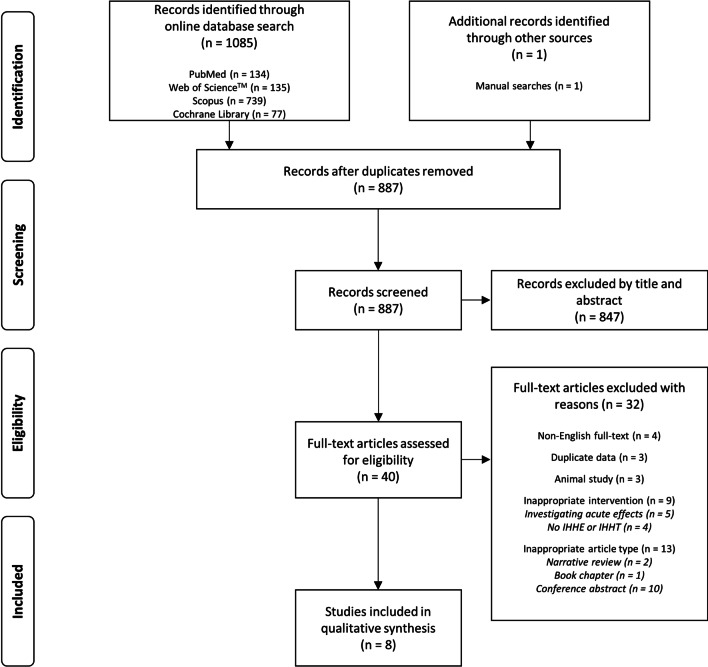
Methods: PubMed, Web of Science™, Scopus, and Cochrane Library databases were searched in accordance with PRISMA guidelines (January 2000 to September 2021) using the following inclusion criteria: (1) original research articles involving humans, (2) investigation of the chronic effect of IHH, (3) inclusion of a control group being not exposed to IHH, and (4) articles published in peer-reviewed journals written in English.
Results: Of 1085 articles initially found, eight studies were included. IHH was solely performed at rest in different populations including geriatric patients (n = 1), older patients with cardiovascular (n = 3) and metabolic disease (n = 2) or cognitive impairment (n = 1), and young athletes with overtraining syndrome (n = 1). The included studies confirmed the beneficial effects of chronic exposure to IHH, showing improvements in exercise tolerance, peak oxygen uptake, and global cognitive functions, as well as lowered blood glucose levels. A trend was discernible that chronic exposure to IHH can trigger a reduction in systolic and diastolic blood pressure. The evidence of whether IHH exerts beneficial effects on blood lipid levels and haematological parameters is currently inconclusive. A meta-analysis was not possible because the reviewed studies had a considerable heterogeneity concerning the investigated populations and outcome parameters.
Conclusion: Based on the published literature, it can be suggested that chronic exposure to IHH might be a promising non-pharmacological intervention strategy for improving peak oxygen consumption, exercise tolerance, and cognitive performance as well as reducing blood glucose levels, and systolic and diastolic blood pressure in older patients with cardiovascular and metabolic diseases or cognitive impairment. However, further randomized controlled trials with adequate sample sizes are needed to confirm and extend the evidence. This systematic review was registered on the international prospective register of systematic reviews (PROSPERO-ID: CRD42021281248) ( https://www.crd.york.ac.uk/prospero/ ).
Keywords: Cardiovascular disease; Cognitive impairment; Geriatrics; Hypoxic conditioning; Metabolic disease; Therapy.
© 2022. The Author(s).
Conflict of interest statement
Tom Behrendt, Robert Bielitzki, Martin Behrens, Fabian Herold, and Lutz Schega declare that they have no conflicts of interest relevant to the content of this review.
Figures
References
-
- Millet GP, Roels B, Schmitt L, Woorons X, Richalet JP. Combining hypoxic methods for peak performance. Sports Med. 2010;40:2–25. - PubMed
Publication types
LinkOut - more resources
Full Text Sources
Medical
