


Perinatal care in Western Uganda: Prevalence and factors associated with appropriate care among women attending three district hospitals
- PMID: 35639711
- PMCID: PMC9154186
- DOI: 10.1371/journal.pone.0267015
Perinatal care in Western Uganda: Prevalence and factors associated with appropriate care among women attending three district hospitals
Abstract
Background: Perinatal mortality remains high globally and remains an important indicator of the quality of a health care system. To reduce this mortality, it is important to provide the recommended care during the perinatal period. We assessed the prevalence and factors associated with appropriate perinatal care (antenatal, intrapartum, and postpartum) in Bunyoro region, Uganda. Results from this study provide valuable information on the perinatal care services and highlight areas of improvement for better perinatal outcomes.
Methods: A cross sectional survey was conducted among postpartum mothers attending care at three district hospitals in Bunyoro. Following consent, a questionnaire was administered to capture the participants' demographics and data on care received was extracted from their antenatal, labour, delivery, and postpartum records using a pre-tested structured tool. The care received by women was assessed against the standard protocol established by World Health Organization (WHO). Poisson regression with robust standard errors was used to assess factors associated with appropriate postpartum care.
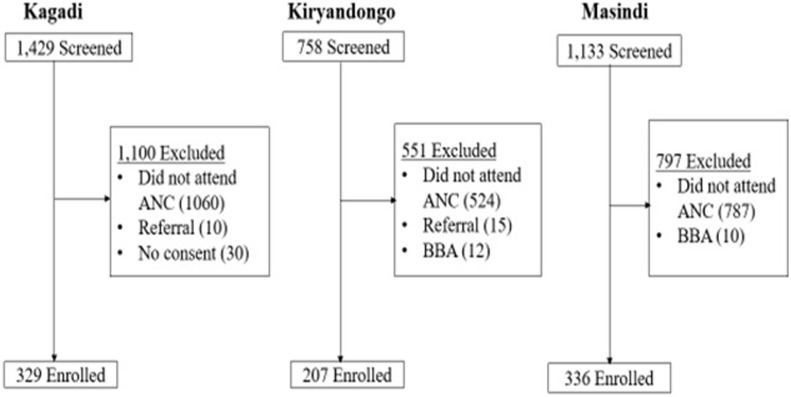
Results: A total of 872 mothers receiving care at the participating hospitals between March and June 2020 were enrolled in the study. The mean age of the mothers was 25 years (SD = 5.95). None of the mothers received appropriate antenatal or intrapartum care, and only 3.8% of the participants received appropriate postpartum care. Factors significantly associated with appropriate postpartum care included mothers being >35 years of age (adjusted prevalence ratio [aPR] = 11.9, 95% confidence interval [CI] 2.8-51.4) and parity, with low parity (2-3) and multiparous (>3) mothers less likely to receive appropriate care than prime gravidas (aPR = 0.3, 95% CI 0.1-0.9 and aPR = 0.3, 95% CI 0.1-0.8 respectively).
Conclusions: Antenatal, intrapartum, and postpartum care received by mothers in this region remains below the standard recommended by WHO, and innovative strategies across the continuum of perinatal care need to be devised to prevent mortality among the mothers. The quality of care also needs to be balanced for all mothers irrespective of the age and parity.
Conflict of interest statement
The authors have declared that no competing interests exist.
Figures
Similar articles
-
Perinatal care and its association with perinatal death among women attending care in three district hospitals of western Uganda.BMC Pregnancy Childbirth. 2024 Feb 6;24(1):113. doi: 10.1186/s12884-024-06305-5. BMC Pregnancy Childbirth. 2024. PMID: 38321398 Free PMC article.
-
Dietary diversity, undernutrition, and predictors among pregnant adolescents and young women attending Gulu University teaching hospitals in northern Uganda.PLoS One. 2024 Jul 24;19(7):e0307749. doi: 10.1371/journal.pone.0307749. eCollection 2024. PLoS One. 2024. PMID: 39046972 Free PMC article.
-
Perinatal death triples the prevalence of postpartum depression among women in Northern Uganda: A community-based cross-sectional study.PLoS One. 2020 Oct 13;15(10):e0240409. doi: 10.1371/journal.pone.0240409. eCollection 2020. PLoS One. 2020. PMID: 33048971 Free PMC article.
-
Impact of mobile health (mHealth) interventions during the perinatal period for mothers in low- and middle-income countries: a systematic review.JBI Database System Rev Implement Rep. 2019 Aug;17(8):1634-1667. doi: 10.11124/JBISRIR-2017-004022. JBI Database System Rev Implement Rep. 2019. PMID: 31404051
-
Maternal and child health services in India with special focus on perinatal services.J Perinatol. 1997 Jan-Feb;17(1):65-9. J Perinatol. 1997. PMID: 9069069 Review.
Cited by
-
Delays in Care for Children With Low Anorectal Malformations in Southwestern Uganda.J Surg Res. 2025 Jan;305:156-162. doi: 10.1016/j.jss.2024.11.013. Epub 2024 Dec 18. J Surg Res. 2025. PMID: 39700891
-
Do in-service training materials for midwifery care providers in sub-Saharan Africa meet international competency standards? A scoping review 2000-2020.BMC Med Educ. 2022 Oct 14;22(1):725. doi: 10.1186/s12909-022-03772-2. BMC Med Educ. 2022. PMID: 36242024 Free PMC article.
-
Factors associated with Women's timing of first antenatal care visit during their last pregnancy: evidence from 2016 Uganda demographic health survey.BMC Pregnancy Childbirth. 2022 Nov 10;22(1):829. doi: 10.1186/s12884-022-05167-z. BMC Pregnancy Childbirth. 2022. PMID: 36357843 Free PMC article.
-
Prevalence of postpartum complications and associated factors among postpartum women in Uganda, a cross-sectional study.BMC Pregnancy Childbirth. 2024 Oct 3;24(1):640. doi: 10.1186/s12884-024-06827-y. BMC Pregnancy Childbirth. 2024. PMID: 39363168 Free PMC article.
-
A secondary analysis of the factors associated with women´s adequate utilization of antenatal care services during their last pregnancy in Uganda.BMC Pregnancy Childbirth. 2023 Sep 26;23(1):692. doi: 10.1186/s12884-023-05994-8. BMC Pregnancy Childbirth. 2023. PMID: 37749492 Free PMC article.
References
-
- WHO. Every newborn: An action plan to end preventable deaths. Geneva; 2014.
-
- WHO. Maternal Mortality 2019 [updated 19 September 2019. Available from: https://www.who.int/news-room/fact-sheets/detail/maternal-mortality.
MeSH terms
LinkOut - more resources
Full Text Sources
Miscellaneous
