


Antiresorptive treatments for corticosteroid-induced osteoporosis: a Bayesian network meta-analysis
- PMID: 35641234
- PMCID: PMC9494254
- DOI: 10.1093/bmb/ldac017
Antiresorptive treatments for corticosteroid-induced osteoporosis: a Bayesian network meta-analysis
Abstract
Introduction: Corticosteroid-induced osteoporosis (CIO) is the most common type of secondary osteoporosis, leading to fractures, and increased morbidity and mortality.
Source of data: Pubmed, EMBASE, Scopus and Google Scholar databases.
Areas of agreement: Prolonged glucocorticoids administration leads to secondary osteoporosis.
Areas of controversy: The optimal management for CIO is controversial.
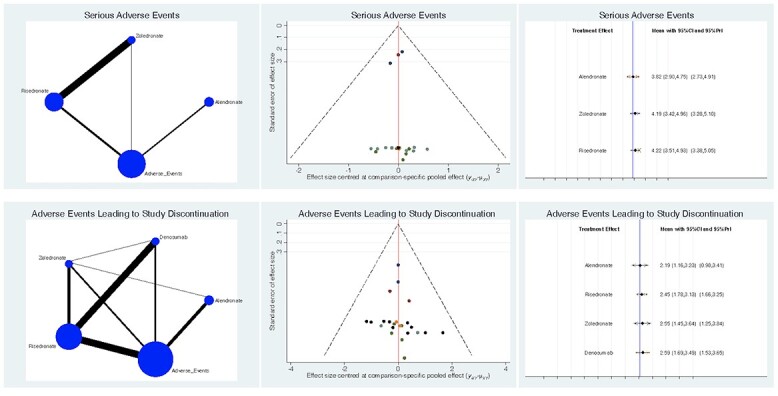
Growing points: The present study compared bone mineral density, fractures and adverse events in patients undergoing treatment with risedronate, alendronate, zoledronate, denosumab or etidronate for CIO.
Areas timely for developing research: For selected patients with CIO, alendronate performed better overall. These results must be interpreted within the limitations of the present study.
Level of evidence: I, Bayesian network meta-analysis of randomized clinical trials.
Keywords: BMD; alendronate; corticosteroid; drugs; fracture; osteoporosis.
© The Author(s) 2022. Published by Oxford University Press.
Figures
References
-
- Eriksen EF, Diez-Perez A, Boonen S. Update on long-term treatment with bisphosphonates for postmenopausal osteoporosis: a systematic review. Bone 2014;58:126–35. - PubMed
-
- Anastasilakis AD, Polyzos SA, Makras P. Therapy of endocrine disease: denosumab vs bisphosphonates for the treatment of postmenopausal osteoporosis. Eur J Endocrinol 2018;179:R31–45. - PubMed
-
- Sambrook P, Cooper C. Osteoporosis. Lancet 2006;367:2010–8. - PubMed
-
- Bilezikian JP. Efficacy of bisphosphonates in reducing fracture risk in postmenopausal osteoporosis. Am J Med 2009;122:S14–21. - PubMed
Publication types
MeSH terms
Substances
LinkOut - more resources
Full Text Sources
Medical
Research Materials
