


Age-Stratified Prevalence and Predictors of Neoplasia Among U.S. Adults Undergoing Screening Colonoscopy in a National Endoscopy Registry
- PMID: 35643172
- PMCID: PMC9398947
- DOI: 10.1053/j.gastro.2022.05.036
Age-Stratified Prevalence and Predictors of Neoplasia Among U.S. Adults Undergoing Screening Colonoscopy in a National Endoscopy Registry
Abstract
Background & aims: Several U.S. organizations now recommend starting average-risk colorectal cancer screening at age 45 years, but the prevalence of colonic neoplasia in individuals younger than 50 years has not been well characterized. We used a national endoscopic registry to calculate age-stratified prevalence and predictors of colorectal neoplasia.
Methods: Outpatient screening colonoscopies performed during 2010-2020 in the GI Quality Improvement Consortium registry were analyzed. We measured the prevalence of advanced neoplasia and adenomas by age, sex, and race/ethnicity, as well as the prevalence ratio of neoplasia compared with the reference group of 50- to 54-year-olds. Multivariable logistic regression models were used to identify predictors of neoplasia.
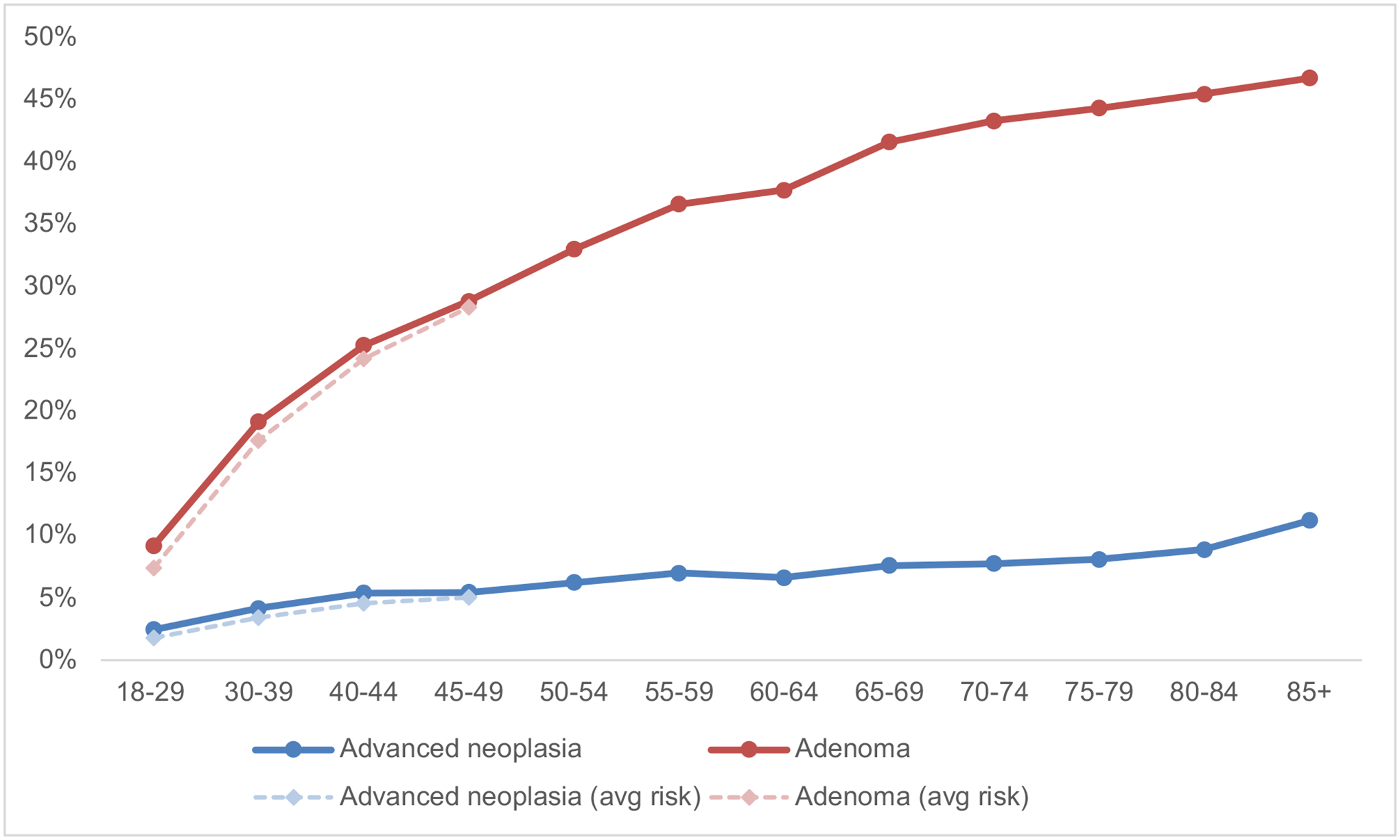
Results: We identified 3,928,727 screening colonoscopies, of which 129,736 (3.3%) were performed on average-risk individuals younger than 50 years. The prevalence of advanced neoplasia was 6.2% for 50- to 54-year-olds and 5.0% (prevalence ratio, 0.81; 95% confidence interval, 0.78-0.83) for average-risk 45- to 49-year-olds. Men had higher prevalence of neoplasia than women for all age groups. White individuals had higher prevalence of advanced neoplasia than persons of other racial/ethnic groups in most age groups, which was partially driven by serrated lesions. On multivariable regression, White individuals had higher odds of advanced neoplasia than Black, Hispanic, and Asian individuals in both younger and older age groups.
Conclusions: In a large U.S. endoscopy registry, the prevalence of advanced neoplasia in 45- to 49-year-olds was substantial and supports beginning screening at age 45 years. White individuals had higher risk of advanced neoplasia than Black, Hispanic, and Asian individuals across the age spectrum. These findings may inform adenoma detection benchmarks and risk-based screening strategies.
Keywords: Advanced Neoplasia; Early-Onset Colorectal Cancer; GIQuIC.
Published by Elsevier Inc.
Figures
References
-
- Bray F, Ferlay J, Soerjomataram I, et al. Global cancer statistics 2018: GLOBOCAN estimates of incidence and mortality worldwide for 36 cancers in 185 countries. CA Cancer J Clin 2018;68:394–424. - PubMed
-
- Santucci C, Boffetta P, Levi F, et al. Colorectal Cancer Mortality in Young Adults Is Rising in the United States, Canada, United Kingdom, and Australia but Not in Europe and Asia. Gastroenterology 2021. - PubMed
Publication types
MeSH terms
Grants and funding
LinkOut - more resources
Full Text Sources
Medical
