


Mitogenomes provide new insights of evolutionary history of Boreheptagyiini and Diamesini (Diptera: Chironomidae: Diamesinae)
- PMID: 35646319
- PMCID: PMC9130564
- DOI: 10.1002/ece3.8957
Mitogenomes provide new insights of evolutionary history of Boreheptagyiini and Diamesini (Diptera: Chironomidae: Diamesinae)
Abstract
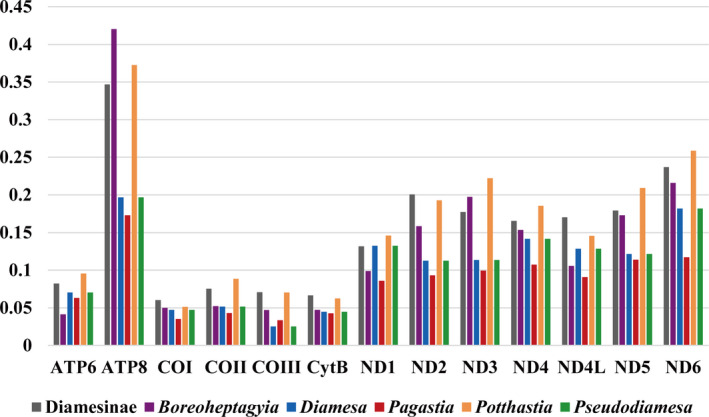
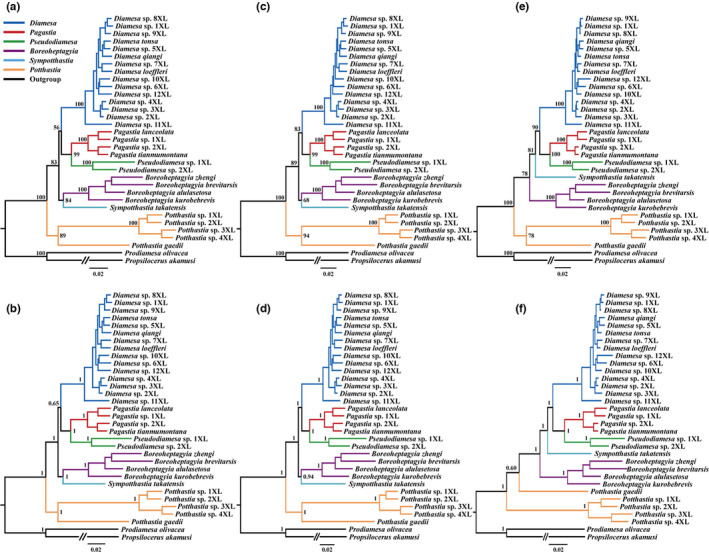
Mitogenomes have been widely used for phylogenetic reconstruction of various Dipteran groups, but specifically for chironomid, they have not been carried out to resolve the relationships. Diamesinae (Diptera: Chironomidae) are important bioindicators for freshwater ecosystem monitoring, but its evolutionary history remains uncertain for lack of information. Here, coupled with one previously published and 30 new mitogenomes of Diamesinae, we carried out comparative mitogenomic analysis and phylogenetic analysis. Mitogenomes of Diamesinae were conserved in structure, and all genes arranged in the same order as the ancestral insect mitogenome. All protein-coding genes in Diamesinae were under stronger purifying selection than those of other nonbiting midge species, which may exhibit signs of adaptation to life at cold living conditions. Phylogenetic analyses strongly supported the monophyly of Diamesinae, with Boreheptagyiini deeply nested within Diamesini. In addition, phylogenetic relationship of selected six genera was resolved, except Sympotthastia remained unstable. Our study revealed that the mitogenomes of Diamesinae are highly conserved, and they are practically useful for phylogenetic inference.
Keywords: Diamesinae; mitogenome; phylogeny.
© 2022 The Authors. Ecology and Evolution published by John Wiley & Sons Ltd.
Conflict of interest statement
The authors declare that they have no conflicts of interest.
Figures
References
-
- Ashe, P. , & O'Connor, J. P. (2009). A world catalogue of Chironomidae (Diptera), Part 1: Buchonomyiinae, Chilenomyiinae, Podonominae, Aphroteniinae, Tanypodinae, Usambaromyiinae, Diamesinae, Prodiamesinae and Telmatogetoninae (445 pp). Irish Biogeographical Society.
LinkOut - more resources
Full Text Sources
