


2,4-Diacetylphloroglucinol producing Pseudomonas fluorescens JM-1 for management of ear rot disease caused by Fusarium moniliforme in Zea mays L
- PMID: 35646503
- PMCID: PMC9130364
- DOI: 10.1007/s13205-022-03201-7
2,4-Diacetylphloroglucinol producing Pseudomonas fluorescens JM-1 for management of ear rot disease caused by Fusarium moniliforme in Zea mays L
Abstract
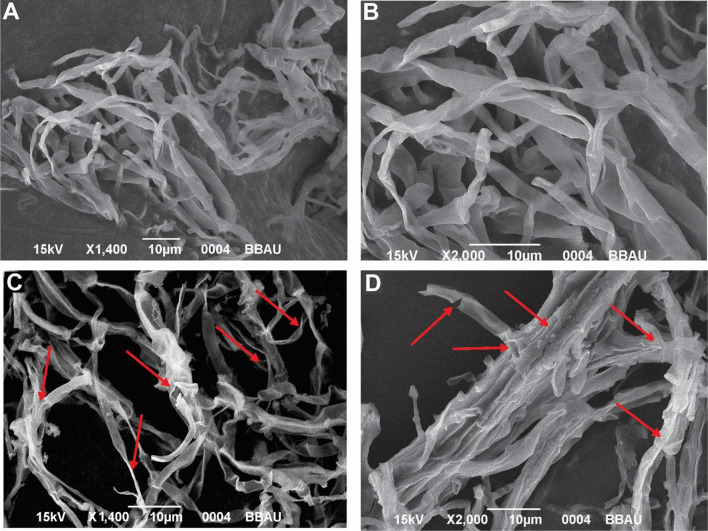
Maize (Zea mays L.) is a major cereal crop grown in a large number of countries. Loss in maize yield due to biotic stresses including fungal phytopathogens is a matter of immense concern. Control measures applied for eradication of fungal phytopathogens in maize are not up to the mark and more often involve harsh chemical(s)/pesticide(s) that cause deleterious effects both in humans and soil biota. Greener alternatives, such as the use of rhizosphere microbes in the form of bioinoculants, have proven to be very successful in terms of enhancing crop yield and suppressing fungal phytopathogens. In the present study, fluorescent pseudomonads were isolated from the maize rhizosphere and monitored for their plant growth-promoting (PGP) and biocontrol activities against Fusarium moniliforme. Based on various PGP traits and biocontrol potential, isolate JM-1 was found to be most effective and as per 16S rRNA gene sequencing analysis was identified as Pseudomonas fluorescens. Further experiments showed that the biocontrol potential of JM-1 against ear rot fungus involved the production of antifungal compound 2,4-diacetylphloroglucinol (DAPG). When examined for antagonistic interaction under scanning electron microscopy (SEM), structural abnormality, hyphal lysis, and deformity in fungal mycelium were observed. In the pot experiment, application of talc-based JM-1 containing bioformulation (in pot trials) showed significant enhancement in maize growth parameters (including the seed number and weight) in comparison to control even in presence of the phytopathogen. Ear fresh weight, dry weight, number of seeds per plant, and 100-grain weight were found to increase significantly by 34, 34, 52, and 18% respectively, in comparison to control. P. fluorescens JM-1 can therefore be used as a bioinoculant for ear rot disease control and sustainably enhancing maize yield.
Supplementary information: The online version contains supplementary material available at 10.1007/s13205-022-03201-7.
Keywords: 2,4-DAPG; Biocontrol; Ear rot; Fluorescent pseudomonads; Maize; Metabolite; Pseudomonas.
© King Abdulaziz City for Science and Technology 2022.
Conflict of interest statement
Conflict of interestThe authors declare that they have no conflict of interest in the publication.
Figures
References
-
- Abbaszadeh-Dahaji P, Masalehi F, Akhgar A. Improved growth and nutrition of Sorghum (Sorghum bicolor) plants in a low-Fertility calcareous soil treated with plant growth–promoting rhizobacteria and Fe-EDTA. J Soil Sci Plant Nutr. 2020;20(1):31–42. doi: 10.1007/s42729-019-00098-9. - DOI
-
- Agaras BC, Noguera F, González Anta G, Wall L, Valverde C. Biocontrol potential index of pseudomonads, instead of their direct-growth promotion traits, is a predictor of seed inoculation effect on crop productivity under field conditions. Biol Control. 2020;143:104209. doi: 10.1016/j.biocontrol.2020.104209. - DOI
-
- Andreolli M, Zapparoli G, Angelini E, Lucchetta G, Lampis S, Vallini G. Pseudomonas protegens MP12: A plant growth-promoting endophytic bacterium with broad-spectrum antifungal activity against grapevine phytopathogens. Microbiol Res. 2019;219:123–131. doi: 10.1016/j.micres.2018.11.003. - DOI - PubMed
-
- Andriolli CF, Casa RT, Kuhnem PR, Bogo A, Zancan RL, Reis EM. Timing of fungicide application for the control of Gibberella ear rot of maize. Trop Plan Pathol. 2016;41(4):264–269. doi: 10.1007/s40858-016-0095-3. - DOI
-
- Arora NK, Fatima T, Mishra I, Verma M, Mishra J, Mishra V. Environmental sustainability: challenges and viable solutions. Env Sust. 2018;1:309–340.
LinkOut - more resources
Full Text Sources
Miscellaneous
