


doi: 10.1016/j.eats.2022.01.007.
eCollection 2022 May.
Anterior Slope Correction-Flexion Osteotomy in Traumatic Genu Recurvatum
Affiliations
- PMID: 35646563
- PMCID: PMC9134481
- DOI: 10.1016/j.eats.2022.01.007
Item in Clipboard
Anterior Slope Correction-Flexion Osteotomy in Traumatic Genu Recurvatum
Arthrosc Tech.
.
Abstract
A decreased posterior tibial slope has been associated with an increased risk of posterior cruciate ligament failure, anterior knee pain, and premature knee osteoarthritis. Trauma is a common cause of osseous genu recurvatum. Surgical management is recommended to correct the tibial slope and prevent knee pain and osteoarthritis progression. This article discusses our preferred treatment using a proximal tibial opening-wedge osteotomy for surgical management of genu recurvatum secondary to significant anterior tibial slope.
© 2022 The Authors.
Figures

(A) Preoperative lateral view radiograph of the right knee showing an anterior tibial slope of 15.8°. (B) Lateral view radiograph of the left knee, showing anterior tibial slope of 4.1°. The tibial slope was measured using the anatomic tibial axis using points at approximately 5 and 15 cm distal to the joint line on both the anterior and posterior tibial cortices. The midpoint between the respective anterior and posterior points was then established. These midpoints were connected with a vertical line to establish the longitudinal axis of the posterior tibial slope calculation.

Right knee. (A) Intraoperative photo of stacked osteotomes being used to create the opening wedge in the right tibia. (B) Intraoperative fluoroscopic lateral imaging of the proximal tibial is performed to confirm the correct depth of the osteotomy, to make sure the posterior tibial cortex is intact, and to evaluate the degree of slope correction.

Right knee. Anterior intraoperative photo of a spreader device maintaining distraction to achieve stress relaxation of the posterior cortex to minimize the risk of an undesired fracture, after gradual and continuous opening with osteotomes until the desired tibial slope is achieved on fluoroscopic imaging.
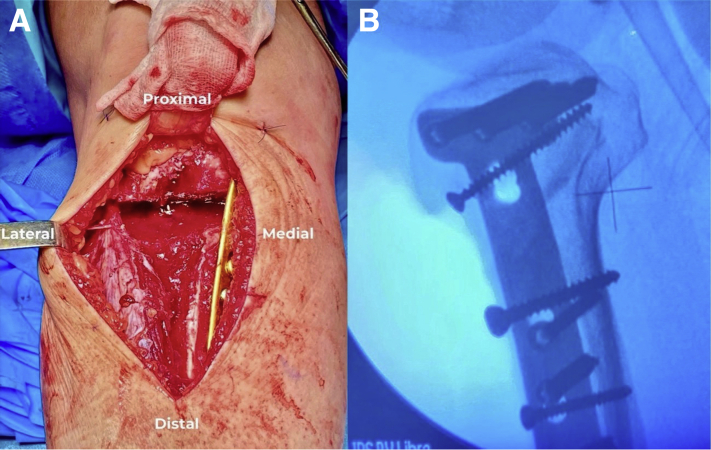
Right knee. (A) A TomoFix plate is placed just medial to the tibial tuberosity osteotomy and fixed in full extension. To achieve correct adaptation of the plate to bone, the use of a 4.5-mm cortical screw in the first of the 3 distal holes is recommended. Once adapted to the tibia, the rest of the distal fixation can also be carried out with angular stability screws. (B) Lateral intraoperative fluoroscopy confirmed proper placement of the plate and screws and correction of the anterior tibial slope.

Right knee. (A) Preoperative lateral view radiograph showing anterior tibial slope of 15.8°. (B) Postoperative lateral view radiograph showing posterior tibial slope of 0.6° after the anterior opening-wedge osteotomy, demonstrating a correction of 16.4°.
Comment in
-
Regarding "Anterior Slope Correction-Flexion Osteotomy in Traumatic Genu Recurvatum".Arthroscopy. 2023 Nov;39(11):2257-2258. doi: 10.1016/j.arthro.2023.07.015. Arthroscopy. 2023. PMID: 37866859 No abstract available.
-
Author Reply to "Regarding 'Anterior Slope Correction-Flexion Osteotomy in Traumatic Genu Recurvatum'".Arthroscopy. 2023 Nov;39(11):2258-2259. doi: 10.1016/j.arthro.2023.07.016. Arthroscopy. 2023. PMID: 37866860 No abstract available.
References
-
- Dejour D., La Barbera G., Pasqualotto S., et al. Sagittal plane corrections around the knee. J Knee Surg. 2017;30:736–745. - PubMed
-
- Dean R.S., DePhillipo N.N., Chahla J., Larson C.M., LaPrade R.F. Posterior tibial slope measurements using the anatomic axis are significantly increased compared with those that use the mechanical axis. Arthroscopy. 2021;37:243–249. - PubMed
LinkOut - more resources
Full Text Sources
