


COVID-19 Vaccine Hesitancy Among Older Adolescents and Young Adults: A National Cross-Sectional Study in China
- PMID: 35646783
- PMCID: PMC9133905
- DOI: 10.3389/fpubh.2022.877668
COVID-19 Vaccine Hesitancy Among Older Adolescents and Young Adults: A National Cross-Sectional Study in China
Abstract
Background: With promotion of COVID-19 vaccinations, there has been a corresponding vaccine hesitancy, of which older adolescents and young adults represent groups of particular concern. In this report, we investigated the prevalence and reasons for vaccine hesitancy, as well as potential risk factors, within older adolescents and young adults in China.
Methods: To assess these issues, an online survey was administered over the period from March 14 to April 15, 2021. Older adolescents (16-17 years old) and young adults (18-21 years old) were recruited nationwide from Wechat groups and results from a total of 2,414 respondents were analyzed. Socio-demographic variables, vaccine hesitancy, psychological distress, abnormal illness behavior, global well-being and social support were analyzed in this report.
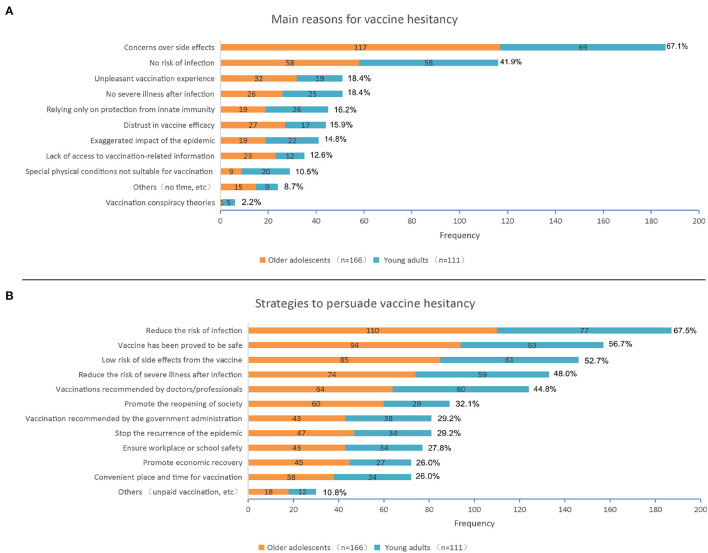
Results: Compared to young adults (n = 1,405), older adolescents (n = 1,009) showed higher prevalence rates of COVID-19 vaccine hesitancy (16.5 vs. 7.9%, p < 0.001). History of physical diseases (p = 0.007) and abnormal illness behavior (p = 0.001) were risk factors for vaccine hesitancy among older adolescents, while only a good self-reported health status (p = 0.048) was a risk factor for young adults. Concerns over COVID-19 vaccine side effects (67.1%) and beliefs of invulnerability regarding infection risk (41.9%) were the most prevalent reasons for vaccine hesitancy. Providing evidence on the vaccine reduction of COVID-19 infection risk (67.5%), ensuring vaccine safety (56.7%) and the low risk of side effects (52.7%) were the most effective persuasions for promoting vaccinations.
Conclusion: In China, older adolescents showed a higher prevalence for vaccine hesitancy than that of young adults. Abnormal illness behavior and history of physical diseases were risk factors for vaccine hesitancy among these older adolescents, while social support represents an important factor which could help to alleviate this hesitancy.
Keywords: COVID-19; PSI-Y; older adolescents; vaccine hesitancy; young adults.
Copyright © 2022 Zhang, Li, Wang, Luo, Wang, Wang, Li, Meng, Yang, Liu, Zhou, Li, Zhang, Bi, Zhang and Zheng.
Conflict of interest statement
The authors declare that the research was conducted in the absence of any commercial or financial relationships that could be construed as a potential conflict of interest.
Figures
References
Publication types
MeSH terms
Substances
LinkOut - more resources
Full Text Sources
Medical
Miscellaneous
