


Monitoring Acclimatization and Training Responses Over 17-21 Days at 1,800 m in Elite Cross-Country Skiers and Biathletes
- PMID: 35647539
- PMCID: PMC9130592
- DOI: 10.3389/fspor.2022.852108
Monitoring Acclimatization and Training Responses Over 17-21 Days at 1,800 m in Elite Cross-Country Skiers and Biathletes
Abstract
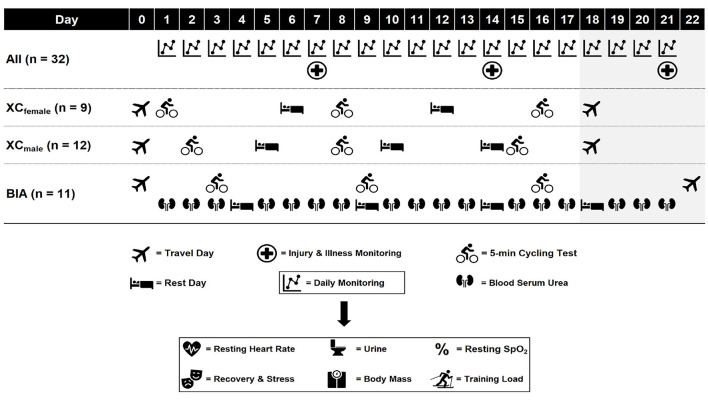
Objective: To monitor the daily variations and time course of changes in selected variables during a 17-21-day altitude training camp at 1,800 m in a group of elite cross-country skiers (9 women, 12 men) and biathletes (7 women, 4 men).
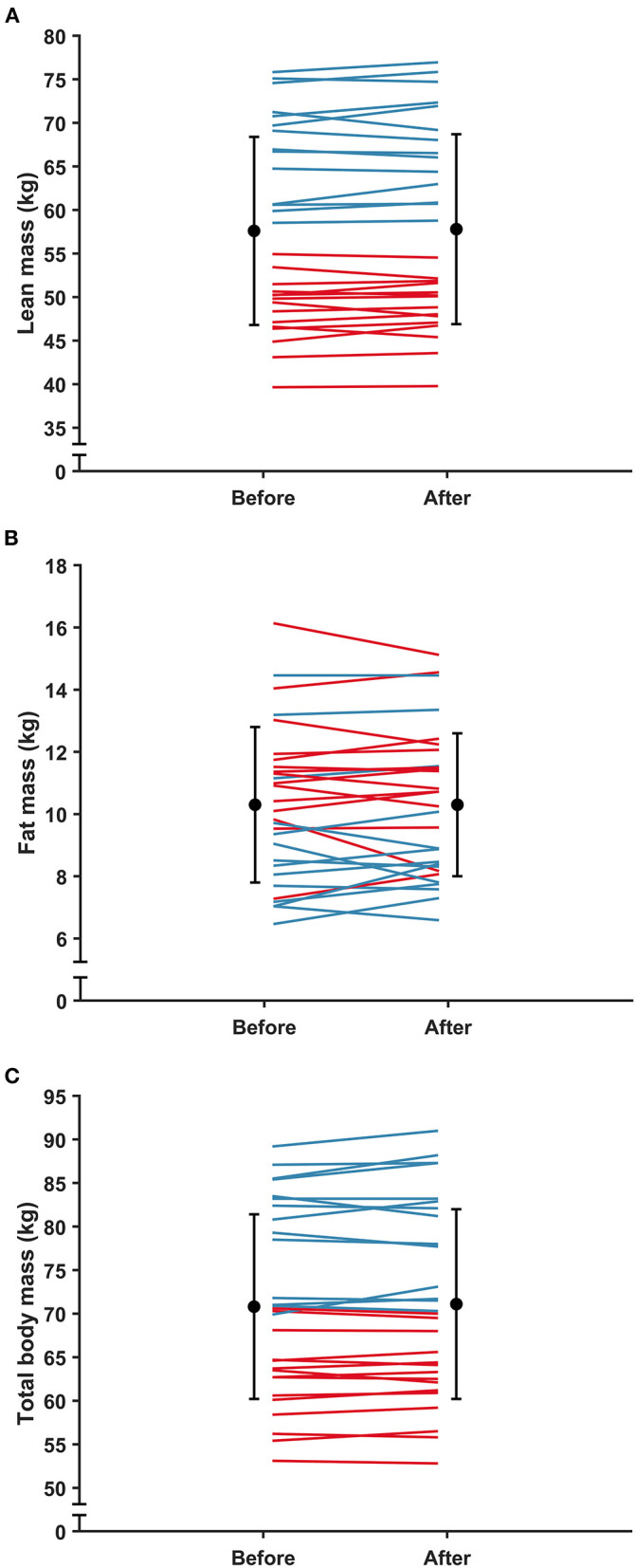
Methods: Among other variables, resting peripheral oxygen saturation (SpO2rest), resting heart rate (HRrest) and urine specific gravity (USG) were monitored daily at altitude, while illness symptoms were monitored weekly. Before and after the camp, body composition (i.e., lean and fat mass) and body mass were assessed in all athletes, while roller-skiing speed at a blood lactate concentration of 4 mmol·L-1 (Speed@4mmol) was assessed in the biathletes only.
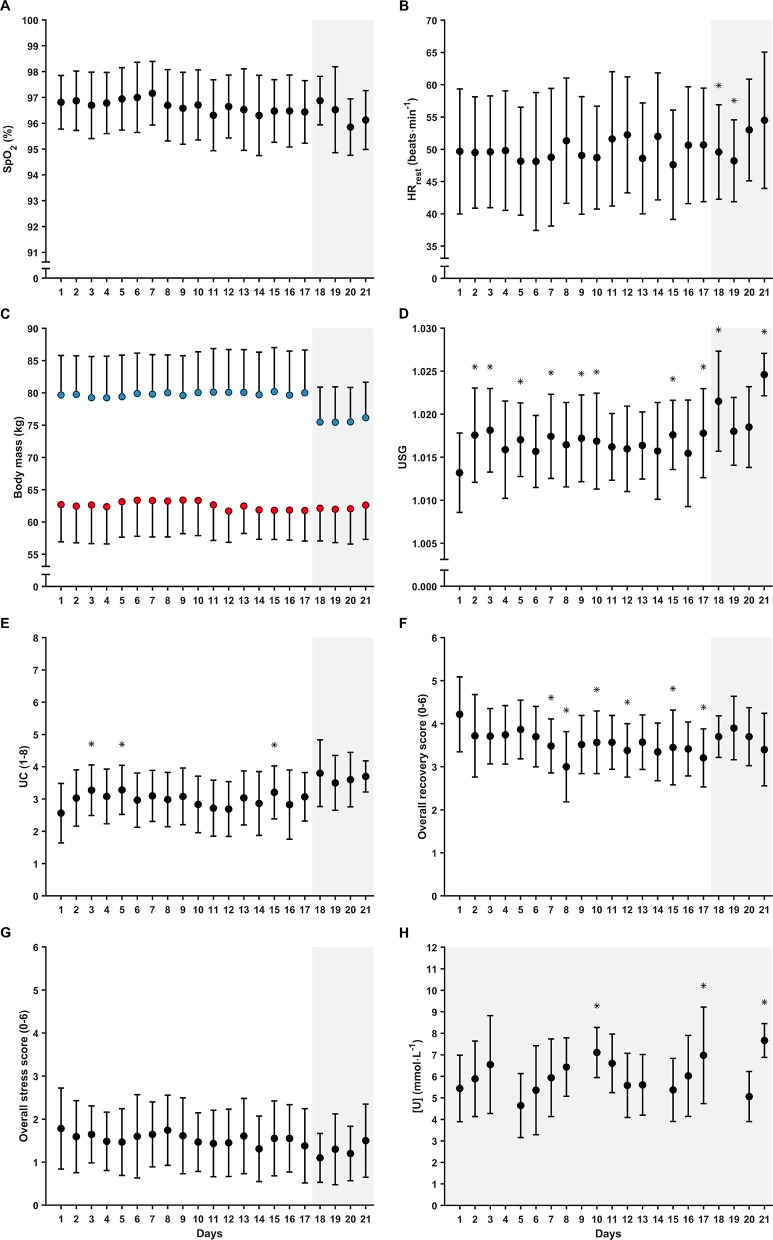
Results: Neither SpO2rest, HRrest nor USG changed systematically during the camp (p > 0.05), although some daily time points differed from day one for the latter two variables (p < 0.05). In addition, body composition and body mass were unchanged from before to after the camp (p > 0.05). Eleven out of 15 illness episodes were reported within 4 days of the outbound or homebound flight. The five biathletes who remained free of illness increased their Speed@4mmol by ~ 4% from before to after the camp (p = 0.031).
Conclusions: The present results show that measures typically recommended to monitor acclimatization and responses to altitude in athletes (e.g., SpO2rest and HRrest) did not change systematically over time. Further research is needed to explore the utility of these and other measures in elite endurance athletes at altitudes typical of competition environments.
Keywords: Nordic skiing; altitude; athlete monitoring; endurance sports; hypoxia; winter sports.
Copyright © 2022 Karlsson, Laaksonen and McGawley.
Conflict of interest statement
The authors declare that the research was conducted in the absence of any commercial or financial relationships that could be construed as a potential conflict of interest.
Figures
References
-
- Bates D., Machler M., Bolker B. M., Walker S. C. (2015). Fitting linear mixed-effects models using lme4. J. Stat. Softw. 67, 1–48. 10.18637/jss.v067.i01 - DOI
LinkOut - more resources
Full Text Sources
