Review
. 2022 May 3;2(5):1054-1070.
doi: 10.1021/jacsau.2c00138. eCollection 2022 May 23.

Emerging Electrochemical Processes to Decarbonize the Chemical Industry

Affiliations
Review

Emerging Electrochemical Processes to Decarbonize the Chemical Industry

Rong Xia et al. JACS Au. .

Abstract

Electrification is a potential approach to decarbonizing the chemical industry. Electrochemical processes, when they are powered by renewable electricity, have lower carbon footprints in comparison to conventional thermochemical routes. In this Perspective, we discuss the potential electrochemical routes for chemical production and provide our views on how electrochemical processes can be matured in academic research laboratories for future industrial applications. We first analyze the CO2 emission in the manufacturing industry and conduct a survey of state of the art electrosynthesis methods in the three most emission-intensive areas: petrochemical production, nitrogen compound production, and metal smelting. Then, we identify the technical bottlenecks in electrifying chemical productions from both chemistry and engineering perspectives and propose potential strategies to tackle these issues. Finally, we provide our views on how electrochemical manufacturing can reduce carbon emissions in the chemical industry with the hope to inspire more research efforts in electrifying chemical manufacturing.


Conflict of interest statement

The authors declare no competing financial interest.

Figures
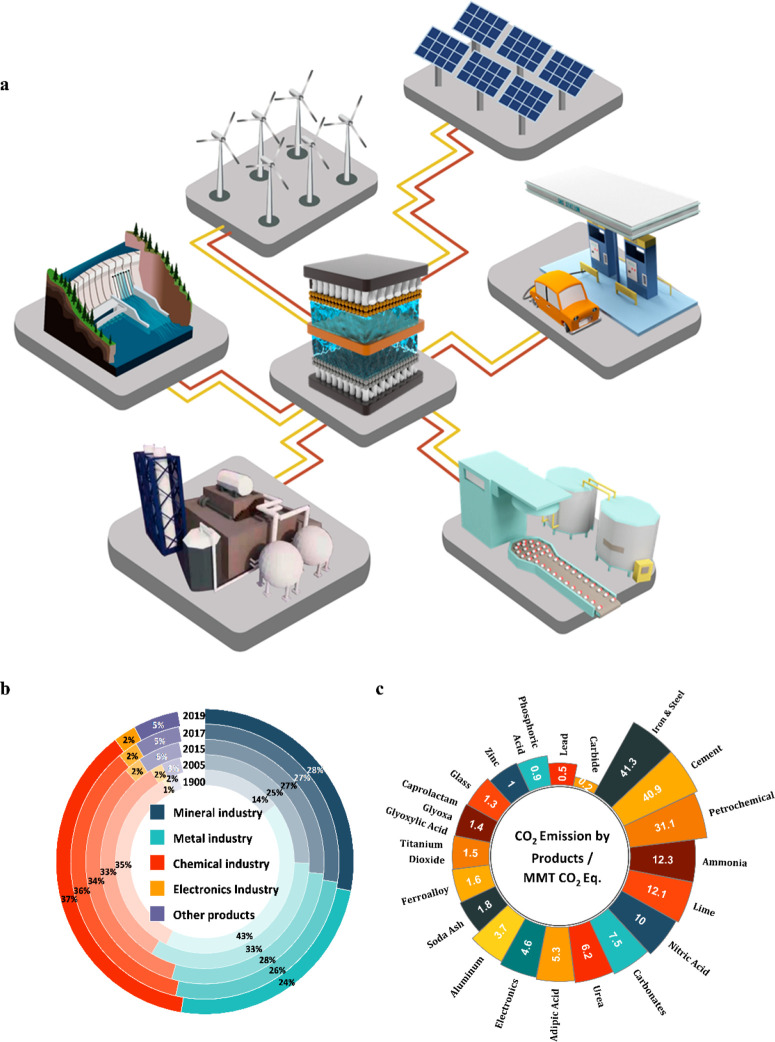
Figure 1
Figure 1
Electrochemical production with a low carbon footprint and evaluation of CO2 emission in the current industry: (a) schematics of electrochemical production driven by renewable energy (i.e., solar, wind, and hydropower) to produce fuels, commodity chemicals, and specialty chemicals; (b) CO2 emission in various industries; (c) CO2 emission divided into different products.
Figure 2
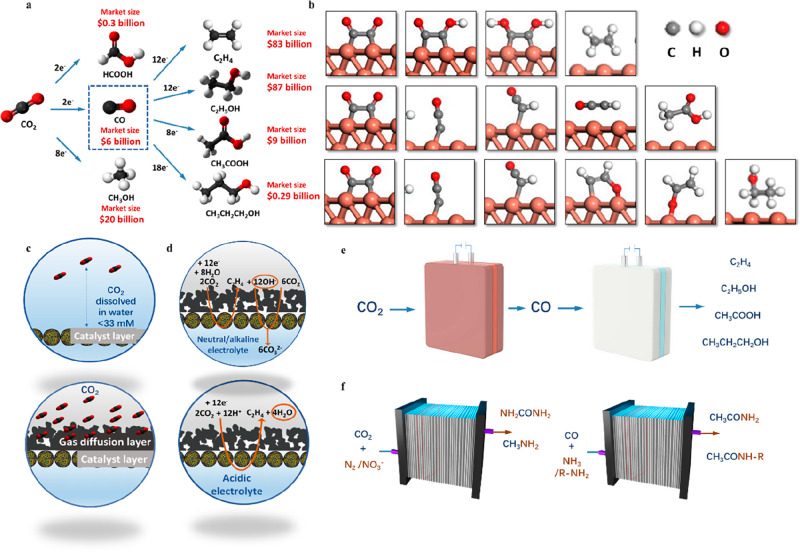
Figure 2
CO2 electroreduction to valuable fuels and feedstocks: (a) potential products of CO2 electroreduction with the market size; (b) reaction mechanism of C–C coupling on Cu in CO2 and CO electroreduction; (c) CO2 abundance on the electrode surface in a batch cell and a gas diffusion electrode, respectively. (d) CO2 electroreduction with CO2 absorption by OH at neutral and alkaline pH and CO2 electroreduction without CO2 loss under acidic conditions; (e) tandem process of CO2 electrochemical conversion to multicarbon products in cascade high-temperature solid oxide electrolyzer and low-temperature CO electrolyzer; (f) CO2/CO coelectrolysis with N-containing compounds forming high-value-added chemicals beyond hydrocarbons and oxygenates.,
Figure 3
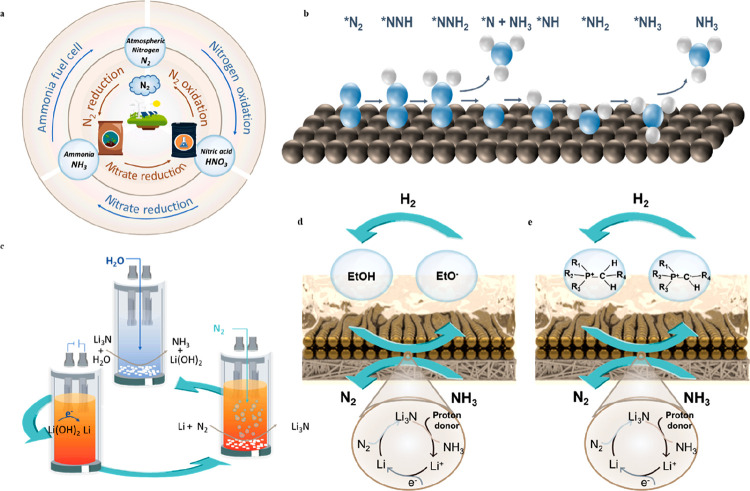
Figure 3
Electrochemical N2 fixation: (a) electrochemical nitrogen cycle; (b) reaction mechanism of nitrogen electroreduction in aqueous electrolyte. (c) high-temperature Li-mediated N2 electroreduction in molten lithium hydroxide; room-temperature Li-mediated N2 electroreduction in an organic electrolyte using ethanol (d) or phosphonium cation (e) as the proton source.
Figure 4
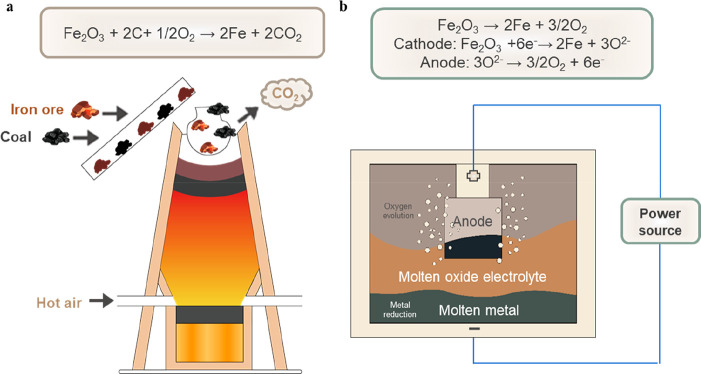
Figure 4
Comparison of conventional metal industry and electrochemical metal manufacturing: (a) conventional iron making in a blast furnace with coal as a reducing agent; (b) molten oxide electrolysis technology applied in metal manufacturing.
Figure 5
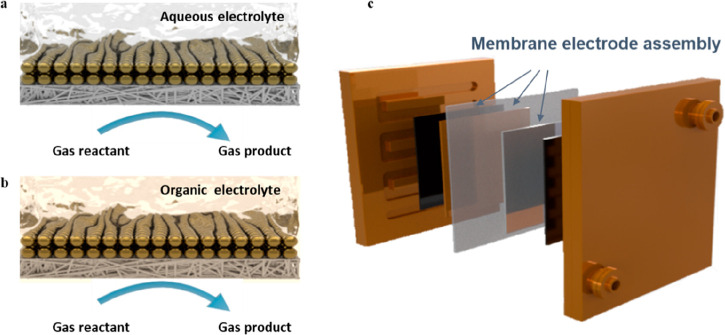
Figure 5
Diagram of reactor design for electrosynthesis: (a) schematic of a hydrophobic gas diffusion electrode; (b) schematic of an oleophobic gas diffusion electrode that can potentially be applied in gas-fed organic electrosynthesis; (c) membrane electrode assembly (MEA) electrolyzer.
Figure 6
Figure 6
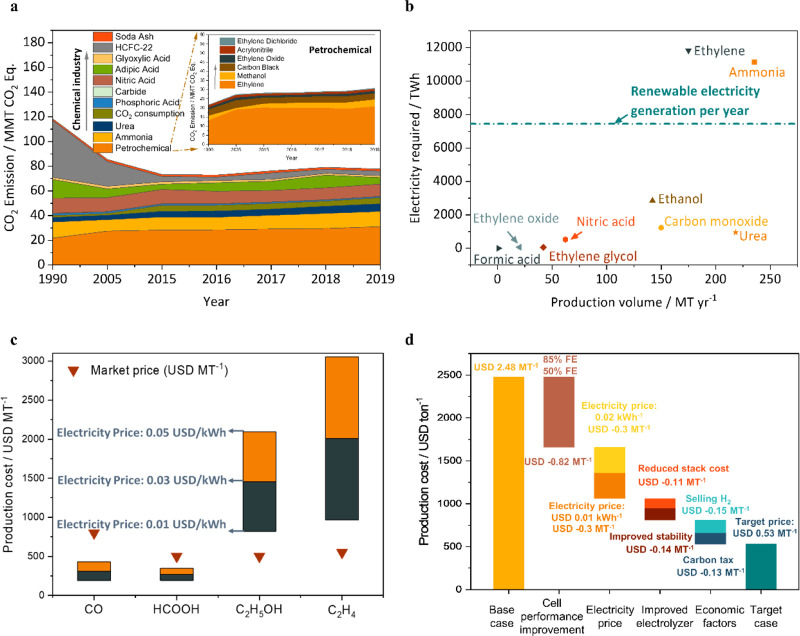
Commodity chemicals with high carbon footprint: (a) CO2 emission of commodity chemicals; (b) estimated electricity consumption if the production is completely electrified; (c) sensitivity analysis of production cost on electricity price of carbon monoxide, formic acid, ethanol, and ethylene production from CO2 electroreduction; (d) reducing production cost through successive process optimization.

References

    1. Bouckaert S.; Fernandez Pales A.; McGlade C.; Remme U.; Wanner B.; Varro L.; D’Ambrosio D.; Spencer T.. Net Zero by 2050-A Roadmap for the Global Energy Sector; International Energy Agency: 2021.
    1. Mitigation of climate change. Contribution of Working Group III to the Fifth Assessment Report of the Intergovernmental Panel on Climate Change; 2014; p 1454.
    1. Chu S.; Cui Y.; Liu N. The path towards sustainable energy. Nat. Mater. 2017, 16 (1), 16–22. 10.1038/nmat4834. - DOI - PubMed
    1. Davidson D. J. Exnovating for a renewable energy transition. Nat. Energy 2019, 4 (4), 254–256. 10.1038/s41560-019-0369-3. - DOI
    1. Tackett B. M.; Gomez E.; Chen J. G. Net reduction of CO2 via its thermocatalytic and electrocatalytic transformation reactions in standard and hybrid processes. Nat. Catal. 2019, 2 (5), 381–386. 10.1038/s41929-019-0266-y. - DOI