Clinical Trial
. 2023 Jan 5;29(1):85-96.
doi: 10.1093/ibd/izac063.

Long-term Risk of Herpes Zoster Infection in Patients With Ulcerative Colitis Receiving Tofacitinib

Affiliations
Clinical Trial

Long-term Risk of Herpes Zoster Infection in Patients With Ulcerative Colitis Receiving Tofacitinib

Kevin L Winthrop et al. Inflamm Bowel Dis. .

Abstract

Background: Tofacitinib is an oral, small molecule Janus kinase inhibitor for the treatment of ulcerative colitis (UC). We report herpes zoster (HZ) incidence and risk factors in the tofacitinib UC clinical program (up to 7.8 years).

Methods: Proportions and incidence rates (IRs; unique patients with events/100 patient-years) of HZ were evaluated in 4 cohorts: Induction (phase 2 and 3 induction study data), Maintenance (phase 3 maintenance study data), Overall (data from all phase 2, 3, and open-label, long-term extension studies), and Overall plus interim 6-month phase 3b and 4 data. Herpes zoster risk factors were assessed by Cox regression analysis.

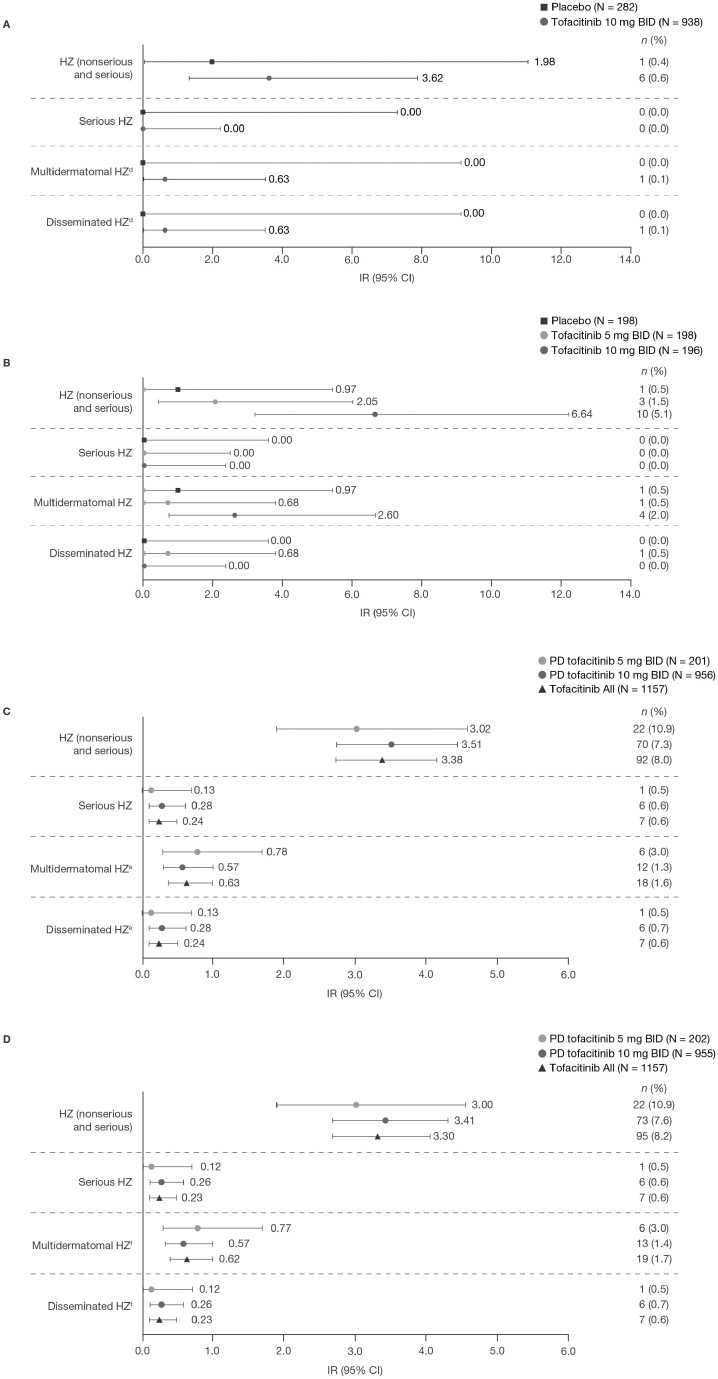
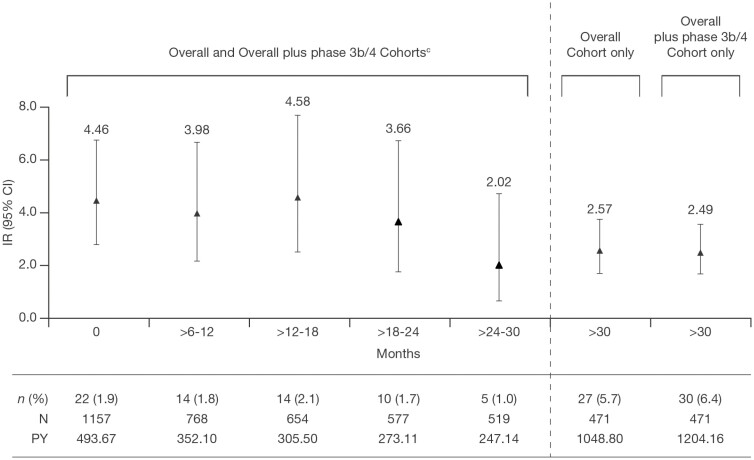
Results: In the Induction and Maintenance Cohorts, IRs for HZ (nonserious and serious) were numerically higher with tofacitinib 10 mg twice daily (BID) vs placebo and tofacitinib 10 vs 5 mg BID, respectively. With all tofacitinib doses (5 or 10 mg BID), IRs (95% confidence intervals) for HZ in the Overall and Overall plus phase 3b/4 Cohorts (total exposure, 2814.4 and 2999.7 patient-years, respectively) were 3.38 (2.73-4.15) and 3.30 (2.67-4.04), respectively. In the Overall plus phase 3b/4 Cohort, >90% of HZ were nonserious; >90% were mild/moderate; >90% resolved without discontinuing tofacitinib; 0.6% of patients had multiple HZ events. Herpes zoster IRs were stable when analyzed by 6-month intervals up to >30 months. Herpes zoster risk factors included older age, lower weight, geographic region, and prior tumor necrosis factor inhibitor (TNFi) failure.

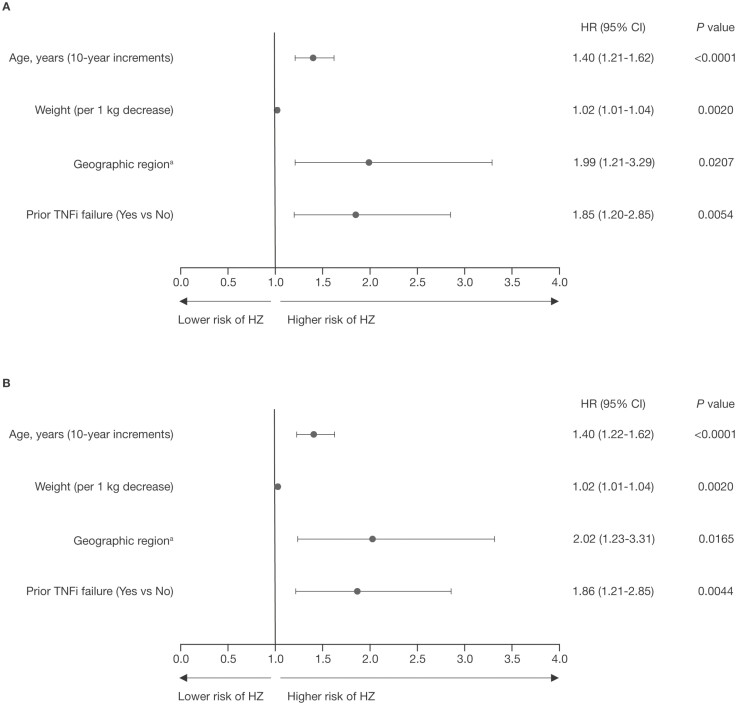
Conclusions: Most HZ events were mild/moderate. Herpes zoster IRs remained stable over 7.8 years of exposure. Older age, lower weight, geographic region, and prior TNFi failure were associated with increased HZ risk.

Clinicaltrials.gov: NCT00787202;NCT01465763;NCT01458951;NCT01458574;NCT01470612;NCT03281304.

Keywords: herpes zoster; tofacitinib; ulcerative colitis.

Plain language summary

Incidence rates for herpes zoster in patients with ulcerative colitis have remained stable over 7.8 years of tofacitinib exposure. Older age, lower weight, geographic region, and prior tumor necrosis factor inhibitor failure were identified as significant herpes zoster risk factors.


Figures

Figure 1.
Figure 1.
Proportions and IRs for HZ events in (A) the Induction Cohorta; (B) the Maintenance Cohorta; (C) the Overall Cohort (data as of August 2020)b; and (D) the Overall plus phase 3b/4 Cohort.c aIncludes data previously reported by Winthrop KL, et al 2018.bIncludes final data from OCTAVE Open, as of August 24, 2020 (≤7.8 years of exposure). cIncludes final data from OCTAVE Open, as of August 24, 2020, and data from RIVETING, as of February 20, 2020 (≤7.8 years of exposure). dN = 234 and N = 905 for placebo and tofacitinib 10 mg BID, respectively. eN = 923 and N = 1124 for tofacitinib 10 mg BID and Tofacitinib All, respectively. fN = 202, N = 922, and N = 1124 for PD tofacitinib 5 mg BID, PD tofacitinib 10 mg BID, and Tofacitinib All, respectively. Abbreviations: BID, twice daily; CI, confidence interval; HZ, herpes zoster; IR, incidence rate (unique patients with events per 100 PY); N, total number of patients in the analysis; n, number of patients with an event; PD, predominant dose; PY, patient-years.
Figure 2.
Figure 2.
Proportions and IRs for all HZ (nonserious and serious) events over time in the Overall Cohorta and Overall plus phase 3b/4 Cohort.b Incidence rates (95% CI), numbers of patients, and PY of exposure were the same in both Overall and Overall plus phase 3b/4 Cohorts at time points ≤30 months. aIncludes final data from OCTAVE Open, as of August 24, 2020. bIncludes final data from OCTAVE Open, as of August 24, 2020, and data from RIVETING, as of February 20, 2020. cThe patient population was the same for the Overall and Overall plus phase 3b/4 Cohorts because patients could enter RIVETING if they had received tofacitinib 10 mg BID for ≥2 consecutive years in OCTAVE Open, were in stable remission for ≥6 months, and had not received corticosteroids for UC for ≥4 weeks prior to baseline. Abbreviations: CI, confidence interval; HZ, herpes zoster; IR, incidence rate (unique patients with events per 100 PY); N, total number of patients in the analysis; n, number of patients with an event; PY, patient-years.
Figure 3.
Figure 3.
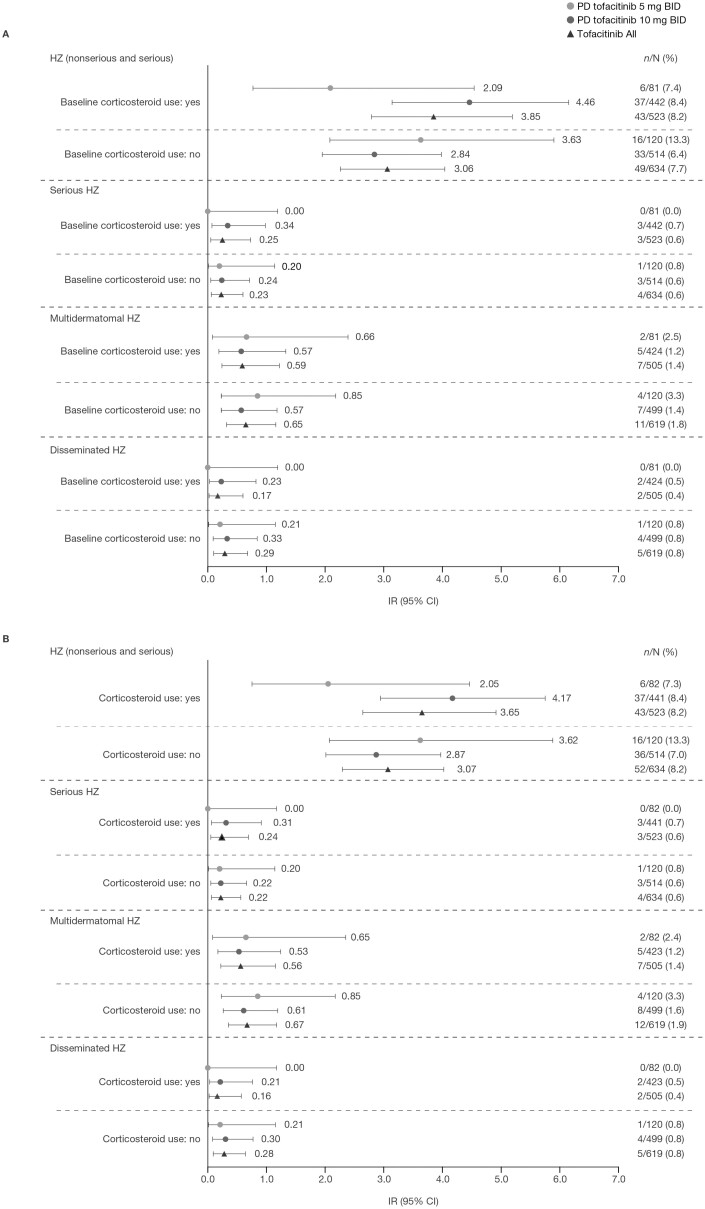
Herpes zoster events by baseline corticosteroid use in (A) the Overall Cohorta and (B) the Overall plus phase 3b/4 Cohort.b Events were counted up to 28 days beyond the last dose of study drug. aIncludes final data from OCTAVE Open, as of August 24, 2020. bIncludes final data from OCTAVE Open, as of August 24, 2020 and data from RIVETING, as of February 20, 2020. Abbreviations: BID, twice daily; CI, confidence interval; HZ, herpes zoster; IR, incidence rate (patients with events per 100 PY); N, total number of patients in the analysis; n, number of patients with an event; PD, predominant dose; PY, patient-years.
Figure 4.
Figure 4.
Risk factors for HZ by multivariable regression analysis (stepwise selection) in (A) the Overall Cohort and (B) the Overall plus phase 3b/4 Cohort. In total, 92 of 1157 patients in the Overall Cohort with an HZ (nonserious and serious) event and 95 of 1157 patients in the Overall plus phase 3b/4 Cohort with an HZ (nonserious and serious) event were included in Cox multivariable models. aGeographic region (which included North America, Europe, and other) was a significant risk factor; data shown are for North American vs European region. Abbreviations: CI, confidence interval; HR, hazard ratio; HZ, herpes zoster; TNFi, tumor necrosis factor inhibitor.

References

    1. Ordás I, Eckmann L, Talamini M, et al. Ulcerative colitis. Lancet. 2012;380:1606–1619. - PubMed
    1. Yun H, Yang S, Chen L, et al. Risk of herpes zoster in auto-immune and inflammatory diseases: implications for vaccination. Arthritis Rheumatol. 2016;68:2328–2337. - PMC - PubMed
    1. Ning L, Liu R, Li S, et al. Increased risk of herpes zoster infection in patients with inflammatory bowel disease: a meta-analysis of cohort studies. Eur J Clin Microbiol Infect Dis. 2020;39:219–227. - PubMed
    1. Marra F, Lo E, Kalashnikov V, et al. Risk of herpes zoster in individuals on biologics, disease-modifying antirheumatic drugs, and/or corticosteroids for autoimmune diseases: a systematic review and meta-analysis. Open Forum Infect Dis. 2016;3:ofw205. - PMC - PubMed
    1. Gupta G, Lautenbach E, Lewis JD.. Incidence and risk factors for herpes zoster among patients with inflammatory bowel disease. Clin Gastroenterol Hepatol. 2006;4:1483–1490. - PubMed

Publication types

MeSH terms

Associated data