


Randomized double-masked controlled trial of cognitive training in breast cancer survivors: a preliminary study
- PMID: 35648204
- PMCID: PMC9156616
- DOI: 10.1007/s00520-022-07182-4
Randomized double-masked controlled trial of cognitive training in breast cancer survivors: a preliminary study
Abstract
Purpose: To evaluate the acceptability, satisfaction, and preliminary efficacy of cognitive training for improving cognitive function and health outcomes in breast cancer survivors (BCS).
Patients and methods: BCS enrolled in this 2-group randomized, double-masked controlled trial of cognitive training. Primary outcomes included the acceptability and satisfaction of the interventions. Secondary outcomes included examining the effect size and reliable improvement of perceived cognitive function and health outcomes, including work ability, health perception (status and change), and quality of life. Exploratory outcomes were performance on neuropsychological tests and plasma levels of brain-derived neurotropic factor (BDNF). Data were collected at baseline and immediately post-intervention. Using ANCOVA models, the intervention was compared to attention control while adjusting for covariates and baseline values. The effect sizes for differences in means and the reliable improvement percentage were reported.
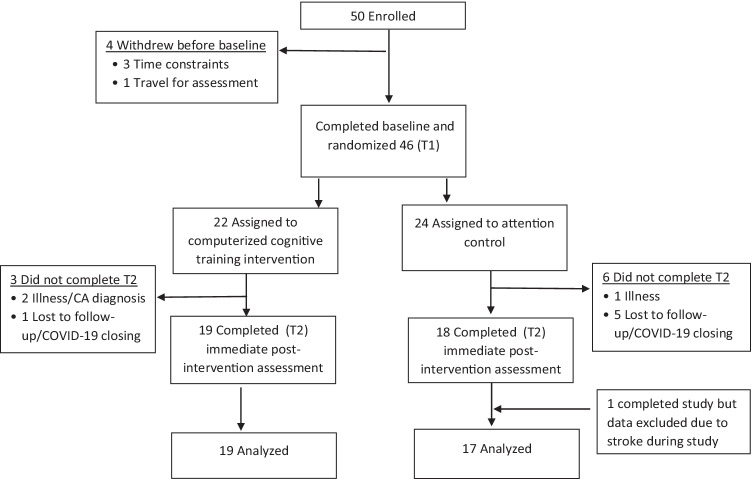
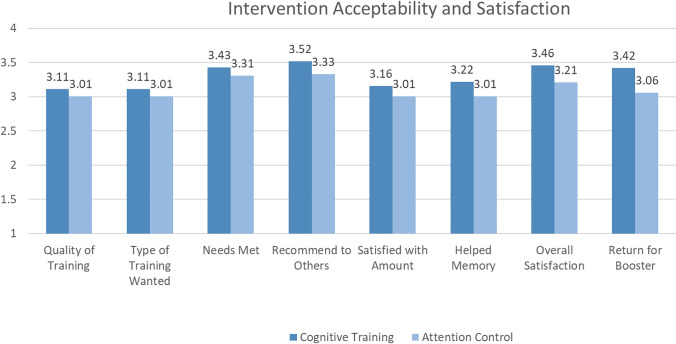
Results: Thirty-six BCS completed the study and were on average 57.6 (SD = 8.0) years old, 59.4% Caucasian, and had some college education (74.5%). Both programs were reported to be satisfactory and acceptable. Non-significant small effect sizes were noted for the intervention on cognitive abilities (d = 0.26) and cognitive concerns (d = - 0.32), with reliable improvement noted in 32% and 28% of BCS, respectively. Small to medium effect sizes were noted in improvement in work ability (d = 0.37) and health perception status (d = 0.30) and change (d = 0.60, p < 0.05).
Conclusions: Cognitive training was acceptable to BCS and resulted in improvement in perceived cognitive function and perceptions of "real-world" health benefits. A larger randomized controlled trial is warranted to determine its effectiveness for objective cognitive performance.
Keywords: Breast cancer survivors; Cognitive training; Perceived cognitive impairment; Quality of life.
© 2022. The Author(s), under exclusive licence to Springer-Verlag GmbH Germany, part of Springer Nature.
Conflict of interest statement
The authors declare no competing interests.
Figures
References
-
- Janelsins MC, Heckler CE, Peppone LJ, Kamen C, Mustian KM, Mohile SG, et al. Cognitive complaints in survivors of breast cancer after chemotherapy compared with age-matched controls: an analysis from a nationwide, multicenter, prospective longitudinal study. J Clin Oncol. 2017;35(5):506–514. doi: 10.1200/JCO.2016.68.5826. - DOI - PMC - PubMed
Publication types
MeSH terms
Grants and funding
LinkOut - more resources
Full Text Sources
Medical
