


Simplified Histologic Mucosal Healing Scheme (SHMHS) for inflammatory bowel disease: a nationwide multicenter study of performance and applicability
- PMID: 35648263
- PMCID: PMC9360061
- DOI: 10.1007/s10151-022-02628-7
Simplified Histologic Mucosal Healing Scheme (SHMHS) for inflammatory bowel disease: a nationwide multicenter study of performance and applicability
Erratum in
-
Correction to: Simplified Histologic Mucosal Healing Scheme (SHMHS) for inflammatory bowel disease: a nationwide multicenter study of performance and applicability.Tech Coloproctol. 2023 Feb;27(2):167-168. doi: 10.1007/s10151-022-02714-w. Tech Coloproctol. 2023. PMID: 36287287 Free PMC article. No abstract available.
Abstract
Background: Assessment of mucosal healing is important for the management of patients with inflammatory bowel disease (IBD), but endoscopy can miss microscopic disease areas that may relapse. Histological assessment is informative, but no single scoring system is widely adopted. We previously proposed an eight-item histological scheme for the easy, fast reporting of disease activity in the intestine. The aim of the present study was to evaluate the performance of our Simplified Histologic Mucosal Healing Scheme (SHMHS).
Methods: Between April and May 2021 pathologists and gastroenterologists in Italy were invited to contribute to this multicenter study by providing data on single endoscopic-histological examinations for their IBD patients undergoing treatment. Disease activity was expressed using SHMHS (maximum score, 8) and either Simple Endoscopic Score for Crohn's Disease (categorized into grades 0-3) or Mayo Endoscopic Subscore (range 0-3).
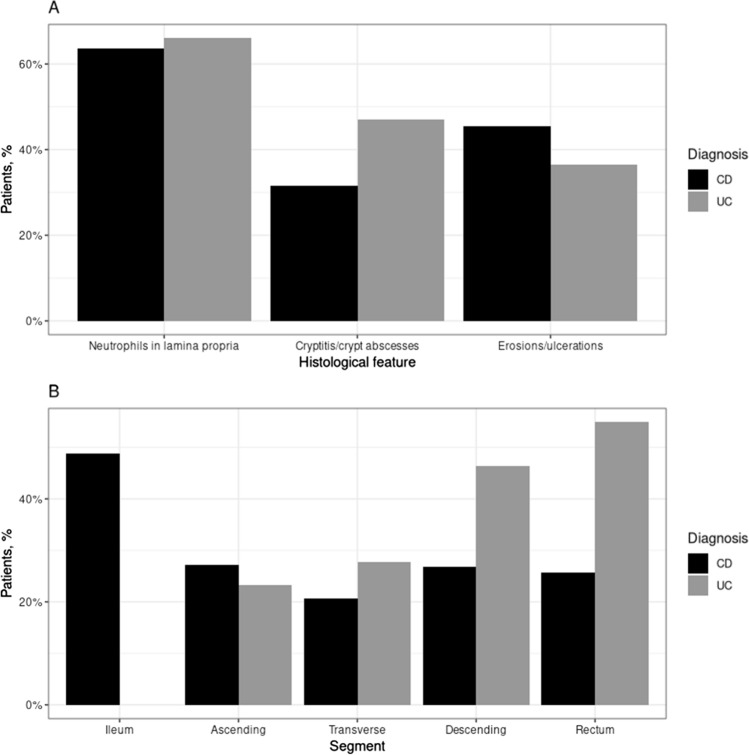
Results: Thirty hospitals provided data on 597 patients (291 Crohn's disease; 306 ulcerative colitis). The mean SHMHS score was 2.96 (SD = 2.42) and 66.8% of cases had active disease (score ≥ 2). The mean endoscopic score was 1.23 (SD = 1.05), with 67.8% having active disease (score ≥ 1). Histologic and endoscopic scores correlated (Spearman's ρ = 0.76), and scores for individual SHMHS items associated directly with endoscopic scores (chi-square p < 0.001, all comparisons). Between IBD types, scores for SHMHS items reflected differences in presentation, with cryptitis more common and erosions/ulcerations less common in Crohn's disease, and the distal colon more affected in ulcerative colitis.
Conclusions: SHMHS captures the main histological features of IBD. Routine adoption may simplify pathologist workload while ensuring accurate reporting for clinical decision making.
Keywords: Endoscopic score; Histological assessment; Inflammatory bowel disease; Mucosal healing.
© 2022. The Author(s).
Conflict of interest statement
Marco Daperno reports consulting fees from Bioclinica; honoraria from Janssen, Abbvie, Takeda, Pfizer, Roche; support for attending meetings from SOFAR, Chiesi, Takeda, Janssen, Abbvie, Mundifarma, Roche; Alessandro Armuzzi reports grants from Pfizer and Takeda; consulting fees from AbbVie, Amgen, Arena, Biogen, Boehringer Ingelheim, Bristol-Myers Squibb, Celgene, Celltrion, Eli-Lilly, Galapagos, Gilead, Janssen, MSD, Mylan, Pfizer, Roche, Samsung Bioepis, Sandoz, Takeda; honoraria from AbbVie, Amgen, Arena, Biogen, Bristol-Myers Squibb, Galapagos, Gilead, Janssen, MSD, Novartis, Pfizer, Roche, Samsung Bioepis, Sandoz, Takeda; support for attending meetings from Abbvie, Janssen, Pfizer, Takeda; Antonio Rispo reports grants from AbbVie, MSD, Janssen, Takeda, Chiesi; consulting fees from AbbVie, MSD, Janssen, Takeda, Chiesi; honoraria from AbbVie, MSD, Janssen, Takeda, Chiesi; participation on a data safety monitoring board or advisory board for AbbVie, MSD, Janssen, Takeda, Chiesi. All other authors have no conflicts of interest to declare.
Figures


References
Publication types
MeSH terms
LinkOut - more resources
Full Text Sources
Medical
Miscellaneous
