Association of COVID-19 Vaccination During Pregnancy With Incidence of SARS-CoV-2 Infection in Infants
- PMID: 35648413
- PMCID: PMC9161123
- DOI: 10.1001/jamainternmed.2022.2442
Association of COVID-19 Vaccination During Pregnancy With Incidence of SARS-CoV-2 Infection in Infants
Abstract
Importance: Pregnant women are recommended to receive COVID-19 vaccination to reduce risk of severe COVID-19. Whether vaccination during pregnancy also provides passive protection to infants after birth remains unclear.
Objective: To determine whether COVID-19 vaccination in pregnancy was associated with reduced risk of COVID-19 in infants up to age 4 months during COVID-19 pandemic periods dominated by Delta and Omicron variants.
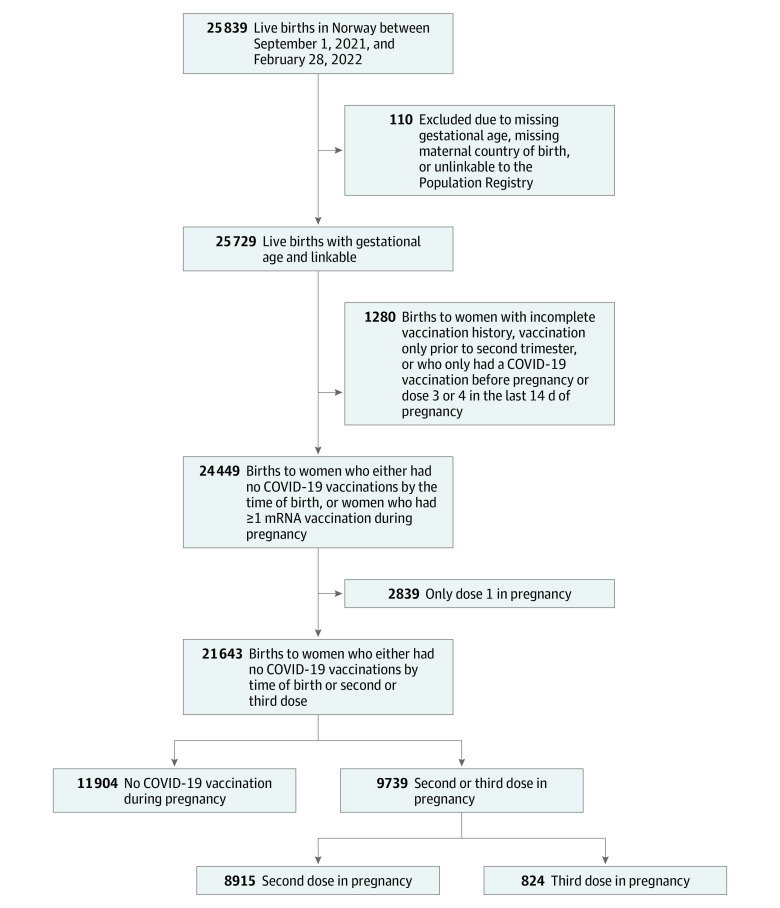
Design, setting, and participants: This nationwide, register-based cohort study included all live-born infants born in Norway between September 1, 2021, and February 28, 2022.
Exposures: Maternal messenger RNA COVID-19 vaccination during second or third trimester compared with no vaccination before or during pregnancy.
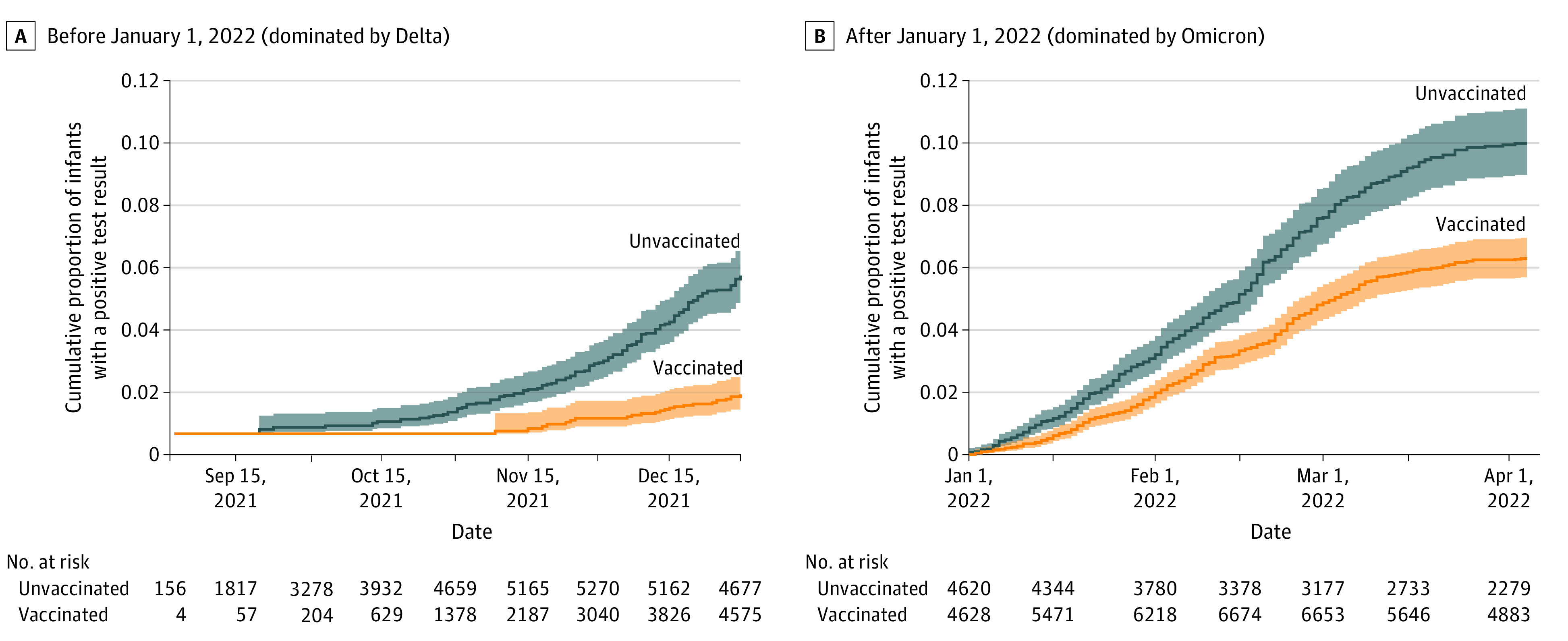
Main outcomes and measures: The risk of a positive polymerase chain reaction test result for SARS-CoV-2 during an infant's first 4 months of life by maternal vaccination status during pregnancy with either dose 2 or 3 was estimated, as stratified by periods dominated by the Delta variant (between September 1 and December 31, 2021) or Omicron variant (after January 1, 2022, to the end of follow-up on April 4, 2022). A Cox proportional hazard regression was used, adjusting for maternal age, parity, education, maternal country of birth, and county of residence.
Results: Of 21 643 live-born infants, 9739 (45.0%) were born to women who received a second or third dose of a COVID-19 vaccine during pregnancy. The first 4 months of life incidence rate of a positive test for SARS-CoV-2 was 5.8 per 10 000 follow-up days. Infants of mothers vaccinated during pregnancy had a lower risk of a positive test compared with infants of unvaccinated mothers and lower risk during the Delta variant-dominated period (incidence rate, 1.2 vs 3.0 per 10 000 follow-up days; adjusted hazard ratio, 0.29; 95% CI, 0.19-0.46) compared with the Omicron period (incidence rate, 7.0 vs 10.9 per 10 000 follow-up days; adjusted hazard ratio, 0.67; 95% CI, 0.57-0.79).
Conclusions and relevance: The results of this Norwegian population-based cohort study suggested a lower risk of a positive test for SARS-CoV-2 during the first 4 months of life among infants born to mothers who were vaccinated during pregnancy. Maternal COVID-19 vaccination may provide passive protection to young infants, for whom COVID-19 vaccines are currently not available.
Conflict of interest statement
Figures
References
-
- Abu-Raya B, Madhi SA, Omer SB, et al. Global perspectives on immunization against SARS-CoV-2 during pregnancy and priorities for future research: an international consensus paper from the World Association of Infectious Diseases and Immunological Disorders. Front Immunol. 2021;12:808064. doi: 10.3389/fimmu.2021.808064 - DOI - PMC - PubMed
Publication types
MeSH terms
Substances
Supplementary concepts
LinkOut - more resources
Full Text Sources
Other Literature Sources
Medical
Miscellaneous