Review
. 2022 Aug:348:84-94.
doi: 10.1016/j.jconrel.2022.05.043. Epub 2022 Jun 2.

Circular RNA: An emerging frontier in RNA therapeutic targets, RNA therapeutics, and mRNA vaccines

Affiliations
Review

Circular RNA: An emerging frontier in RNA therapeutic targets, RNA therapeutics, and mRNA vaccines

Xiang Liu et al. J Control Release. 2022 Aug.

Abstract

Circular RNAs (circRNA) is a class of natural (biogenic) or synthetic closed RNA without 5' or 3' ends. Meanwhile, their unique covalently-closed structures of circRNA prevent RNA degradation by exonucleases, thereby empowering them with high pharmaceutical stability and biostability relative to current standard-of-care linear mRNA. Natural circRNA can be non-coding RNAs as well as protein-coding RNA, the latter of which was recently discovered. The physiological functions of biogenic circRNAs, which largely remain elusive, include protein and gene sponges, cell activity modulators, and protein translation. The discovery that the circRNA levels can be correlated with some human diseases empowers circRNA with the potential as a novel type of disease biomarkers and a noncanonical class of therapeutic targets. Recently, synthetic circRNA have been engineered to explore their applications as a novel class of mRNA therapeutics and vaccines. In this review, we will discuss the current understanding of the biogenesis and physiological functions of natural circRNAs, the approaches to circRNA synthesis, and current research in the exploration of endogenous circRNAs as novel therapeutic targets and testing circRNAs as an emerging class of RNA therapeutics and vaccines.

Keywords: Back-splicing; Circular RNA; RNA engineering; mRNA therapeutics; mRNA vaccine.


Conflict of interest statement

Declaration of Competing Interest

G. Z. is a co-founder and CSO of AmpedRNA Biosciences, LLC. The other authors declare no conflicts of interest.

Figures
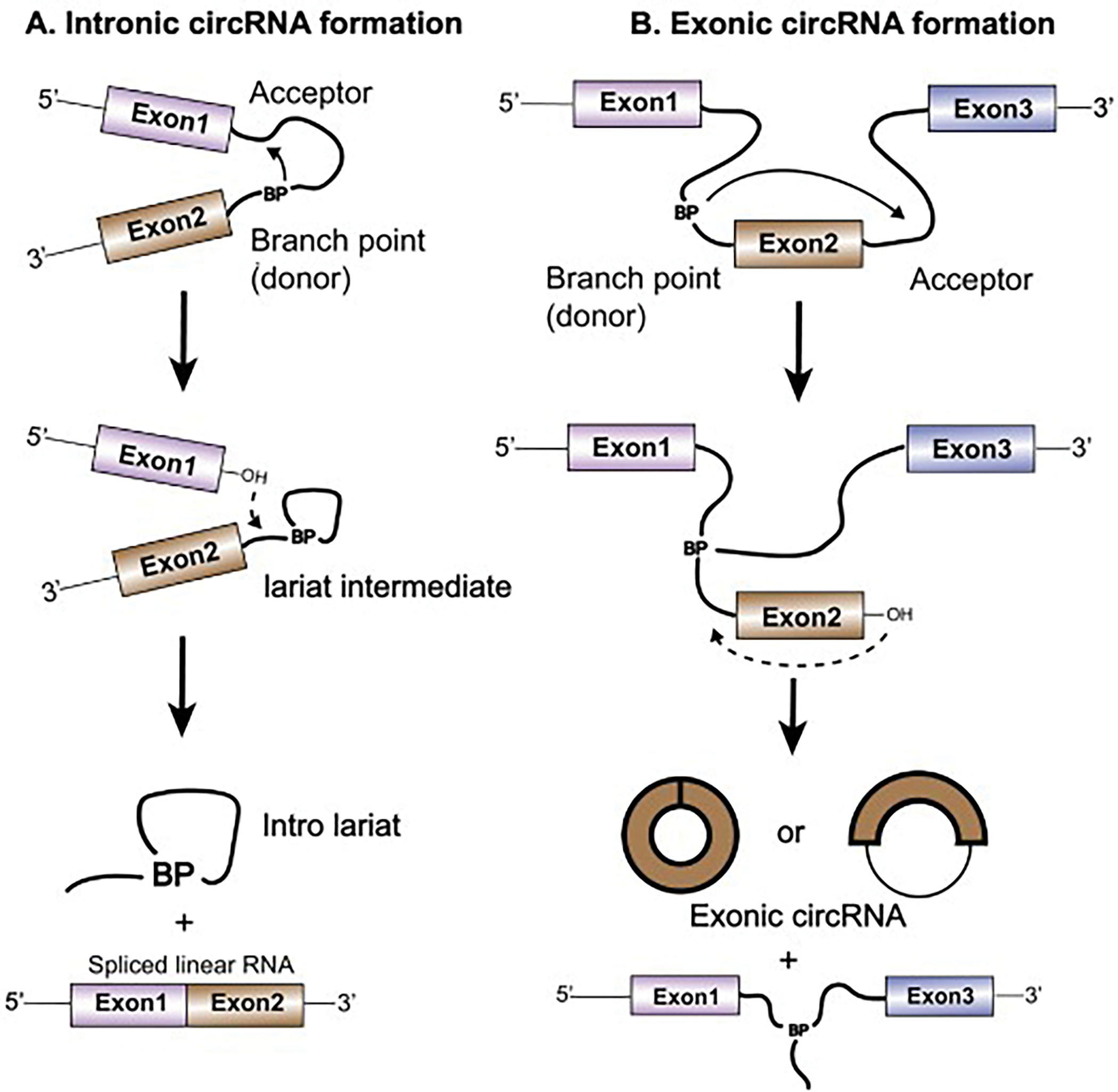
Fig. 1.
Fig. 1.
The biogenesis processes of natural intronic circRNA and exonic circRNA. (A) Intronic circRNA is produced during forward splicing, where an upstream donor splice site joins forces with a downstream acceptor splice site. (B) Exonic circRNA is produced by back splicing, where a downstream donor splice site connects with an upstream acceptor. Adapted from Obi, P. and Chen, Y. G., The design and synthesis of circular RNAs. Adapted from Obi, P. and Chen, Y. G., The design and synthesis of circular RNAs. Methods, 2021. 196: p. 85–103)
Fig. 2.
Fig. 2.
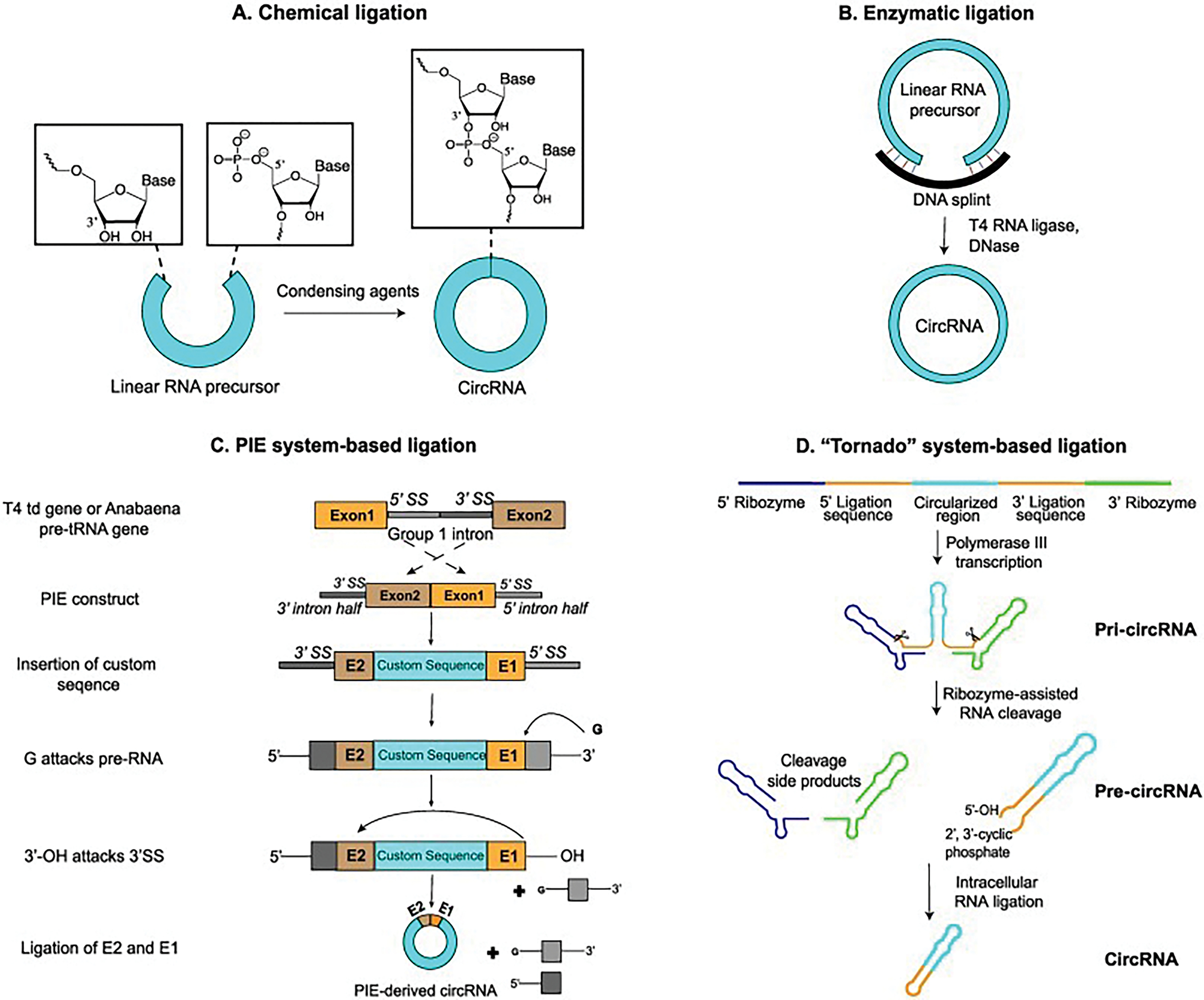
Schematic illustration of different RNA circularization methods. (A) Chemical RNA ligation by the conjugation of 5′-end phosphate with 3′-end hydroxyl. (B) Enzymatic RNA ligation catalyzed by T4 RNA ligase using DNA splints that bring the ends of RNA into close proximity to facilitate site-specific ligation. (C) PIE system-based RNA ligation. Permutation of a native group I intron and insertion of a custom RNA into the exonic region generate a PIE construct, which is then spontaneously circularized in the presence of free guanosine to form circRNA of the native exonic RNA. (Adapted from Obi, P. and Chen, Y. G., The design and synthesis of circular RNAs. Methods, 2021. 196: p. 85–103). (D) ‘Tornado’ system-based RNA ligation. The RNA of interest is flanked by the 5′ - and 3′ - stem-forming sequences, each of which is flanked by the 5′ - and 3′ - self-cleaving ribozymes. The ribozymes in this linear RNA is automatically cleaved to generate a 2′,3′-cyclic phosphate and 5′-OH on the new RNA ends. The stem-forming sequences of the precursor RNA hybridize and become circularized by endogenous ligase (RtcB) to form circRNA. (Adapted from Litke, J.L. and S.R. Jaffrey, Highly efficient expression of circular RNA aptamers in cells using autocatalytic transcripts. (Adapted from Litke, J.L. and S.R. Jaffrey, Highly efficient expression of circular RNA aptamers in cells using autocatalytic transcripts. Nat Biotechnol, 2019. 37(6): p. 667–675).
Fig. 3.
Fig. 3.
The working mechanisms of RNAi by conventional siRNA and circular siRNAs. Double-stranded, hairpin-shaped, and dumbbell-shaped siRNAs generate not only the single-stranded sense RNA but also a linear anti-sense RNA, the latter of which can bind with the RISC complex to cause off-targeting side effects. The caged circRNA, upon light irradiation, will be activated and generate a linear sense RNA and a circular anti-sense RNA that cannot bind with the RISC complex. (Dicer: dicer endoribonuclease; TRBP: trans-activation responsive RNA-binding protein; Ago: Argonaute protein.) (Caged siRNA was modified from [99]).
Fig. 4.
Fig. 4.
The comparison of the half-life, translatability, and stability of linear modified mRNA and modification-free circRNA. (A) Left: relative hEpo expression duration over 3 days after transfection of 293 cells with equimolar 5moU-mRNA or circRNA, both delivered by LNPs; Right: relative hEpo expression over 42 h in serum from the mice injected with equimolar 5moU-mRNA or circRNA delivered in LNPs. (Reprinted from Wesselhoeft, R.A., et al., RNA circularization diminishes immunogenicity and can extend translation duration in vivo. Mol Cell, 2019. 74(3): p. 508–520 e4). (B) Measurements of RBD antigen expression in the supernatant of HEK293T cells transfected with circRNARBD and 1mΨ-mRNARBD through Lipofectamine MessengerMax. (C) Measurements of RBD antigen expression in the supernatant of HEK293T cells transfected with LNP-circRNARBD, LNP-1mΨ-mRNARBD, and LNP-unmodified-mRNARBD that were stored at 4 °C (left) and 25 °C (right) for the indicated duration, prior to transfection into cells. (B, C: reprinted from Liang Qu, et al., Circular RNA vaccines against SARS-CoV-2 and emerging variants. Cell, 2022. 185(10): p. 1728–1744 e16).
Fig. 5.
Fig. 5.
CircRNA vaccine caused no obvious signs of illness in rhesus macaques. (A) IL-6 and MCP-1 levels in the plasma of circRNA-immunized animals. (B) Body temperature of circRNA-immunized rhesus macaques. (Reprinted from Liang Qu, et al., Circular RNA vaccines against SARS-CoV-2 and emerging variants. Cell, 2022. 185(10): p. 1728–1744 e16).

References

    1. Obi P, Chen YG, The design and synthesis of circular RNAs, Methods 196 (2021) 85–103. - PMC - PubMed
    1. Zhang Y, et al. , The biogenesis of nascent circular RNAs, Cell Rep. 15 (3) (2016) 611–624. - PubMed
    1. Li X, Yang L, Chen LL, The biogenesis, functions, and challenges of circular RNAs, Mol. Cell 71 (3) (2018) 428–442. - PubMed
    1. Sanger HL, et al. , Viroids are single-stranded covalently closed circular RNA molecules existing as highly base-paired rod-like structures, Proc. Natl. Acad. Sci. U. S. A. 73 (11) (1976) 3852–3856. - PMC - PubMed
    1. Nigro JM, et al. , Scrambled exons, Cell 64 (3) (1991) 607–613. - PubMed

Publication types