


Raeding with the fingres: Towards a universal model of letter position coding
- PMID: 35650465
- PMCID: PMC9722860
- DOI: 10.3758/s13423-022-02078-0
Raeding with the fingres: Towards a universal model of letter position coding
Abstract
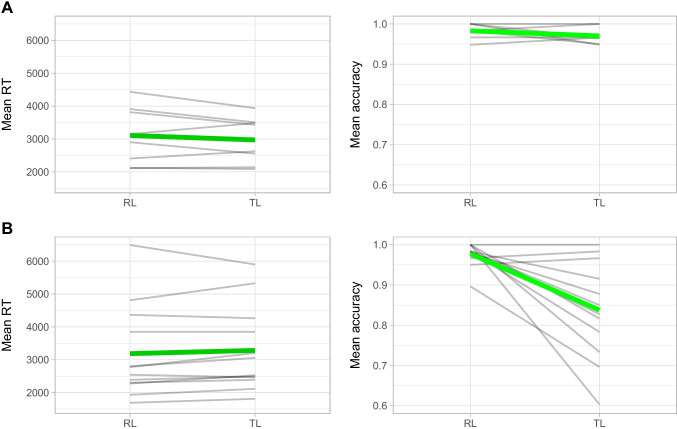
Letter position coding in word recognition has been widely investigated in the visual modality (e.g., labotarory is confusable with laboratory), but not as much in the tactile modality using braille, leading to an incomplete understanding of whether this process is modality-dependent. Unlike sighted readers, braille readers do not show a transposed-letter similarity effect with nonadjacent transpositions (e.g., labotarory = labodanory; Perea et al., 2012). While this latter finding was taken to suggest that the flexibility in letter position coding was due to visual factors (e.g., perceptual uncertainty in the location of visual objects (letters)), it is necessary to test whether transposed-letter effects occur with adjacent letters to reach firm conclusions. Indeed, in the auditory modality (i.e., another serial modality), a transposed-phoneme effect occurs for adjacent but not for nonadjacent transpositions. In a lexical decision task, we examined whether pseudowords created by transposing two adjacent letters of a word (e.g., laboartory) are more confusable with their base word (laboratory) than pseudowords created by replacing those letters (laboestory) in braille. Results showed that transposed-letter pseudowords produced more errors and slower responses than the orthographic controls. Thus, these findings suggest that the mechanism of serial order, while universal, can be shaped by the sensory modality at play.
Keywords: Braille; Lexical decision; Transposed-letter effect; Word recognition.
© 2022. Crown.
Figures
References
-
- Bates D, Maechler M, Bolker B, Walker S. Fitting linear mixed-effects models using lme4. Journal of Statistical Software. 2015;67(1):1–48. doi: 10.18637/jss.v067.i01. - DOI
-
- Bertelson P, Mousty P, Radeau M. The time course of braille word recognition. Journal of Experimental Psychology: Learning, Memory, and Cognition. 1992;18(2):284–297. - PubMed
-
- Braille L. Procedure for writing words, music and plain song using dots for the use of the blind and made available to them. Institut National des Jeunes Aveugles; 1829.
-
- Bürkner PC. brms: An R package for Bayesian multilevel models using Stan. Journal of Statistical Software. 2017;80(1):1–28. doi: 10.18637/jss.v080.i01. - DOI
MeSH terms
LinkOut - more resources
Full Text Sources
