Review
. 2022 May 16:13:878271.
doi: 10.3389/fimmu.2022.878271. eCollection 2022.

Molecular Determinants Regulating the Plasticity of the MHC Class II Immunopeptidome

Affiliations
Review

Molecular Determinants Regulating the Plasticity of the MHC Class II Immunopeptidome

Laura Santambrogio. Front Immunol. .

Abstract

In the last few years, advancement in the analysis of the MHC class II (MHC-II) ligandome in several mouse and human haplotypes has increased our understanding of the molecular components that regulate the range and selection of the MHC-II presented peptides, from MHC class II molecule polymorphisms to the recognition of different conformers, functional differences in endosomal processing along the endocytic tract, and the interplay between the MHC class II chaperones DM and DO. The sum of all these variables contributes, qualitatively and quantitatively, to the composition of the MHC II ligandome, altogether ensuring that the immunopeptidome landscape is highly sensitive to any changes in the composition of the intra- and extracellular proteome for a comprehensive survey of the microenvironment for MHC II presentation to CD4 T cells.

Keywords: HLA-DM; HLA-DO; MHC class II; antigen processing and presentation; dendritic cells.


Conflict of interest statement

The author declares that the research was conducted in the absence of any commercial or financial relationships that could be construed as a potential conflict of interest.

Figures
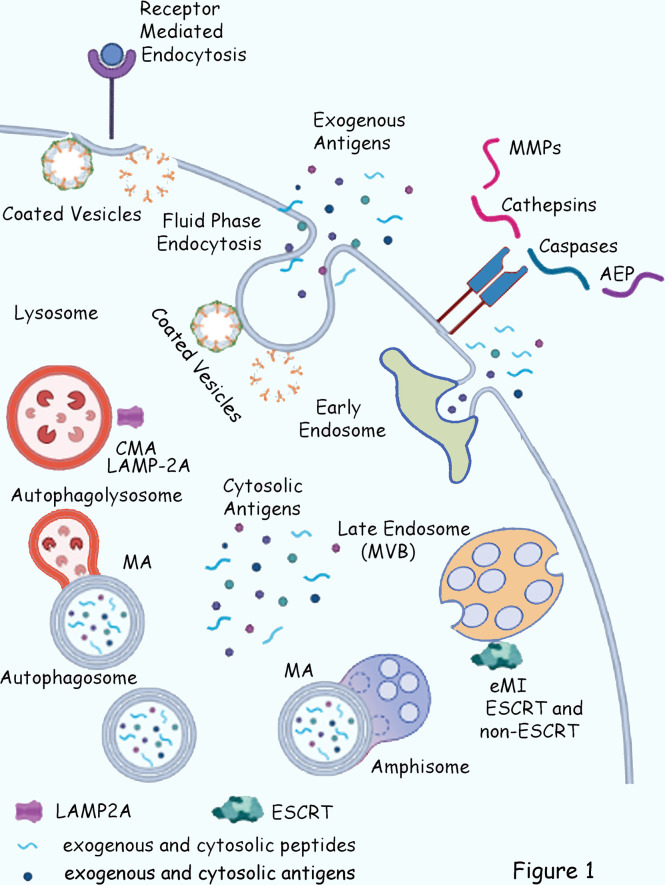
Figure 1
Figure 1
Schematic of the cytosolic and exogenous pathways for antigen delivery to MHC II compartments. Exogenous antigens are acquired through fluid phase endocytosis and receptor-mediated endocytosis. Cytosolic proteins enter MHC II compartments through Macroautophagy (MA), upon fusion of the Autophagosomes with Lysosomes (Autophagolysosome) or with Late Endosomes (Amphisome); Endosomal Microautophagy (eMI, ESCRT-dependent and independent), and LAMP2A-mediated chaperone-mediated autophagy (CMA). Additional antigen-acquisition routes include preprocessed cytosolic proteasome-generated peptides, as well as acquisition of extracellular peptides present in biological fluids loaded on plasma membrane and early-endosomes recycling MHC-II molecules. As such, MHC-II-eluted self-peptides derived from a variety of processing pathways including Cathepsins, Caspases and other endopeptidase such as asparagine endopeptidase (AEP), and matrix metalloproteases (MMPs), among many others.
Figure 2
Figure 2
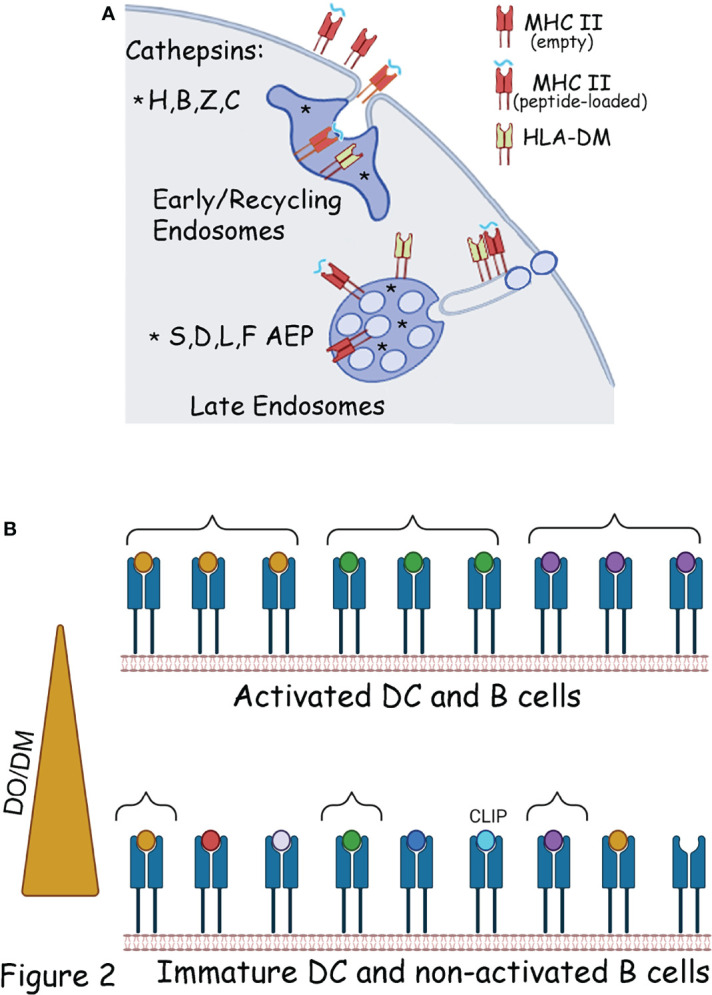
Chaperones and organelles involved in the generation of the MHC II ligandome.(A) Endopeptidases (*) present in early and late endosomes, involved in the generation of the MHC II ligandome. In early endosomes the processed peptides will be loaded on MHC II molecule recycling from the plasma membrane. Peptide can also load directly at the cell surface on empty MHC II molecules or in exchange for low affinity peptides. In late endosomes the processing enzymes are located in the lumen of the compartment, outside the vesicles. MHC II molecules are anchored to the vesicles limiting membrane and exposed to the processed peptides. DM is mostly located on the endosomal limiting membrane. As such optimal DM activity is generated during inflammation-mediated endosomal tubulation, which transport MHC II at the cell surface. (B) In immature DC, or non-activated B cells, DM activity is inhibited by DO, as such the MHC-II ligandome contains a broad and diverse peptide spectrum, comprises of both low and high affinity peptides and with some empty and MHC-II-CLIP complexes at the cell surface. This MHC-II ligandome facilitate tolerance (Bottom panel) Following DCs and B cell activation the decreased DO activity allows DM to select a more focused, and high affinity MHC-II ligandome to facilitate immunity (Top panel). Braces indicates MHC II molecules in the top and bottom panels, loaded with the same peptide.

References

    1. Reith W, Mach B. The Bare Lymphocyte Syndrome and the Regulation of MHC Expression. Annu Rev Immunol (2001) 19:331–73. doi: 10.1146/annurev.immunol.19.1.331 - DOI - PubMed
    1. Cosgrove D, Gray D, Dierich A, Kaufman J, Lemeur M, Benoist C, et al. . Mice Lacking MHC Class II Molecules. Cell (1991) 66:1051–66. doi: 10.1016/0092-8674(91)90448-8 - DOI - PubMed
    1. Chen YT, Su YC, Chang ML, Tsai PF, Kung JT. Low-Level MHC Class II Expression Leads to Suboptimal Th Cell Response, Increased Autoaggression, and Heightened Cytokine Inducibility. J Immunol (2017) 198:1928–43. doi: 10.4049/jimmunol.1600967 - DOI - PubMed
    1. Terasaki PI. A Brief History of HLA. Immunol Res (2007) 38:139–48. doi: 10.1007/s12026-007-0020-4 - DOI - PubMed
    1. Klein J, Sato A. The HLA System. Second of two parts. N Engl J Med (2000) 343:782–6. doi: 10.1056/NEJM200009143431106 - DOI - PubMed

Publication types

Substances