


2b-RAD Genotyping of the Seagrass Cymodocea nodosa Along a Latitudinal Cline Identifies Candidate Genes for Environmental Adaptation
- PMID: 35651946
- PMCID: PMC9149362
- DOI: 10.3389/fgene.2022.866758
2b-RAD Genotyping of the Seagrass Cymodocea nodosa Along a Latitudinal Cline Identifies Candidate Genes for Environmental Adaptation
Abstract
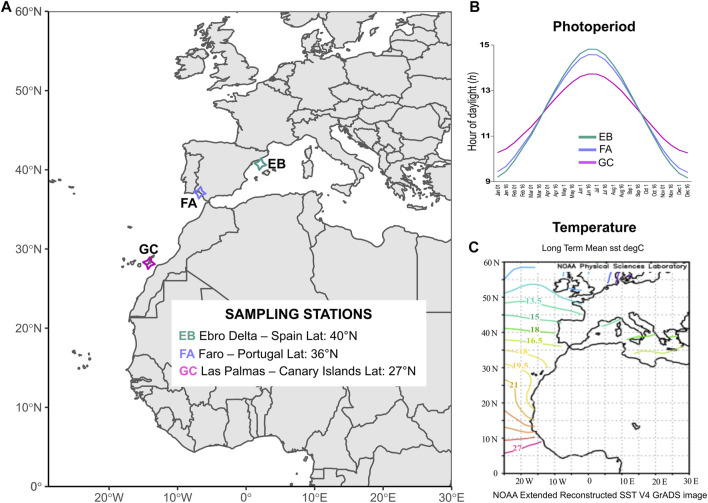
Plant populations distributed along broad latitudinal gradients often show patterns of clinal variation in genotype and phenotype. Differences in photoperiod and temperature cues across latitudes influence major phenological events, such as timing of flowering or seed dormancy. Here, we used an array of 4,941 SNPs derived from 2b-RAD genotyping to characterize population differentiation and levels of genetic and genotypic diversity of three populations of the seagrass Cymodocea nodosa along a latitudinal gradient extending across the Atlantic-Mediterranean boundary (i.e., Gran Canaria-Canary Islands, Faro-Portugal, and Ebro Delta-Spain). Our main goal was to search for potential outlier loci that could underlie adaptive differentiation of populations across the latitudinal distribution of the species. We hypothesized that such polymorphisms could be related to variation in photoperiod-temperature regime occurring across latitudes. The three populations were clearly differentiated and exhibited diverse levels of clonality and genetic diversity. Cymodocea nodosa from the Mediterranean displayed the highest genotypic richness, while the Portuguese population had the highest clonality values. Gran Canaria exhibited the lowest genetic diversity (as observed heterozygosity). Nine SNPs were reliably identified as outliers across the three sites by two different methods (i.e., BayeScan and pcadapt), and three SNPs could be associated to specific protein-coding genes by screening available C. nodosa transcriptomes. Two SNPs-carrying contigs encoded for transcription factors, while the other one encoded for an enzyme specifically involved in the regulation of flowering time, namely Lysine-specific histone demethylase 1 homolog 2. When analyzing biological processes enriched within the whole dataset of outlier SNPs identified by at least one method, "regulation of transcription" and "signalling" were among the most represented. Our results highlight the fundamental importance signal integration and gene-regulatory networks, as well as epigenetic regulation via DNA (de)methylation, could have for enabling adaptation of seagrass populations along environmental gradients.
Keywords: 2b-RAD; SNPs; flowering; latitude; outlier loci; seagrass.
Copyright © 2022 Ruocco, Jahnke, Silva, Procaccini and Dattolo.
Conflict of interest statement
The authors declare that the research was conducted in the absence of any commercial or financial relationships that could be construed as a potential conflict of interest.
Figures


References
-
- Aitken S. N., Hannerz M. (2001). “Genecology and Gene Resource Management Strategies for Conifer Cold Hardiness,” in Conifer Cold Hardiness (Springer; ), 23–53. 10.1007/978-94-015-9650-3_2 - DOI
-
- Alberto F., Arnaud-Haond S., Duarte C., Serrão E. (2006). Genetic Diversity of a Clonal Angiosperm Near its Range Limit: the Case of Cymodocea Nodosa at the Canary Islands. Mar. Ecol. Prog. Ser. 309, 117–129. 10.3354/meps309117 - DOI
-
- Alberto F., Massa S., Manent P., Diaz-Almela E., Arnaud-Haond S., Duarte C. M., et al. (2008). Genetic Differentiation and Secondary Contact Zone in the seagrassCymodocea Nodosaacross the Mediterranean-Atlantic Transition Region. J. Biogeogr. 35, 1279–1294. 10.1111/j.1365-2699.2007.01876.x - DOI
-
- Alexander D. H., Lange K. (2011). Enhancements to the ADMIXTURE Algorithm for Individual Ancestry Estimation. BMC Bioinforma. 12, 246. 10.1186/1471-2105-12-246 - DOI
-
- Allendorf F. W. (2017). Genetics and the Conservation of Natural Populations: Allozymes to Genomes. Wiley Online Library.
LinkOut - more resources
Full Text Sources
