Clinical Trial
. 2022 Sep-Oct;42(5):429-439.
doi: 10.1097/JCP.0000000000001575. Epub 2022 Jun 2.

Efficacy, Safety, and Tolerability of Centanafadine Sustained-Release Tablets in Adults With Attention-Deficit/Hyperactivity Disorder: Results of 2 Phase 3, Randomized, Double-blind, Multicenter, Placebo-Controlled Trials

Affiliations
Clinical Trial

Efficacy, Safety, and Tolerability of Centanafadine Sustained-Release Tablets in Adults With Attention-Deficit/Hyperactivity Disorder: Results of 2 Phase 3, Randomized, Double-blind, Multicenter, Placebo-Controlled Trials

Lenard A Adler et al. J Clin Psychopharmacol. 2022 Sep-Oct.

Abstract

Purpose/background: Centanafadine is an inhibitor of norepinephrine, dopamine, and serotonin reuptake transporters under investigation for the treatment of attention-deficit/hyperactivity disorder (ADHD).

Methods/procedures: Two phase 3 randomized, double-blind, placebo-controlled, parallel-group studies of 200 mg/d or 400 mg/d centanafadine sustained-release tablets versus placebo included adults (18-55 years of age) with a diagnosis of ADHD. The primary and key secondary efficacy endpoints were the change from baseline at day 42 in the Adult ADHD Investigator Symptom Rating Scale (AISRS) total score and the Clinical Global Impression-Severity of Illness Scale, respectively.

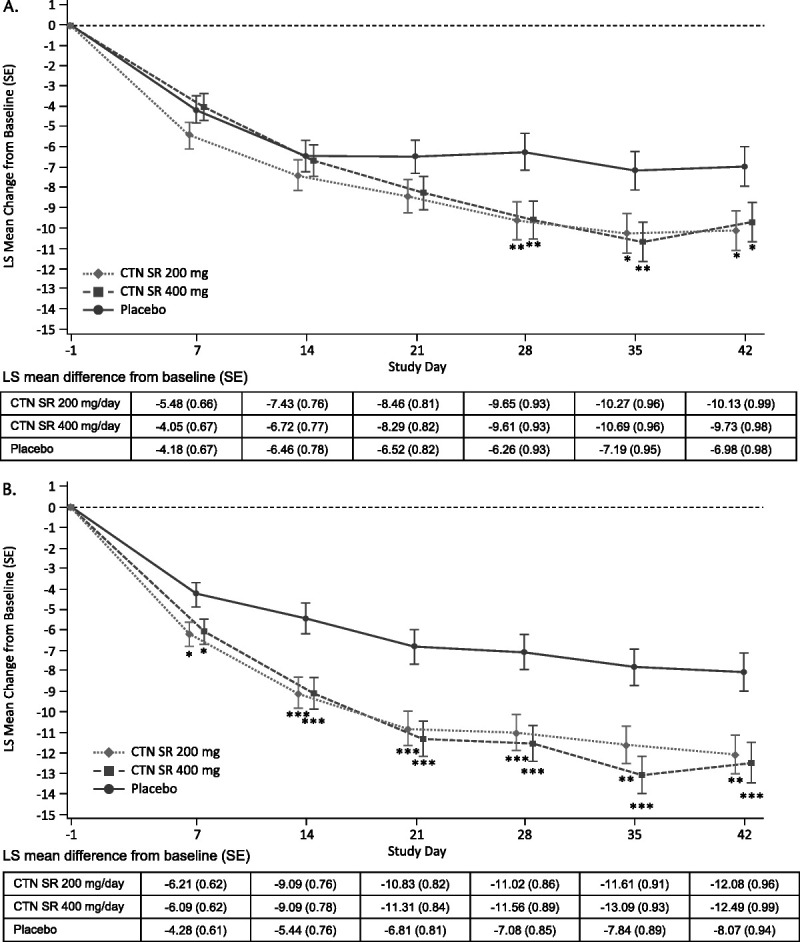
Findings/results: Subjects randomized in study 1 (centanafadine 200 mg/d, n = 149; centanafadine 400 mg/d, n = 149; placebo, n = 148) and study 2 (centanafadine 200 mg/d, n = 145; centanafadine 400 mg/d, n = 143; placebo, n = 142) had moderate to severe ADHD (mean AISRS total score, 38.7 [SD, 6.8] across both studies). At day 42, statistically significant least-squares mean differences in AISRS total score were observed in favor of centanafadine versus placebo in study 1 (200 mg/d: -3.16, P = 0.019; 400 mg/d: -2.74, P = 0.039) and study 2 (200 mg/d: -4.01, P = 0.002; 400 mg/d: -4.47, P = 0.001). Effect sizes versus placebo were -0.28 for 200 mg/d and -0.24 for 400 mg/d in study 1 and -0.37 for 200 mg/d and -0.40 for 400 mg/d in study 2. The overall rate of treatment-emergent adverse events (TEAEs) was low, but there was a small increase in TEAE occurrence with increasing dose. Incidences of serious TEAEs and abuse potential-related AEs were low.

Implications/conclusions: These are the first large-scale studies to demonstrate the efficacy and safety profiles of 200 mg/d and 400 mg/d centanafadine in adults with ADHD.


Figures

FIGURE 1
FIGURE 1
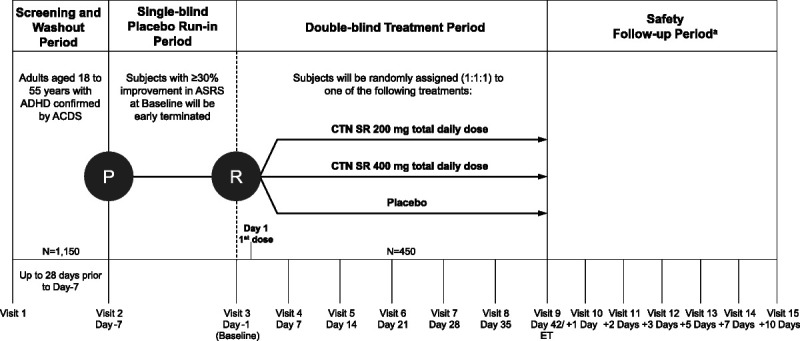
Study design schematic for study 1 (NCT03605680) and study 2 (NCT03605836). Each trial had 4 periods: (1) screening and washout, (2) single-blind placebo run-in, (3) double-blind treatment, and (4) safety follow-up period. aAll subjects were required to participate in the 7-day follow-up period (follow-up telephone calls at 1, 3, and 5 days after the last dose of study treatment and in-clinic follow-up visits at 2 and 7 days after the last dose of study treatment). Subjects who terminated early, decided to not enroll in the long-term open-label safety and tolerability study, or who were not eligible to enroll were also required to participate in an additional follow-up telephone call 10 days after the last dose of centanafadine or placebo. ACDS, Adult ADHD Clinical Diagnostic Scale; ET, early termination; P, placebo administration; R, randomization.
FIGURE 2
FIGURE 2
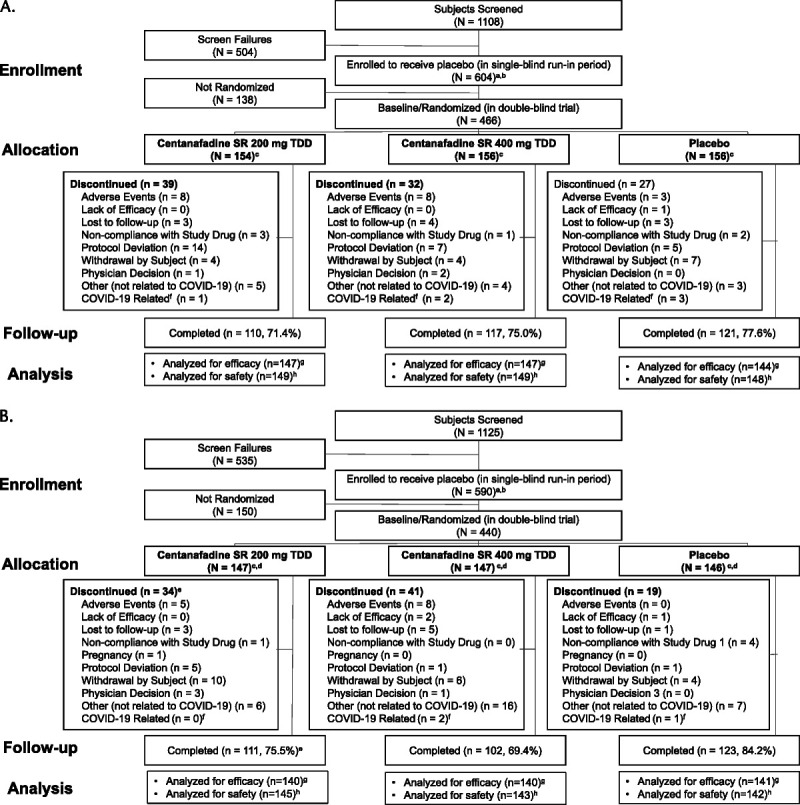
CONSORT (Consolidated Standards of Reporting Trials) flow diagram for (A) study 1 (NCT03605680) and (B) study 2 (NCT03605836). aSubjects receiving at least 1 dose of study medication in single-blind placebo period/double-blind period. bSubjects who signed an informed consent form for the trial and enrolled into the single-blind placebo run-in period. cSubjects who were randomized and received study medication in double-blind period or were not randomized and received study medication in single-blind placebo period. dOne subject who was enrolled in the trial did not receive study medication in the placebo run-in period. eOne subject in the CTN-SR 200 mg/d group was included in the discontinued subject count in error but completed all trial visits to be considered a completer. fDoes not include AEs of COVID-19. gRandomized subjects who received at least 1 dose of double-blind study medication and had a baseline and postbaseline value for AISRS total score. hSubjects who received at least 1 dose of study medication in the double-blind treatment period were included in the safety analysis.
FIGURE 3
FIGURE 3
Least-squares mean change from Baseline to day 42 in AISRS total score (primary endpoint) for (A) study 1 (NCT03605680) and (B) study 2 (NCT03605836). *P value <0.05 versus placebo; **P value <0.01 versus placebo; ***P value <0.001 versus placebo. Note: Error bars are LS mean ± 1 SE. Data are based on an MMRM analysis for AISRS total score. Treatment differences were calculated based on the difference in LS mean changes versus placebo for MMRM.
FIGURE 4
FIGURE 4
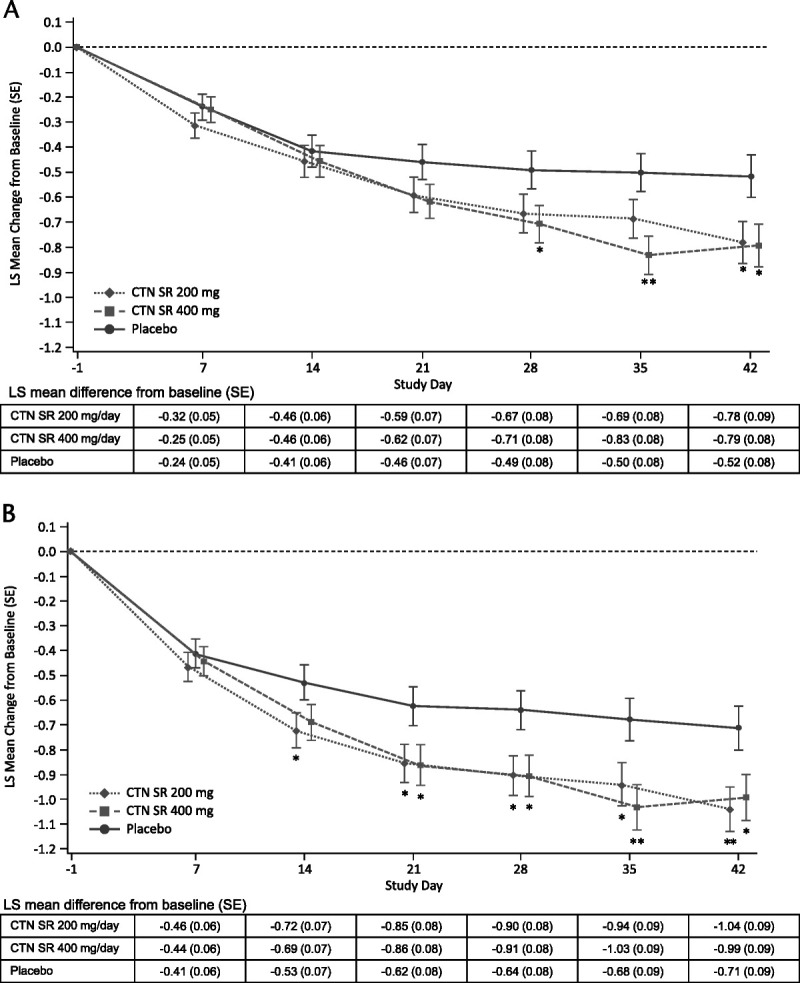
Least-squares mean change from baseline to day 42 in CGI-S score (secondary endpoint) for (A) study 1 (NCT03605680) and (B) study 2 (NCT03605836). *P < 0.05 versus placebo, **P < 0.01 versus placebo. Note: Error bars are LS mean ± 1 SE. Data are based on an MMRM analysis for CGI-S score. Treatment differences were calculated based on the difference in LS mean changes versus placebo for MMRM.

References

    1. Kessler RC Adler L Barkley R, et al. . The prevalence and correlates of adult ADHD in the United States: results from the National Comorbidity Survey Replication. Am J Psychiatry. 2006;163:716–723. - PMC - PubMed
    1. Alexander L, Farrelly N. Attending to adult ADHD: a review of the neurobiology behind adult ADHD. Ir J Psychol Med. 2018;35:237–244. - PubMed
    1. Sharma A, Couture J. A review of the pathophysiology, etiology, and treatment of attention-deficit hyperactivity disorder (ADHD). Ann Pharmacother. 2014;48:209–225. - PubMed
    1. Heal DJ Smith SL Gosden J, et al. . Amphetamine, past and present—a pharmacological and clinical perspective. J Psychopharmacol 2013;27:479–496. - PMC - PubMed
    1. Solanto MV. Neuropsychopharmacological mechanisms of stimulant drug action in attention-deficit hyperactivity disorder: a review and integration. Behav Brain Res. 1998;94:127–152. - PubMed

Publication types

MeSH terms