Review
. 2022 Oct 29;62(4):908-921.
doi: 10.1093/icb/icac061.

The Water to Land Transition Submerged: Multifunctional Design of Pectoral Fins for Use in Swimming and in Association with Underwater Substrate

Affiliations
Review

The Water to Land Transition Submerged: Multifunctional Design of Pectoral Fins for Use in Swimming and in Association with Underwater Substrate

Melina E Hale et al. Integr Comp Biol. .

Abstract

Fins of fishes provide many examples of structures that are beautifully designed to power and control movement in water; however, some species also use their fins for substrate-associated behaviors where interactions with solid surfaces are key. Here, we examine how the pectoral fins of ray-finned fish with these multifunctional behavioral demands, in water and on solid surfaces, are structured and function. We subdivide fins used in swimming and substrate contact into two general morphological categories, regionalized vs. generalized fins. Regionalized fins have ventral rays that are free from connecting membrane or in which that membrane is reduced. Dorsally they maintain a more typical membranous fin. While all pectoral fins vary somewhat in their morphology from leading to trailing edge, generalized fins do not have the substantial membrane loss between rays that is seen in regionalized fins and the distal edge anatomy changes gradually along its margin. We add a new case study in regionalized fins with the dwarf hawkfish (Cirrhitichthys falco). Hawkfishes are most often found perching and moving on structures in their environments. During perching, the free ventral rays are in contact with the substrate and splayed. We found that unlike other fish with regionalized pectoral fins, hawkfish maintain use of the dorsal membranous region of its pectoral fin for rhythmic swimming. We found that typically hawkfish bend their ventral free rays under, toward the medial hemitrichs or hold them straight during substrate-associated postures. This appears also to be the case for the ventral free rays of other species with regionalized fins. Generalized fin use for substrate contact was reviewed in round gobies (Neogobius melanostomus). In addition, although their lobe fins are not representative of ray-finned fish anatomy, we explored fin contact on submerged substrates in the Senegal bichir (Polypterus senegalus), which has a generalized distal fin (no free fin rays or distinct membrane regions). Both groups use their pectoral fins for swimming. During substrate-based postures, unlike hawkfish, their distal rays generally bend outward toward the lateral hemitrichs and a large swath of the fin membrane can contact the surface. The alternative demands on multifunctional fins suggest specialization of the mechanosensory system. We review mechanosensation related to fin movement and surface contact. These alternative regionalized and generalized strategies for serving aquatic and substrate-based functions underwater provide opportunities to further investigate specializations, including sensory structures and systems, that accompany the evolution of substrate-based behaviors in vertebrates.


Figures

Fig. 1
Fig. 1
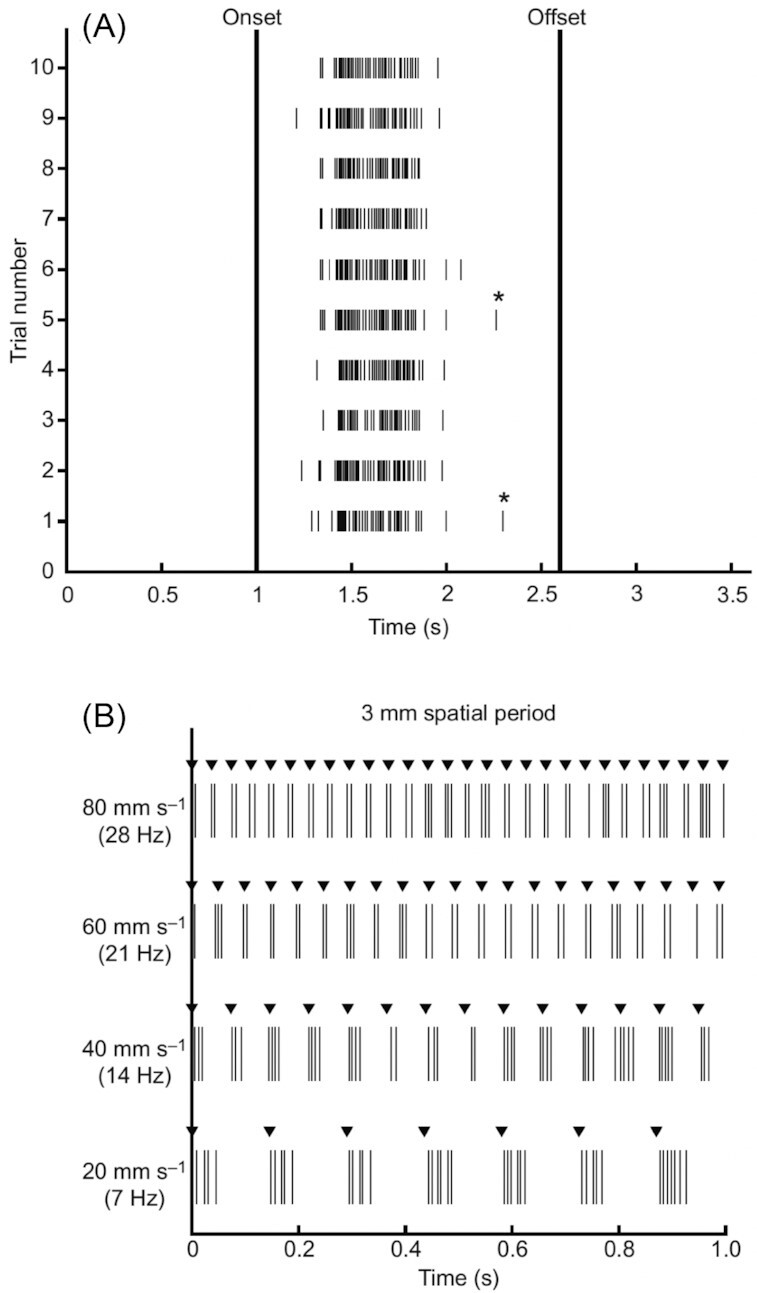
Touch sensation in the round goby, Neogobius melanostomus. Raster plots show spiking of afferent nerve fibers in response to fin ray stimulation. (A) A total of 10 trials of proximodistal brushing along an 8-mm length of a ray at 5 mms−1, passing over an afferent ending showing consistency of the response. (B) A drum with a 3-mm spatial grating rotating so that the gratings make light, brief contact with the fin, brushing proximodistally. Recordings are shown for at four speeds. The ability of the sensory afferent to sense the structure of the stimulus through this range of speeds (drum rotation rates) indicates that these fibers can faithfully report on fine substrate features. Asterisks indicate spikes excluded from analysis of spike bursts as they did not fall within the threshold for firing rate. These data show the fine spatial and temporal sensitivity and reliability of touch sensors in the pectoral fin. Reprinted from Hardy and Hale (2020)
Fig. 2
Fig. 2
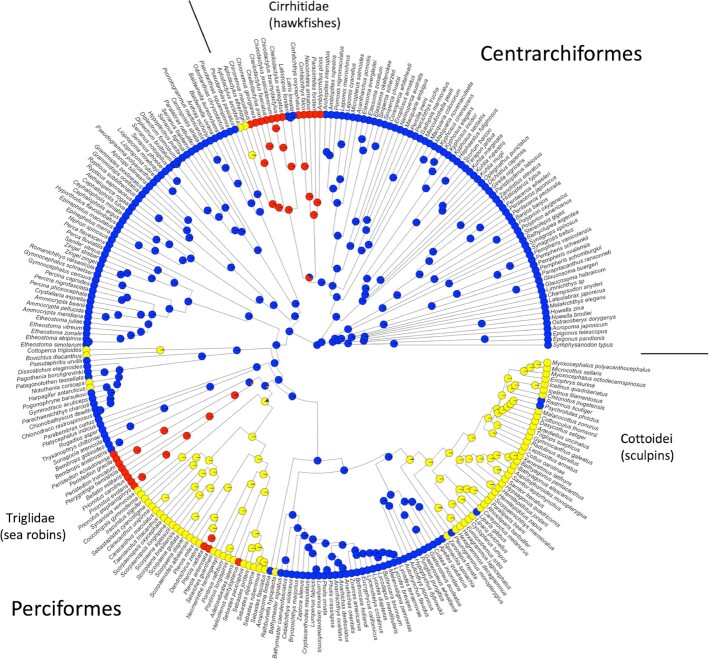
Mapping pectoral fin regionalization on a phylogeny of the group that includes orders Centrarchiformes and Perciformes, highlighting the families discussed, the Cirrhitidae (hawkfishes), Triglidae (sea robins), and Cottoidei (sculpins). Extreme ventral regionalization (near complete loss of membrane between rays) is shown in red. Moderate ventral regionalization (partial loss of membrane connecting ventral rays) is shown in yellow and minimal or no loss of membrane between ventral rays is shown in blue. Note that the hawkfishes are in the centrarchiforms and independently evolved ventral fin regionalization from the other families shown, members of the Perciformes. Those two groups also appear to have evolved ventral regionalization independently. Phylogeny from Betancur et al. (2017), but also see Smith and Busby (2014) and Smith et al. (2018)
Fig. 3
Fig. 3
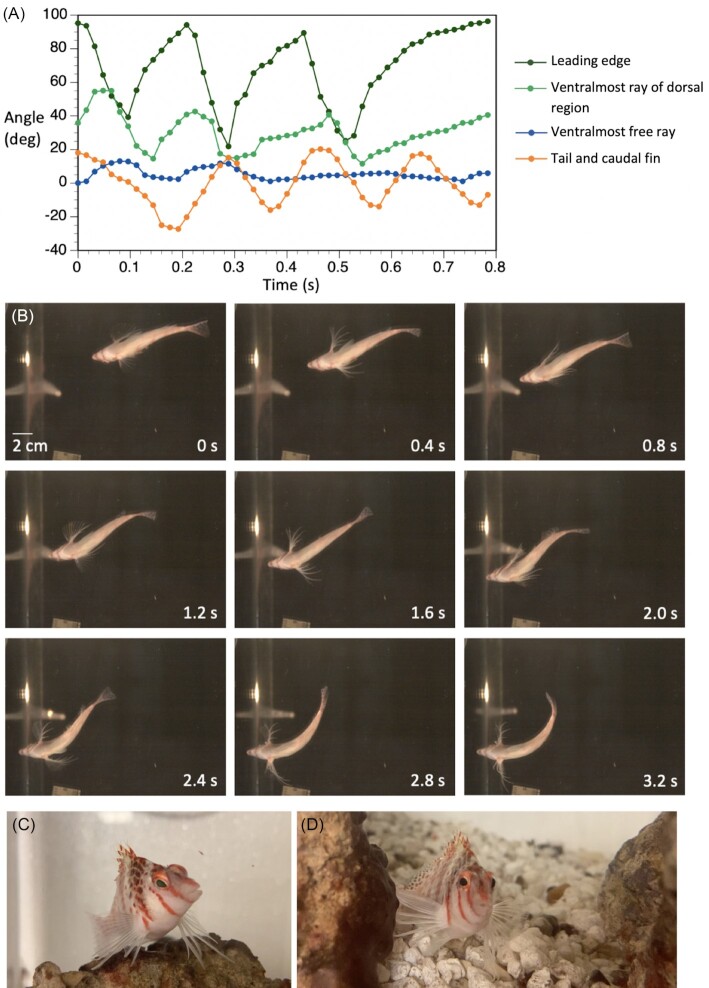
Pectoral fin swimming and perching in the dwarf hawkfish, C. falco. (A) Three cycles of swimming showing angular movement of landmarks on a pectoral fin (left) and the body axis. The leading edge and membranous region of the fin are actuated rhythmically. There is some coincident movement of the ventral free rays but that movement is irregular. (B) A trial of hawkfish swimming and perching (not the same trial as in A) illustrating movement of the membranous dorsal region of the pectoral fin and ventral free rays. Successive instances of peak abduction of the dorsal region of the pectoral fin can be seen during swimming at time 0 and 1.2 s, illustrating that the fins beat synchronously (in phase). At times 2.8 and 3.2 s, the free rays are splayed during perching. (C) and (D) Images of a hawkfish in its home aquarium showing perching on irregular substrate. Fin rays bend back toward the medial aspect of the fin and are curved more or less distally, accommodating varied distances to the surfaces beneath them
Fig. 4
Fig. 4
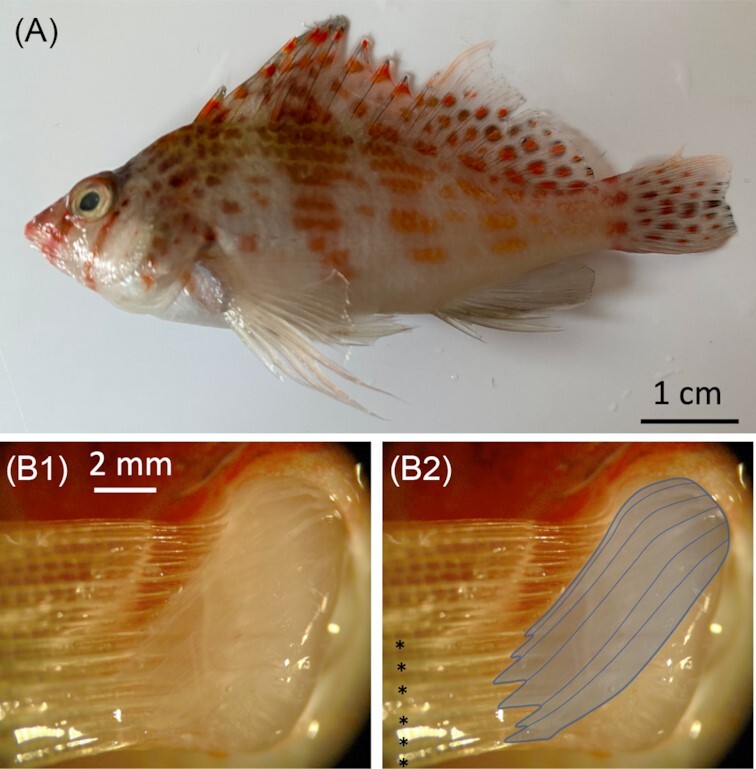
Pectoral fin musculature of the dwarf hawkfish, C. falco. (A) The two regions of the pectoral fin: dorsal region with membrane-connected rays and ventral region that consists of free rays. (B1and B2) Adductor superficialis muscles of the ventral free rays are large and insert distal to the base of the rays (muscles outlined in B2). Ventral free rays are indicated with asterisks
Fig. 5
Fig. 5
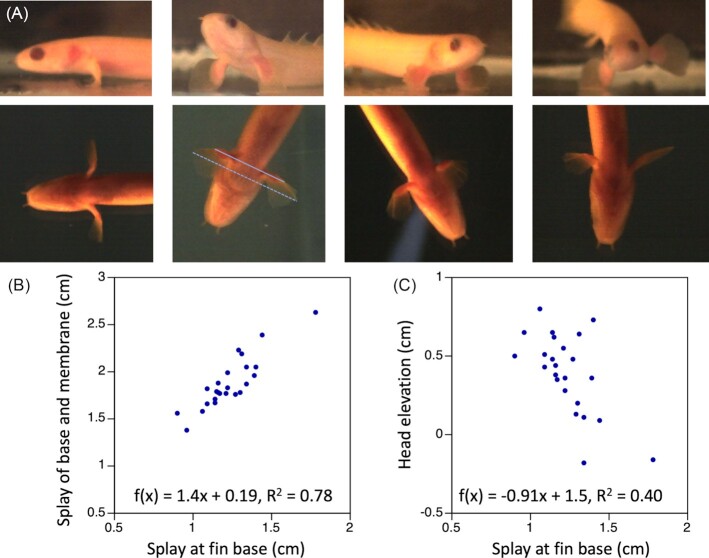
Substrate-based posture of the Senegal bichir, P. senegalus. (A) Lateral (top row) and ventral (bottom row) views of four postures from one individual bichir, illustrating a range of stable positions that the fish assumed resting on its pectoral fins. For scale, maximum head width = 0.87 cm and head height at the caudal eye margin = 0.58 cm. (B) Fin splay increased disproportionately to splay at the fin base. (C) Head elevation decreased with increased splay of the fin base. Splay of the fin is the distance between the lateralmost points on the left and right pectoral fins. The span of the fin base is measured from lateralmost points at the proximal end of the fin membrane on the left and right fins. As examples, the dashed line on ventral view in (A) indicates the splay of the full fin and the solid line indicates the splay of the fin base

References

    1. Aiello BR, Olsen AM, Mathis CE, Westneat MW, Hale ME. 2020. Pectoral fin kinematics and motor patterns are shaped by fin ray mechanosensation during steady swimming in Scarus quoyi. J Exp Biol. 223:jeb211466. - PubMed
    1. Aiello BR, Westneat MW, Hale ME.. 2017. Mechanosensation is evolutionarily tuned to locomotor mechanics. Proc Natl Acad Sci. 114:4459–64. - PMC - PubMed
    1. Arreola VI, Westneat MW.. 1996. Mechanics of propulsion by multiple fins: kinematics of aquatic locomotion in the burrfish (Chilomycterus schoepfi). Proc R Soc Lond B. 263:1689–96.
    1. Bardach JE, Case J.. 1965. Sensory capabilities of the modified fins of squirrel hake (Urophycis chuss) and Searobins (Prionotus carolinus and P. evolans). Copeia. 1965:194–206.
    1. Betancur-R R, Wiley EO, Arratia G, Acero A, Bailly N, Miya M, Lecointre G, Ortí G. 2017. Phylogenetic classification of bony fishes. BMC Evol Biol. 17:162. - PMC - PubMed

Publication types