Telehealth as a Means of Enabling Health Equity
- PMID: 35654429
- PMCID: PMC9719760
- DOI: 10.1055/s-0042-1742500
Telehealth as a Means of Enabling Health Equity
Abstract
Objective: The goal of this paper is to provide a consensus review on telehealth delivery prior to and during the COVID-19 pandemic to develop a set of recommendations for designing telehealth services and tools that contribute to system resilience and equitable health.
Methods: The IMIA-Telehealth Working Group (WG) members conducted a two-step approach to understand the role of telehealth in enabling global health equity. We first conducted a consensus review on the topic followed by a modified Delphi process to respond to four questions related to the role telehealth can play in developing a resilient and equitable health system.
Results: Fifteen WG members from eight countries participated in the Delphi process to share their views. The experts agreed that while telehealth services before and during COVID-19 pandemic have enhanced the delivery of and access to healthcare services, they were also concerned that global telehealth delivery has not been equal for everyone. The group came to a consensus that health system concepts including technology, financing, access to medical supplies and equipment, and governance capacity can all impact the delivery of telehealth services.
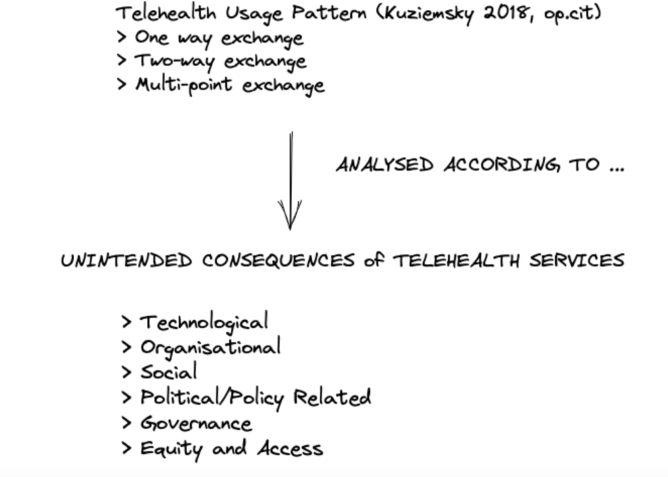
Conclusion: Telehealth played a significant role in delivering healthcare services during the pandemic. However, telehealth delivery has also led to unintended consequences (UICs) including inequity issues and an increase in the digital divide. Telehealth practitioners, professionals and system designers therefore need to purposely design for equity as part of achieving broader health system goals.
IMIA and Thieme. This is an open access article published by Thieme under the terms of the Creative Commons Attribution-NonDerivative-NonCommercial License, permitting copying and reproduction so long as the original work is given appropriate credit. Contents may not be used for commercial purposes, or adapted, remixed, transformed or built upon. (https://creativecommons.org/licenses/by-nc-nd/4.0/).
Conflict of interest statement
Disclosure The authors report no conflicts of interest in this work.
Figures
References
-
- Miller EA. Solving the disjuncture between research and practice: telehealth trends in the 21st century. Health Policy [Internet] 2007 Jul;82(2):133”41. Available from: http://dx.doi.org/10.1016/j.healthpol.2006.09.011 - PubMed
-
- Cusack CM, Pan E, Hook JM, Vincent A, Kaelber DC, Middleton B. The value proposition in the widespread use of telehealth. J Telemed Telecare [Internet] 2008 Jun 1;14(4):167”8. Available from: https://doi.org/10.1258/jtt.2007.007043 - PubMed
-
- Bokolo A Jnr. Use of Telemedicine and Virtual Care for Remote Treatment in Response to COVID-19 Pandemic. J Med Syst [Internet] 2020 Jun 15;44(7):132. Available from: http://dx.doi.org/10.1007/s10916-020-01596-5 - PMC - PubMed
-
- Kannampallil T, Ma J. Digital Translucence: Adapting Telemedicine Delivery Post-COVID-19. Telemed J E Health [Internet]. 2020 Sep;26(9):1120”2. Available from: http://dx.doi.org/10.1089/tmj.2020.0158 - PubMed
MeSH terms
LinkOut - more resources
Full Text Sources
Medical