Review
. 2022 Sep 8:76:461-480.
doi: 10.1146/annurev-micro-102521-014450. Epub 2022 Jun 2.

The Impact of RNA-DNA Hybrids on Genome Integrity in Bacteria

Affiliations
Review

The Impact of RNA-DNA Hybrids on Genome Integrity in Bacteria

Emma K McLean et al. Annu Rev Microbiol. .

Abstract

During the essential processes of DNA replication and transcription, RNA-DNA hybrid intermediates are formed that pose significant risks to genome integrity when left unresolved. To manage RNA-DNA hybrids, all cells rely on RNase H family enzymes that specifically cleave the RNA portion of the many different types of hybrids that form in vivo. Recent experimental advances have provided new insight into how RNA-DNA hybrids form and the consequences to genome integrity that ensue when persistent hybrids remain unresolved. Here we review the types of RNA-DNA hybrids, including R-loops, RNA primers, and ribonucleotide misincorporations, that form during DNA replication and transcription and discuss how each type of hybrid can contribute to genome instability in bacteria. Further, we discuss how bacterial RNase HI, HII, and HIII and bacterial FEN enzymes contribute to genome maintenance through the resolution of hybrids.

Keywords: RNA-DNA hybrids; RNase HI; RNase HII; RNase HIII; genome instability; mutation rate.


Figures
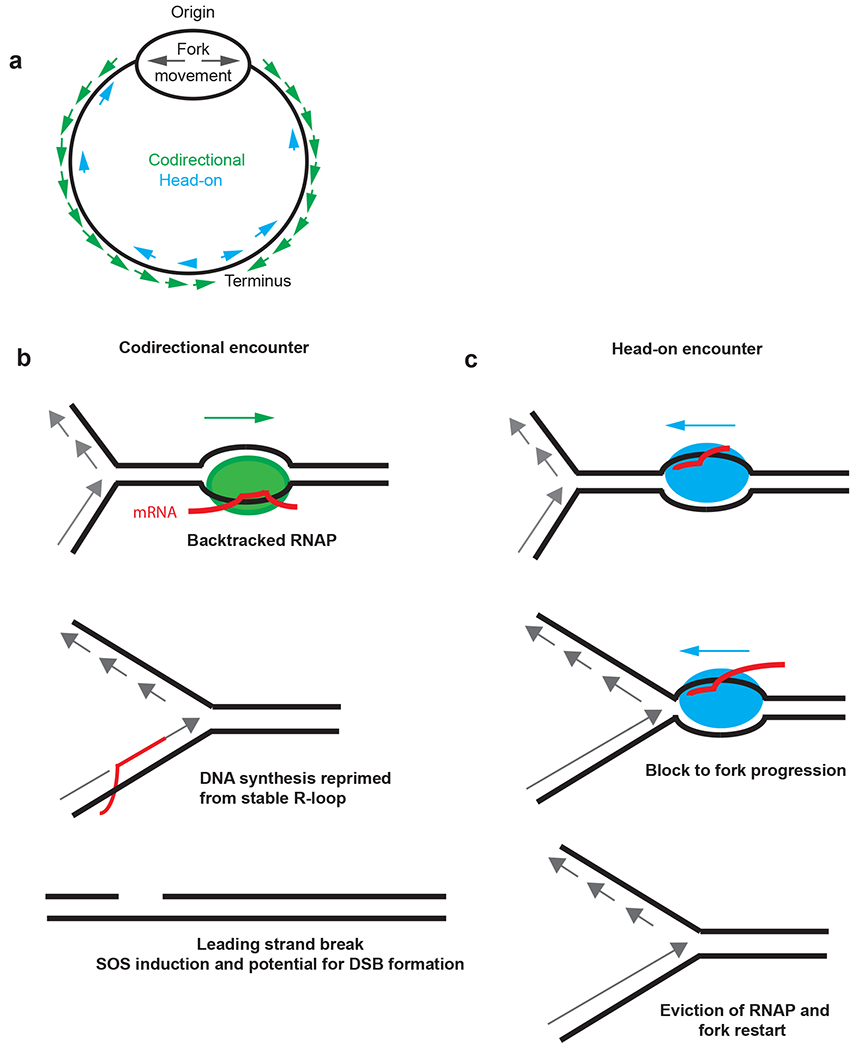
Figure 1.
Figure 1.
Genome instability caused by codirectional and head-on encounters. (a) Schematic of a circular chromosome with genes oriented codirectional or head-on to replication fork movement (b) Codirectional encounter between backtracked RNAP and a replication fork. DNA synthesis by the replisome can be reprimed by mRNA or primase-initiated RNA synthesis following the encounter with RNAP. The replisome and RNAP collision creates a gap on the leading strand behind the repriming event (28, 81). Following excision of the repriming RNA, a gap remains in the leading strand that could be converted to a double-strand break during the next round of DNA replication when the gap is encountered by the replisome. (c) RNAP moving head-on toward a replication fork. Head-on encounters between RNAP and the replisome can block fork progression. Although several outcomes can occur, the fork can be restored by evicting RNAP and enabling primosome-dependent fork restart (,61a). Abbreviation: RNAP, RNA polymerase. Part of this figure is adapted from Reference .
Figure 2.
Figure 2.
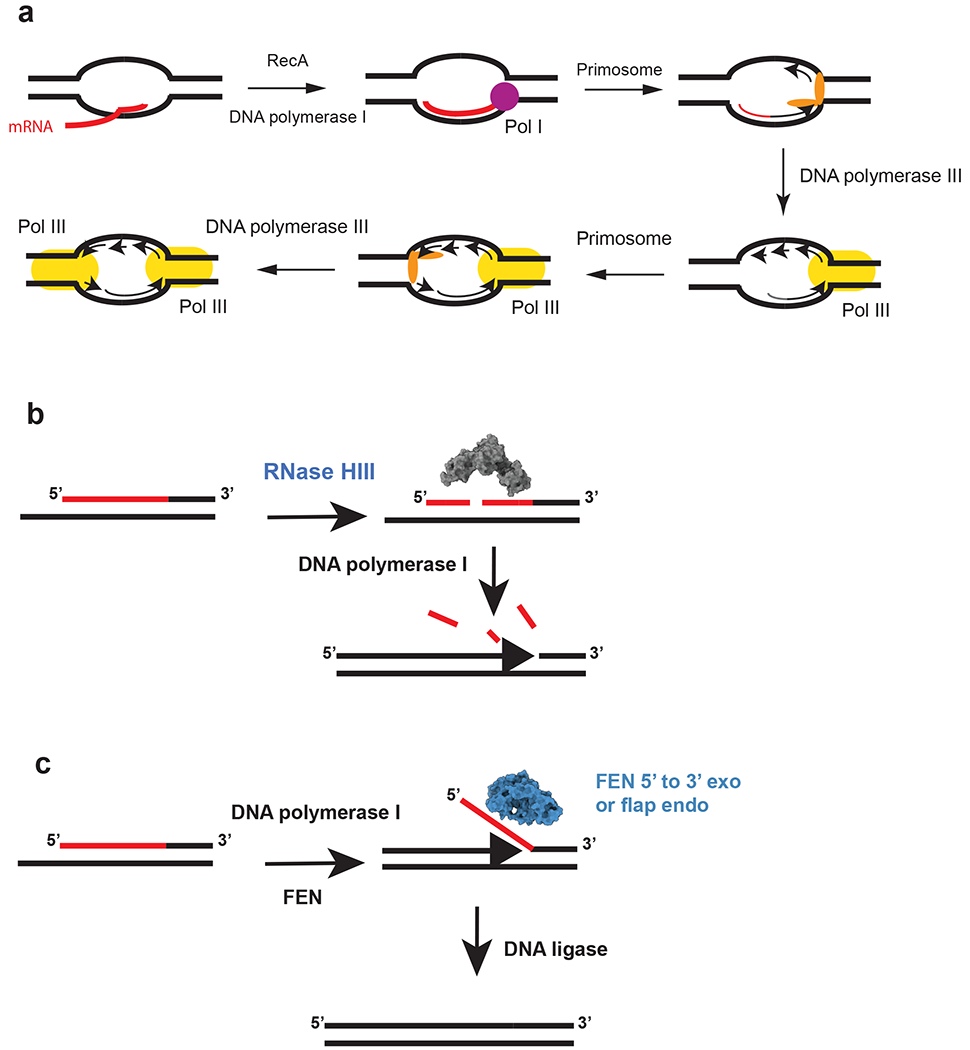
Initiation of replication from R-loops and a model for Okazaki fragment processing in RNase HIII–containing bacteria. The red lines indicate RNA, and the black lines denote DNA. (a) Model for cSDR. The nascent transcript is paired with DNA by RecA in negative supercoiled DNA behind RNAP. The transcript primes synthesis by DNA polymerase I followed by primosome assembly and loading of DNA polymerase III. The second fork is activated following primosome assembly and loading of DNA polymerase III. This figure is based on models from the following References and (b) RNase HIII incises the RNA portion of the Okazaki fragment. The incisions allow for DNA polymerase I to efficiently remove the RNA during DNA synthesis from the 3′-OH on the adjacent fragment (86). (c) Bacteria that have a stand-alone FEN can cleave the flap resulting from DNA polymerase I strand displacement synthesis. For bacteria that contain RNase HIII and FEN, it is expected that both function during Okazaki fragment maturation (1, 86). The model is based on the following reference (86). The space filling models for RNase HIII and FEN were generated using the B. subtilis protein sequences modeled with I-TASSER (116). Abbreviation: FEN, flap endonuclease/5′-to-3′ exonuclease.
Figure 3.
Figure 3.. Model for ribonucleotide excision repair.
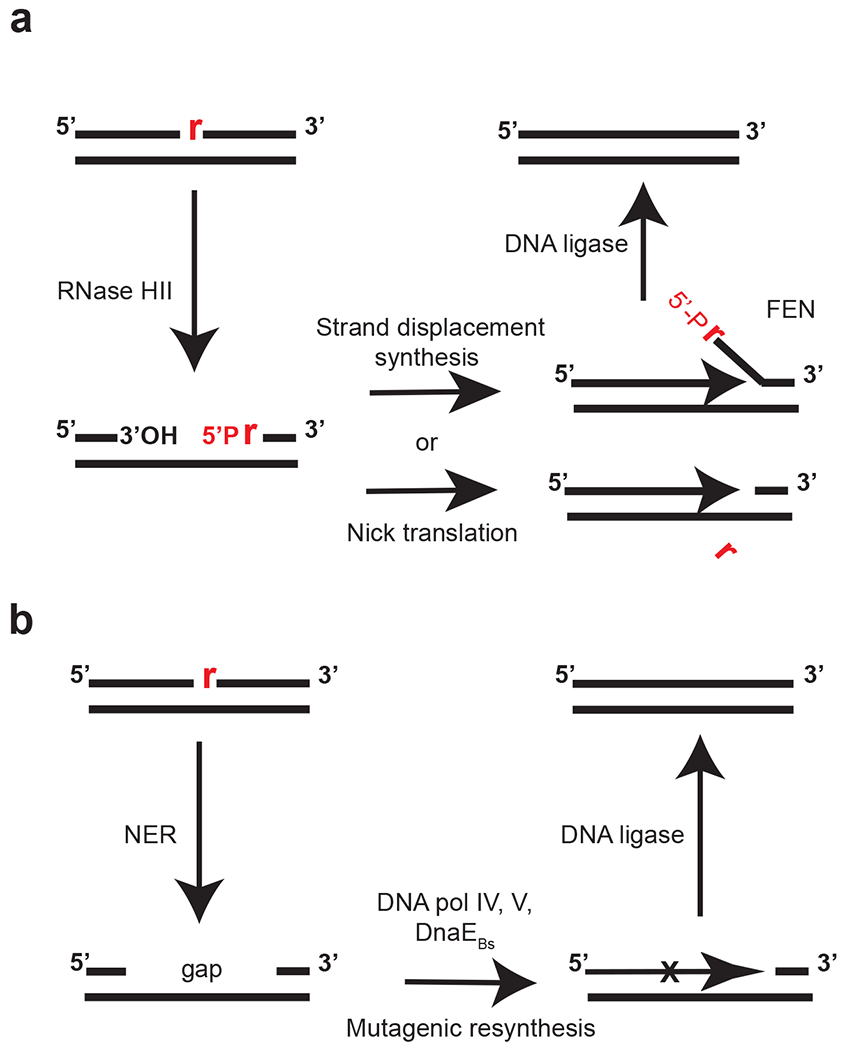
(a) Removal and correction of a single rNMP (red) nested in genomic DNA (black lines). RNase HII incises 5′ to the rNMP. DNA polymerase I synthesizes from the nick, with concomitant 5′-to-3′ exonuclease activity removing the ribonucleotide-containing strand in a process known as nick translation, or by strand displacement synthesis (91, 107). If strand displacement synthesis occurs, DNA polymerase I or a stand-alone FEN cleaves the flap, releasing the fragment (1). (b) In the absence of RNase HII, nucleotide excision repair can recognize single rNMP errors. Nucleotide excision repair action leaves behind a gap allowing mutagenic resynthesis by DNA polymerase IV and DNA polymerase V in Escherichia coli and essential DNA polymerase DnaE in Bacillus subtilis (91, 107, 108). Abbreviation: FEN, flap endonuclease/5′-to-3′ exonuclease.

References

    1. Allen LM, Hodskinson MR, Sayers JR. 2009. Active site substitutions delineate distinct classes of eubacterial flap endonuclease. Biochem J 418:285–92 - PMC - PubMed
    1. AlMalki FA, Flemming CS, Zhang J, Feng M, Sedelnikova SE, et al. 2016. Direct observation of DNA threading in flap endonuclease complexes. Nat Struct Mol Biol 23:640–6 - PMC - PubMed
    1. Beilhartz GL, Gotte M. 2010. HIV-1 Ribonuclease H: Structure, Catalytic Mechanism and Inhibitors. Viruses 2:900–26 - PMC - PubMed
    1. Boubakri H, de Septenville AL, Viguera E, Michel B. 2010. The helicases DinG, Rep and UvrD cooperate to promote replication across transcription units in vivo. EMBO J 29:145–57 - PMC - PubMed
    1. Brochu J, Vlachos-Breton E, Sutherland S, Martel M, Drolet M. 2018. Topoisomerases I and III inhibit R-loop formation to prevent unregulated replication in the chromosomal Ter region of Escherichia coli. PLoS Genet 14:e1007668. - PMC - PubMed

Publication types

LinkOut - more resources