. 2022 Jun 1;13(3):673-697.
doi: 10.14336/AD.2021.1024. eCollection 2022 Jun.

Vascular Calcification in Chronic Kidney Disease: An Update and Perspective

Affiliations

Vascular Calcification in Chronic Kidney Disease: An Update and Perspective

Si-Chong Ren et al. Aging Dis. .

Abstract

Chronic kidney disease is a devastating condition resulting from irreversible loss of nephron numbers and function and leading to end-stage renal disease and mineral disorders. Vascular calcification, an ectopic deposition of calcium-phosphate salts in blood vessel walls and heart valves, is an independent risk factor of cardiovascular morbidity and mortality in chronic kidney disease. Moreover, aging and related metabolic disorders are essential risk factors for chronic kidney disease and vascular calcification. Marked progress has been recently made in understanding and treating vascular calcification in chronic kidney disease. However, there is a paucity of systematic reviews summarizing this progress, and investigating unresolved issues is warranted. In this systematic review, we aimed to overview the underlying mechanisms of vascular calcification in chronic kidney diseases and discuss the impact of chronic kidney disease on the pathophysiology of vascular calcification. Additionally, we summarized potential clinical diagnostic biomarkers and therapeutic applications for vascular calcification with chronic kidney disease. This review may offer new insights into the pathogenesis, diagnosis, and therapeutic intervention of vascular calcification.

Keywords: aging; biomarker; chronic kidney disease; metabolism; vascular calcification.


Conflict of interest statement

Conflicts of interest All authors declare that there are no conflicts of interest or competing interests.

Figures
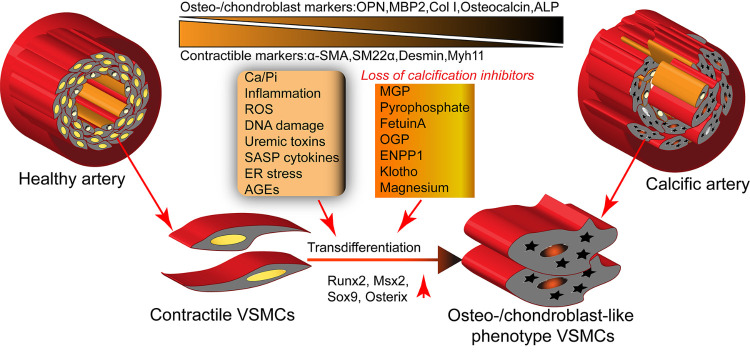
Figure 1.
Figure 1.
VSMC osteo/chondrogenic transdifferentiation is the key mechanism of vascular calcification. Under adverse stimuli, including Ca/Pi, inflammation, ROS, DNA damage, uremic toxins, SASP cytokines, ER stress, and age, VSMCs in the arterial wall trans-differentiate into osteo-/chondroblast cells combined with increased levels of the osteogenic master transcription factors such as Runx2, Msx2, Sox9, and osterix. This process is aggravated by the loss of calcification inhibitors, including MGP, pyrophosphate, fetuin-A, OGP, and ENPP1. These trans-differentiated VSMCs acquire osteo/chondroblast markers, type I collagen, osteocalcin, and ALP but lose contractile markers, including α-SMA and SM22-α.
Figure 2.
Figure 2.
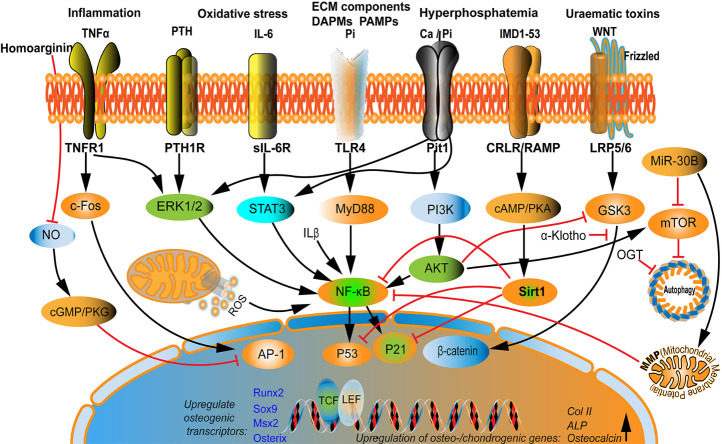
Multifactorial signaling is involved in VSMC osteo/chondrogenic transdifferentiation regulation. Various molecules directly or indirectly mediate the VSMC osteo/chondrogenic transdifferentiation process via cross-talking interaction. For example, phosphate and ECM components activate the TLR4/NF-κB signaling pathway to upregulate the osteogenic transcriptional factors Runx2 and BMP2. Moreover, calcium and phosphate activate the Pit-1 signaling pathway and interact with the IL-6 and PTH signaling pathways. PTH binds to PTH1R and ignites NF-κB signaling pathways through ERK1/2, integrating TNF-α stimulation. Additionally, TNF-α stimulates AP-1 via c-FOS to increase osteo-/chondrogenic genes expression, coordinating the IL-6/sIL-6R/STAT3/p53/p21 pathways to trigger VSMC transdifferentiation. As an interfering agent, IMD1-53 upregulates Sirt1 by activating the cAMP/PKA signaling pathway or upregulating α-klotho levels via the CRLR/RAMP3 complex to inhibit Wnt/β-catenin signaling. miR-30B promotes the MMP and autophagy-related to the mTOR signal pathway, and crosstalk exists between this signaling pathway and NF-κB. PTH, parathyroid hormone; TLR4, toll-like receptor 4; ERK1/2, Extracellular regulated protein kinases 1/2; PTH1R, parathyroid hormone 1 receptor; sIL-6R, soluble IL-6 receptor; STAT3, signal transducer and activator of transcription 3; IMD1-53, intermedin 1-53; CRLR, calcitonin receptor-like receptor; RAMP3, receptor activity-modifying protein-3; and MMP, mitochondrial membrane potential.
Figure 3.
Figure 3.
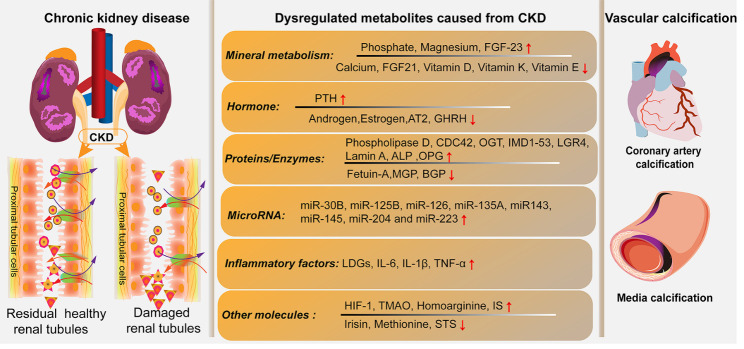
Dysregulated metabolites aggravate VC processes in patients with progressive CKD. In patients with progressive CKD, the damaged and residual healthy renal tubules lose the compensatory functions of excreting and reabsorbing metabolites. These metabolites, including mineral metabolism modulators, hormone, enzymes, microRNAs, inflammatory factors, and other molecules, lead to physiological homeostasis disorders. Consequently, these dysregulated metabolites initiate and accelerate VC processes, resulting in calcium-phosphate depositions in the media layer of central large coronary arteries and/or other peripheral aortas.
Figure 4.
Figure 4.
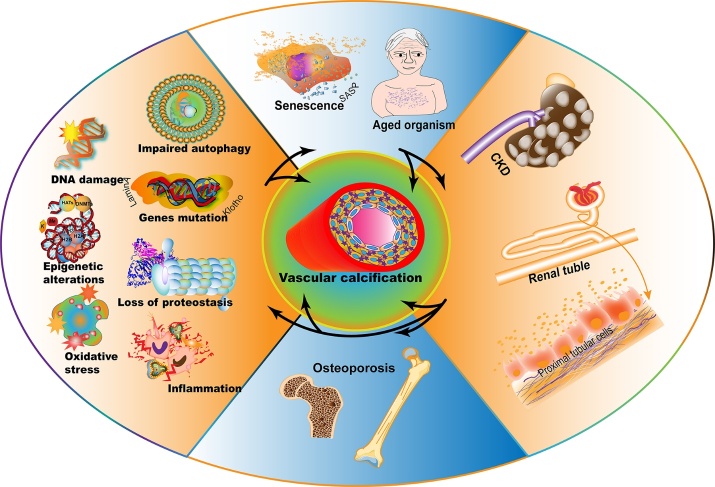
Aging as a vicious accelerator exacerbates VC progression in patients with CKD. Pro-aging factors including DNA damage, epigenetic alterations, oxidative stress, impaired autophagy, klotho and LaminA mutations, proteostasis loss, and inflammation, induce cellular senescence and aged organisms, promoting kidney aging and damage, and consequently accelerating CKD progression. The proximal tubular cells were damaged, and the excretion and absorption functions were abnormal under CKD conditions. Impaired kidney metabolism function evokes metabolite disorders, affecting bone mineralization and osteoporosis and reciprocally increasing pro-aging stimulus, which induces a vicious cycle of pro-calcifying force. Furthermore, the arc arrows indicate that these adverse pro-aging factors (aging, CKD, and osteoporosis) facilitate VC processes. Aging is a hub linker and pivotal accelerator of CKD progression, contributing to VC progression and CKD cardiovascular events. However, the mechanisms regarding this matter need further elucidation.

References

    1. Demer LL, Tintut Y (2008). Vascular calcification: pathobiology of a multifaceted disease. Circulation, 117:2938-2948. - PMC - PubMed
    1. Sage AP, Tintut Y, Demer LL (2010). Regulatory mechanisms in vascular calcification. Nat Rev Cardiol, 7:528-536. - PMC - PubMed
    1. Pescatore LA, Gamarra LF, Liberman M (2019). Multifaceted Mechanisms of Vascular Calcification in Aging. Arterioscler Thromb Vasc Biol, 39:1307-1316. - PubMed
    1. Raggi P (2017). Cardiovascular disease: Coronary artery calcification predicts risk of CVD in patients with CKD. Nat Rev Nephrol, 13:324-326. - PubMed
    1. Tuersun T, Luo Q, Zhang Z, Wang G, Zhang D, Wang M, et al. (2020). Abdominal aortic calcification is more severe in unilateral primary aldosteronism patients and is associated with elevated aldosterone and parathyroid hormone levels. Hypertens Res, 43:1413-1420. - PubMed

LinkOut - more resources