


Clinical decision support methods for children and youths with mental health disorders in primary care
- PMID: 35656854
- PMCID: PMC9680662
- DOI: 10.1093/fampra/cmac051
Clinical decision support methods for children and youths with mental health disorders in primary care
Erratum in
-
Correction to: Clinical decision support methods for children and youths with mental health disorders in primary care.Fam Pract. 2023 Mar 28;40(2):431. doi: 10.1093/fampra/cmac088. Fam Pract. 2023. PMID: 35904182 Free PMC article. No abstract available.
Abstract
Background: Mental health disorders among children and youths are common and often have negative consequences for children, youths, and families if unrecognized and untreated. With the goal of early recognition, primary care physicians (PCPs) play a significant role in the detection and referral of mental disorders. However, PCPs report several barriers related to confidence, knowledge, and interdisciplinary collaboration. Therefore, initiatives have been taken to assist PCPs in their clinical decision-making through clinical decision support methods (CDSMs).
Objectives: This review aimed to identify CDSMs in the literature and describe their functionalities and quality.
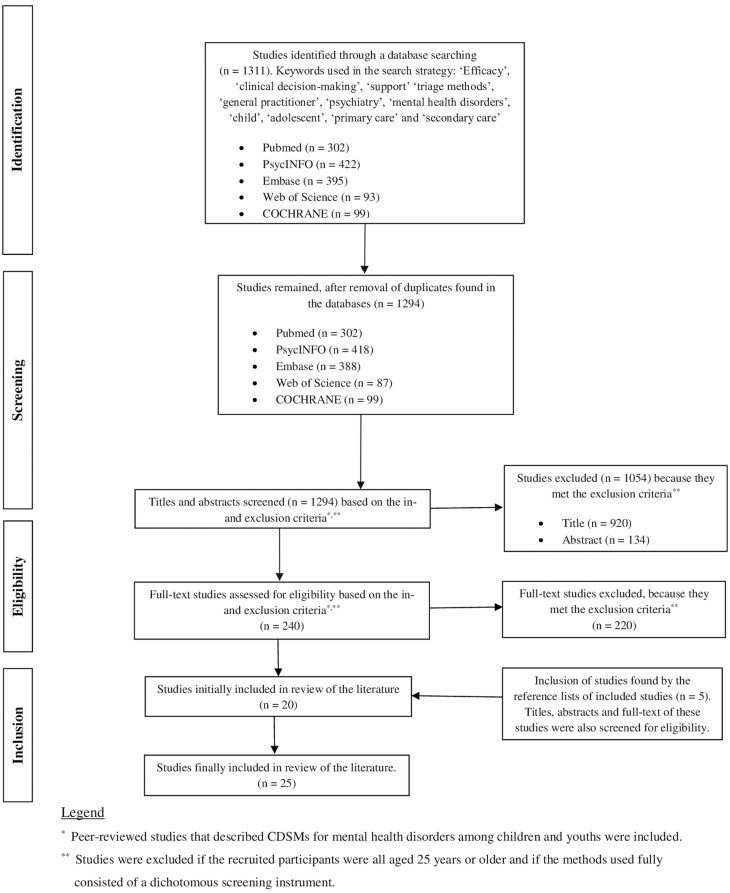
Methods: In this review, a search strategy was performed to access all available studies in PubMed, PsychINFO, Embase, Web of Science, and COCHRANE using keywords. Studies that involved CDSMs for PCP clinical decision-making regarding psychosocial or psychiatric problems among children and youths (0-24 years old) were included. The search was conducted according to PRISMA-Protocols.
Results: Of 1,294 studies identified, 25 were eligible for inclusion and varied in quality. Eighteen CDSMs were described. Fourteen studies described computer-based methods with decision support, focusing on self-help, probable diagnosis, and treatment suggestions. Nine studies described telecommunication methods, which offered support through interdisciplinary (video) calls. Two studies described CDSMs with a combination of components related to the two CDSM categories.
Conclusion: Easy-to-use CDSMs of good quality are valuable for advising PCPs on the detection and referral of children and youths with mental health disorders. However, valid multicentre research on a combination of computer-based methods and telecommunication is still needed.
Keywords: access to care; adolescent; children and youths; family health; mental health; primary care.
Plain language summary
Mental health problems among children and youths are common and have impacts, not only on the person affected but also on families and communities. They are often not recognized and acted upon by primary care providers (PCPs), such as general practitioners. This may be due to a lack of confidence in talking to young people or insufficient knowledge about mental health problems. PCPs make decisions about managing or referring these problems to mental health specialists, which can be assisted through clinical decision support methods (CDSMs). CDSMs can be divided into electronic and non-electronic. This study provided an overview of both types of CDSMs. We focused on the capabilities of CDSMs and how they help PCPs in their decision-making. More than half of the reviewed CDSMs were electronic CDSMs; several CDSMs involved telecommunication between PCPs and mental health specialists. Two of the CDSMs comprised a combination of components of both types of CDSMs. CDSMs offered patients more information about their health while providing PCPs with suggestions for their decision-making.
© The Author(s) 2022. Published by Oxford University Press.
Figures
References
-
- World Health Organization. Adolescent mental health 2020 [accessed 2020 Jan 19]. https://www.who.int/news-room/fact-sheets/detail/adolescent-mental-health.
-
- United Nations. Youth 2019 [accessed 2019 Jan 16]. https://www.un.org/en/sections/issues-depth/youth-0/.
-
- Olfson M, Blanco C, Wang S, Laije G, Correll CU.. National trends in the mental health care of children, adolescents, and adults by office-based physicians. JAMA Psychiatry. 2014;71(1):81–90. - PubMed
Publication types
MeSH terms
LinkOut - more resources
Full Text Sources
Medical
